


Lower connecting rod head bearing
Checking the working clearance
1. Clean the back of the bearing and its installation area in the connecting rod and the connecting rod cap.
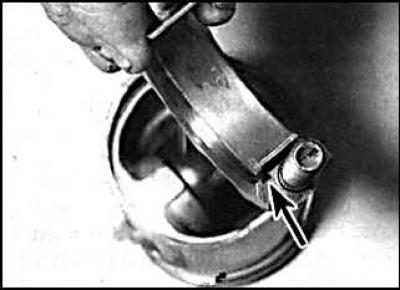
2. Install the liners into place.
3. One method is to install the connecting rod bearing caps with the bearing shell onto the connecting rods and tighten them to the specified torque. Measure the inside diameter of each assembled pair of bearing shells. Measure the diameter of each crankshaft journal. Subtract the corresponding crankshaft journal diameter from the measured bearing diameter.
4. The second and more accurate method is to use a product known as Plastigage. This is a round plastic rod that is compressed between the bearing shell and the crankshaft journal. After removing the connecting rod bearing cap, the deformed plastic rod is measured with a special template that is included with the Plastigage. The procedure for using Plastigage is as follows. Install the connecting rods on the crankshaft without lubrication, the crankshaft journals and bearings must be completely clean and dry. Cut several pieces of plastic rod and install them on each crankshaft journal. Install the caps with the lower bearing shells and tighten the mounting bolts to the specified torque.
5. When measuring the clearance using the Plastigage method, do not rotate the engine crankshaft. Unscrew the bearing cap, remove it and apply the scale ruler printed on the package to the deformed plastic rod. By comparing the width of the deformed plastic rod with the reference width on the scale ruler, determine the clearance value. Finally, carefully clean off any traces of Plastigage material from the bearings and crankshaft.
Visitor comments