


Examination
1. Clean the rear of the bearing shell and its installation location in the cylinder block and main bearing caps.
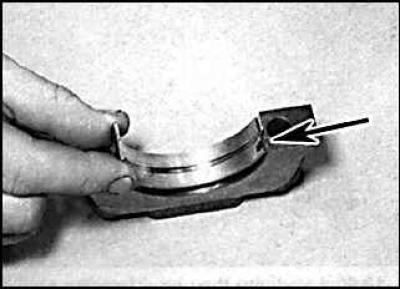
2. Install the inserts in their places, while the protrusion on the insert should be aligned with the groove on the cover (indicated by the arrow).
3. One method, which requires a micrometer to measure bore diameters, is to install the main bearing caps with the bearing shell on the cylinder block and tighten them to the specified torque. Measure the inside diameter of each assembled pair of bearing shells. Measure the diameter of each crankshaft journal. Subtract the corresponding crankshaft journal diameter from the measured bearing diameter.
4. Second (and more accurate) the method is to use a product known as Plastigage. This is a round plastic rod that is compressed between the bearing shell and the crankshaft journal. After removing the main bearing cap, the deformed plastic rod is measured with a special template that is included in the Plastigage kit. Install the crankshaft without lubrication on the bearing shells installed in the cylinder block. The crankshaft journals and bearing shells must be completely clean and dry.
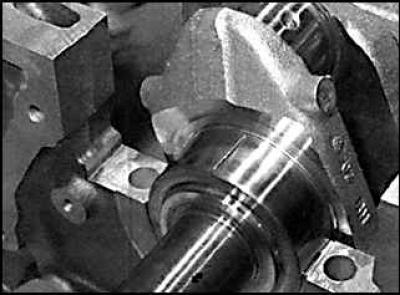
5. Cut a few pieces of Plastigage plastic rod (they should be slightly shorter than the width of the main bearings) and install on each crankshaft journal.
6. Install the caps with the lower liners and tighten the mounting bolts to the specified torque. Do not rotate the crankshaft during the Plastigage clearance measurement.
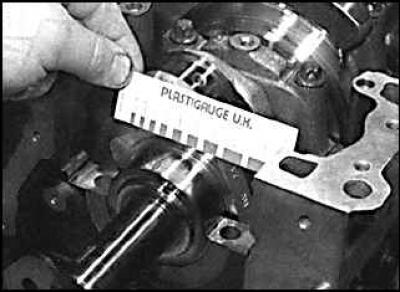
7. Unscrew the liner mounting cover, remove it and apply a scale ruler to the deformed plastic rod. By comparing the width of the deformed plastic rod with the reference width on the scale ruler, determine the size of the gap.
8. Finally, thoroughly clean any traces of Plastigage material from the bearings and crankshaft.
(Article posted on a web portal: «opelbook.ru»)
Visitor comments