
OpelBook.ru
Cars AvtoVAZ Cars Mitsubishi Cars BMW Cars Mercedes Cars Nissan Cars Toyota Cars Chevrolet
English Русский
Български
Беларускі
Український
Српски
Hrvatski
Română
Polski
Slovenský
Magyar
 |  Sitemap  |  Contacts  |    


Main Astra Corsa Insignia Kadett Omega Vectra Zafira Others Articles
Omega A (1986-1993) Omega B (1993-1999) Omega B2 (1999-2003)
  • Main
  • Omega
  • Omega B
  • Power unit
  • Diesel engine repair 2.0 l
  • Cylinder head

Cylinder head (Opel Omega B)

            0

Contents: Disassembly ⬇ Cleaning the cylinder head ⬇ Examination ⬇ Valves ⬇ Lapping valves ⬇ Cylinder head assembly ⬇

Disassembly


1. Remove the camshaft, levers and hydraulic tappets from the cylinder head. Unscrew the glow plugs and remove the cylinder head from the engine.
1. Remove the camshaft, levers and hydraulic tappets from the cylinder head. Unscrew the glow plugs…


1. Remove the camshaft, levers and hydraulic tappets from the cylinder head. Unscrew the glow plugs…


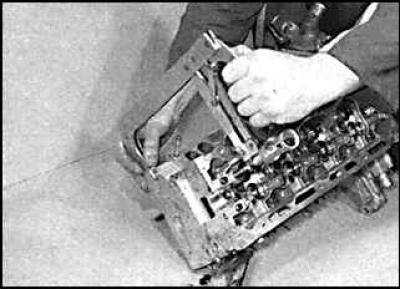
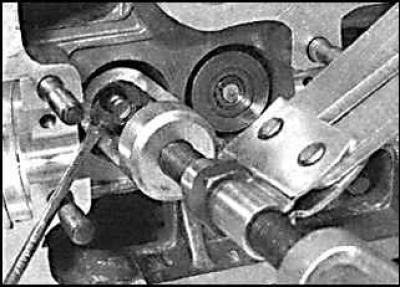
2. On all models, using a valve spring compressor, compress each spring and remove the keepers from the end of the valve.
2. On all models, using a valve spring compressor, compress each spring and remove the keepers from…


2. On all models, using a valve spring compressor, compress each spring and remove the keepers from…


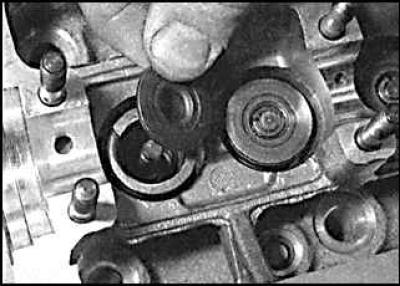
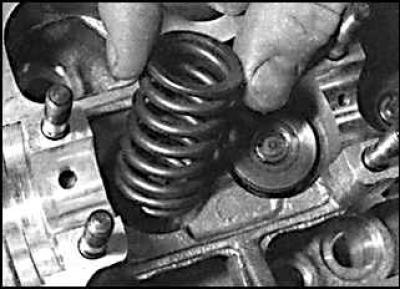
3. Remove the spring compressor and remove the spring plate and spring.
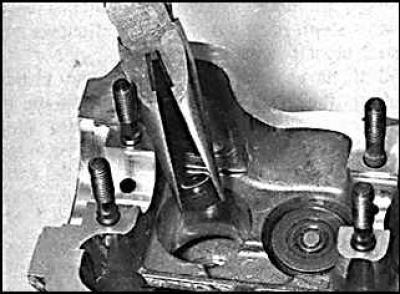


3. Remove the spring compressor and remove the spring plate and spring.


4. Using pliers, carefully remove the oil deflector cap.
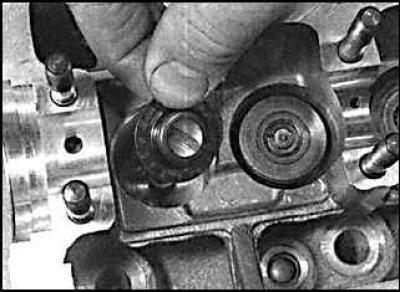
4. Using pliers, carefully remove the oil deflector cap.


5. Remove the spring seat.

6. When the valve spring is compressed and the spring cup does not come off the crackers, it is necessary to hit the spring cup with a hammer through a wooden block, which will release the crackers.

7. Remove the valve through the combustion chamber. Store each valve in a separate plastic bag along with the spring plate, spring, spring seat and crackers for later installation in their places.

Cleaning the cylinder head


1. Remove the remains of the old gasket from the cylinder head.

2. Clean carbon deposits from combustion chambers, then wash the head in a suitable solvent.

3. Clean any carbon deposits from the valves, perhaps even using a wire brush.


Examination


Cylinder head


Checking the flatness of the cylinder head
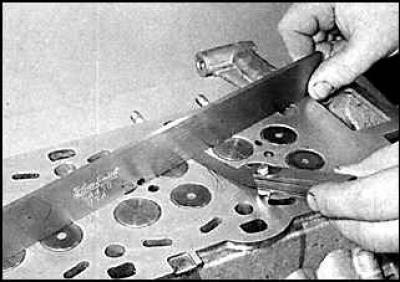
Checking the flatness of the cylinder head


Measuring the protrusion of the swirl chamber from the cylinder head
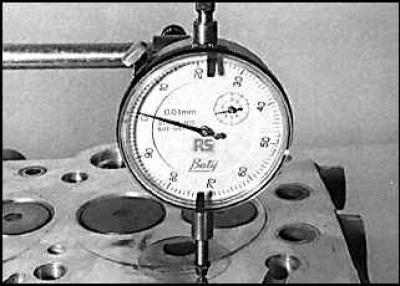
Measuring the protrusion of the swirl chamber from the cylinder head


1. Carefully inspect the cylinder head for cracks and other damage. If cracks are present, the head must be replaced.

2. Using a metal ruler and feeler gauge, check the flatness of the mating surface of the cylinder head. If the flatness is more than 0.1 mm, the head must be re-ground, while its height must meet the requirements.

3. Check the condition of the valve seats. If they are burnt, worn or defective, they must be replaced. If the valve seat is slightly worn, they must be ground in. Check the valve guides for wear by inserting the valve stem into them and moving it to the side. The movement should be insignificant. If the movement is excessive, remove the valve and measure the diameter of the valve stem. Replace the valve if necessary. If the valve stem is not worn, the guide is worn and must be replaced. Replace the valve guides at a service station.


4. If the valve seats need to be reground, this operation must be performed after installing new valve guides.

Valves


1. Check each valve head for localized corrosion, burns, cracks, and general wear. Check the valve stem for wear and bending. Check the end of the valve stem for wear. If any defects are present, the valve must be replaced.
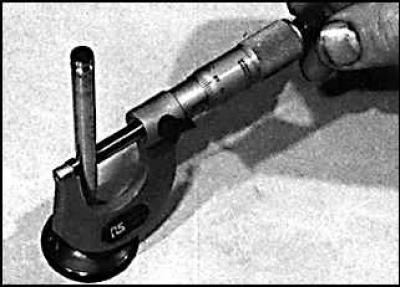
1. Check each valve head for localized corrosion, burns, cracks, and general wear. Check the valve…


2. Using a micrometer, measure the valve stem diameter at several points along the stem. Any significant difference in the readings indicates valve stem wear and a mandatory valve replacement.

3. If the valves are in satisfactory condition, they should be inserted into their seats and lapped. If the valve plates or seats are badly worn, they should be machined or even replaced before lapping.

Lapping valves


1. Place the cylinder head with the combustion chambers facing up on wooden blocks.
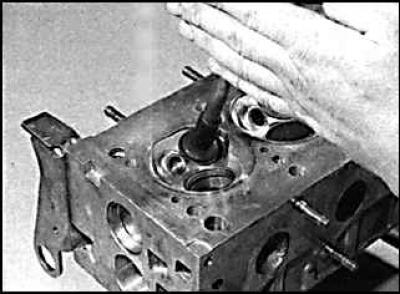
1. Place the cylinder head with the combustion chambers facing up on wooden blocks.


2. Lubricate the lapping paste on the valve plate and valve seat, install the valve in place and install the suction cup with the holder (handle) on the valve plate. Rotate the valve with the suction cup in different directions, lap the valve, and periodically lift the valve to redistribute the lapping paste.


3. If a coarse lapping paste is used, lap until a uniform matte surface appears on the valve seat and valve.

4. Then wipe off the used paste composition and repeat the grinding process with a fine-grained paste. Grind until a light gray-matte color appears.

5. Carefully remove traces of lapping paste using a suitable solvent.

Valve elements


1. Check the valve springs for signs of damage.

2. Install the springs with one of the ends on the frame, check the deviation of the spring axis from the vertical plane and the length of the springs. If one of the springs is damaged, all springs in the set must be replaced.

3. Replace the valve stem seals regardless of their condition.

Cylinder head assembly


Cylinder head assembly


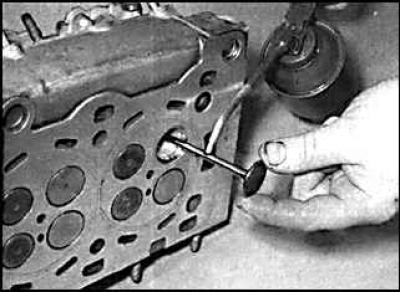
1. Lubricate the valve stems with engine oil and insert them into their places. Install the valves in the places where they were ground.
1. Lubricate the valve stems with engine oil and insert them into their places. Install the valves…


(Text was copied from the portal: «OpelBook.ru»)


2. Install the spring seat.
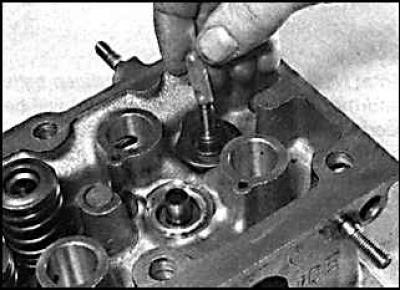
2. Install the spring seat.


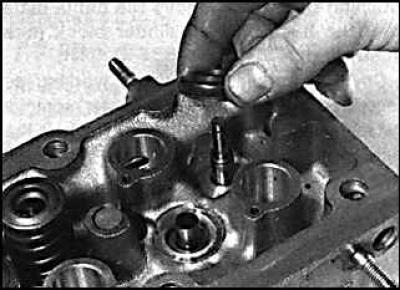
3. Install the thin-walled protective sleeve onto the valve stem.
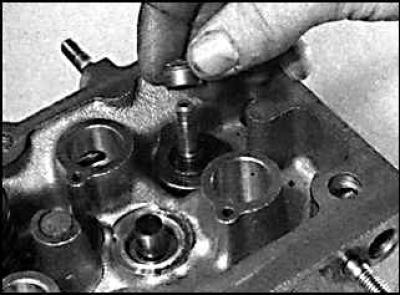
3. Install the thin-walled protective sleeve onto the valve stem.
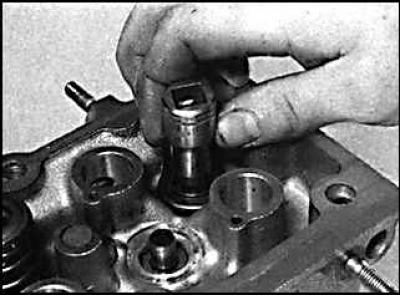

3. Install the thin-walled protective sleeve onto the valve stem.


4. Dip the valve stem seal into fresh engine oil and install it onto the valve stem, being careful not to damage its working edges. Use a special metal mandrel to install the valve stem seals.
4. Dip the valve stem seal into fresh engine oil and install it onto the valve stem, being careful…


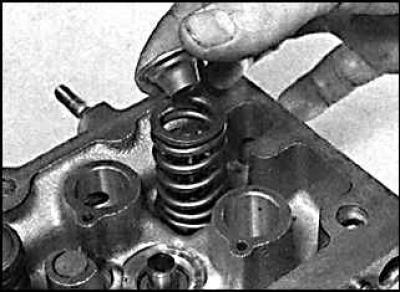
5. Install the valve spring and spring retainer.
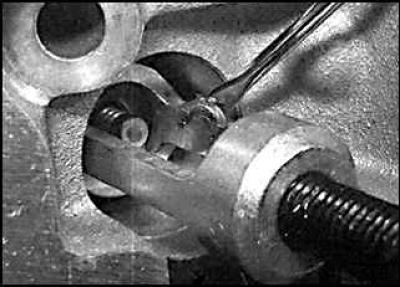


5. Install the valve spring and spring retainer.


6. Using a special tool, compress the valve spring and install the crackers in the recess of the valve stem and lubricate them. Remove the spring compressor. Repeat this operation on the remaining valves.

7. Using a hammer and a wooden block, tap the end of the valve stem to ensure that all valve components are firmly seated in place.

8. Install the head onto the cylinder block and install the hydraulic lifters, levers and camshaft.


This article is available at russian, bulgarian, belarusian, ukrainian, serbian, croatian, romanian, polish, slovak, hungarian
Checking the article: Fedorova Varvara

Share information:

Previous articles
Opel Omega B: Diesel engine repair 2.0 l
Next articles

Technical specifications
Overhaul of a 2.0 liter diesel engine
Pistons and connecting rods — removal, inspection and installation
Crankshaft — removal, inspection and installation
Engine Cylinder Block — Cleaning
Main and connecting rod bearings
Sequence of engine assembly during major repairs
Piston rings — installation


See similar ones from other Opel car manuals:
▶ Cylinder head — removal and installation Opel Astra F (1991-1998, petrol)
▶ Removal and installation the cylinder head Opel Corsa B (1993-2000)
▶ Cylinder head cover Opel Insignia A (2008-2017)
▶ Cylinder head specifications Opel Kadett E (1984-1995)
▶ Cylinder head — removal and installation (engine in a car) Opel Vectra A (1988-1995, petrol)
Link to this page in different formats

Visitor comments


No comments yet


How much will 12 + 32 =


Omega B2 (1999-2003) 
  • General information
  • User manual
  • Maintenance
  • Troubleshooting
  • Power unit
  • Petrol 4-cylinder
  • Petrol 6-cylinder
  • Engine overhaul
  • Diesel engines 2.0 l
  • Diesel engines 2.5 l
  • Cooling and heating
  • Injection system (gasoline)
  • Fuel system (diesel)
  • Fuel system
  • Exhaust system
  • Ignition system
  • Transmission
  • Clutch
  • Mechanical gearbox
  • Automatic gearbox
  • Main gear and shafts
  • Chassis
  • Brake system
  • Car suspension
  • Steering
  • Body
  • Body elements
  • Electrical equipment
  • Equipment and devices
  • Electrical circuits
Omega B (1993-1999) 
  • General information
  • User manual
  • Tips for the car owner
  • Maintenance (gasoline)
  • Maintenance (diesel)
  • Power unit
  • Petrol engine SOHC 2.0 l
  • Petrol engine DOHC 2.0 l
  • Petrol engines 2.5 and 3.0 l
  • Repair of gasoline engines
  • Diesel engine 2.0 l
  • Diesel engine repair 2.0 l
  • Diesel engine 2.5 l
  • Cooling and heating
  • Power system (petrol)
  • Emission reduction
  • Fuel system (diesel 2.0 l)
  • Fuel system (diesel 2.5 l)
  • Launch system
  • Ignition system
  • Transmission
  • Clutch
  • Mechanical gearbox
  • Automatic gearbox
  • Drive shafts
  • Chassis
  • Brake system
  • Wheel suspension
  • Steering
  • Body
  • Exterior
  • Interior
  • Doors and windows
  • Electrical equipment
  • Equipment and devices
  • Wiring diagrams (early)
  • Wiring diagrams (late)
Omega A (1986-1993) 
  • General information
  • User manual
  • Maintenance
  • Changes and additions
  • Troubleshooting
  • Power unit
  • Gasoline engines
  • Diesel engines
  • Cooling system
  • Fuel system (gasoline)
  • Fuel system (diesel)
  • Ignition system
  • Transmission
  • Clutch
  • Mechanical gearbox
  • Automatic gearbox
  • Cardan shaft
  • Drive shafts
  • Chassis
  • Brake system
  • Car suspension
  • Steering
  • Body
  • Exterior
  • Interior
  • Electrical equipment
  • Power devices
  • Lighting and appliances
  • Electrical circuits
OpelBook.ru © 2017–2026 · Mobile version · · Sitemap: EN BG BY UA RS HR RO PL SK HU · Feedback · Site search
Astra F, petrol · Astra G, petrol · Astra G · Astra H · Astra J, petrol · Corsa B · Corsa C, petrol · Corsa C · Insignia A · Kadett D · Kadett E · Omega A · Omega B · Omega B2 · Vectra A, petrol · Vectra A · Vectra B, petrol · Vectra B · Vectra C · Zafira A, petrol · Frontera A, petrol · Frontera B · Ascona C · Vivaro A ·
We want your visit to be comfortable 🤝! We use cookies 🍪 to make that happen.