
OpelBook.ru
Cars AvtoVAZ Cars Mitsubishi Cars BMW Cars Mercedes Cars Nissan Cars Toyota Cars Chevrolet
English Русский
Български
Беларускі
Український
Српски
Hrvatski
Română
Polski
Slovenský
Magyar
 |  Sitemap  |  Contacts  |    


Main Astra Corsa Insignia Kadett Omega Vectra Zafira Others Articles
Vectra A (1988-1995, petrol) Vectra A (1988-1995) Vectra B (1995-2002, petrol) Vectra B (1995-2002) Vectra C (2002-2008)
  • Main
  • Vectra
  • Vectra A
  • Power unit
  • SOHC engine
  • Toothed drive belt and tensioner mechanism (C16NZ2, 1.8 and 2.0 l) — removal, installation and adjustment

Toothed drive belt and tensioner mechanism (C16NZ2, 1.8 and 2.0 l) — removal, installation and adjustment (Opel Vectra A)

            0

Contents: Removal ⬇ Installation ⬇ Adjustment ⬇

Removal


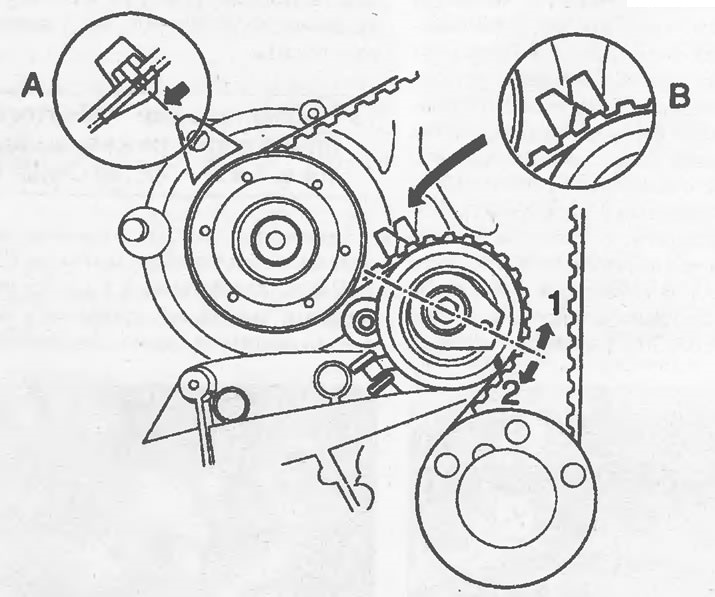
1. Since 1993, engines have been using a modified spring for the automatic tensioning mechanism of the toothed drive belt (see illustration). The assembly of the tensioner mechanism is similar to others, but the removal and installation procedures are different.
14.1 Details of the automatic tensioning mechanism of the drive belt (one of the options)

14.1 Details of the automatic tensioning mechanism of the drive belt (one of the options)
A Alignment of the protrusions on the coolant pump and cylinder block
The indicator on the tensioning mechanism is aligned with the notch in the bracket
1 To loosen the belt, move the lever counterclockwise
2 To tighten the belt, move the lever clockwise


2. The main outer cover of the drive belt can be fixed to the rear cover either by brackets or hexagon head screws; in some cases, staples and screws are combined.

3. To relieve the belt tension before removing, loosen the tensioner mounting bolt slightly, then insert a tool into the groove on the tensioner lever, turn the tensioner lever until the drive belt is slack. If necessary, remove the tensioner completely and inspect it as described in Chapter 12.


Installation


4. Install the tensioning mechanism in place, lightly tighten the mounting bolt.

5. Make sure that the coolant pump is correctly positioned, i.e. the lug on the pump flange should be aligned with the corresponding lug on the cylinder block. If this is not the case, loosen the coolant pump mounting bolts and move the pump slightly in the desired direction (see Section 3). Tighten the bolts with the specified tightening torque Specifications.

6. Install the timing belt, then adjust its tension as follows.

Adjustment


7. Loosen the automatic tensioner mounting bolt, move the mechanism lever counterclockwise until the tensioner indicator hits the stopper. Tighten the mounting bolt to hold the mechanism in this position.

8. Rotate the crankshaft two full revolutions in the normal direction of rotation, and check that the TDC mark on the crankshaft pulley is aligned with the pointer on the rear toothed drive belt cover. The TDC mark on the camshaft sprocket should be aligned with the notch in the rear drive belt cover. Loosen the automatic tensioner mounting bolt, move the mechanism lever clockwise until the pointer is aligned with the notch in the tensioner bracket. The new belt will be bedded in for the first few hours of operation (running-in procedure). If you are installing a used belt (already tested), set the pointer approximately 4 mm to the left of the notch (see illustration).
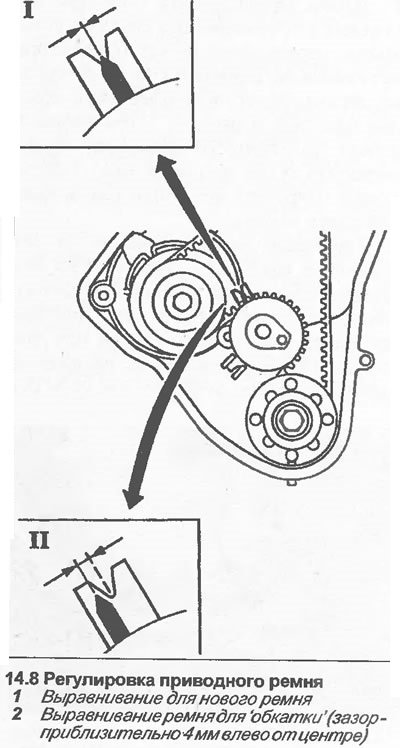
8. Rotate the crankshaft two full revolutions in the normal direction of rotation, and check that…


9. Tighten the tensioner mounting bolt. Rotate the crankshaft one full revolution in the normal direction of rotation, and check that the timing marks on the crankshaft and camshaft remain aligned. Then install all remaining components as described in Chapter 12.


10. Once the timing belt has been adjusted in this way, the correct tension will always be maintained by the automatic tensioning mechanism and no further checking or adjustment is required.

Source is on the website (OpelBook.ru)


This article is available at russian, bulgarian, belarusian, ukrainian, serbian, croatian, romanian, polish, slovak, hungarian
Checking the article: Chernov Alexander

Share information:

Previous articles
Opel Vectra A: SOHC engine
Next articles

Timing Belt Cover Opening, 1.4L and 1.6L Models — General Description
Toothed drive belt and tensioner (1.4 and 1.6L models, except C16NZ2) — removal, installation and adjustment
Toothed drive belt and sprockets (without automatic tensioning mechanism) — removal, installation and adjustment
Disassembling and assembling the engine — general description
Engine and Transmission Mounting Brackets — Replacement
Engine and transmission — removal, separation, connection and installation
Front camshaft oil seal — removal and installation
Rear camshaft oil seal — removal and installation
Camshaft housing and camshaft — general description
Camshaft housing and camshaft — disassembly, inspection and assembly
Camshafts, repair dimensions for models C16NZ2, 1.8 and 2.0 liters — general description
Cylinder head — removal and installation (engine in a car)


See similar ones from other Opel car manuals:
▶ Generator Drive Belt — Removal, Tension Adjustment and… Opel Astra G (1998-2004, petrol)
▶ Replacing the drive belt tensioner for ancillary equipment Opel Insignia A (2008-2017)
▶ Toothed Belt Drive — Design Description Opel Kadett D (1979-1984)
▶ Toothed drive belt — replacement with engine in a car Opel Omega A (1986-1993)
▶ Accessory Drive Belt — Tensioner Replacement Opel Zafira A (1999-2005, petrol)
Link to this page in different formats

Visitor comments


No comments yet


How much will 49 + 46 =


Vectra C (2002-2008) 
  • General information
  • User manual
  • Vehicle device
  • Maintenance
  • Troubleshooting
  • Power unit
  • Engine repair
  • Cooling system
  • Power and control system
  • Engine electrics
  • Transmission
  • Clutch
  • Car gearbox
  • Drive shafts
  • Chassis
  • Car suspension
  • Steering
  • Brake system
  • Body
  • Exterior
  • Interior
  • Doors, locks and windows
  • Heating and ventilation
  • Electrical equipment
  • Equipment and devices
  • Headlights and lighting
  • Electrical circuits
Vectra B (1995-2002) 
  • General information
  • User manual
  • Weekly checks
  • Maintenance (gasoline)
  • Maintenance (diesel)
  • Troubleshooting
  • Power unit
  • SOHC gasoline engine
  • DOHC petrol engine
  • Diesel engine 1.7 liter
  • Diesel engine 2.0 liters
  • Engine repair
  • Cooling system
  • Fuel system (gasoline)
  • Fuel system (diesel)
  • Charging system
  • Launch system
  • Ignition and preheat
  • Transmission
  • Clutch
  • Mechanical gearbox
  • Automatic gearbox
  • Drive shafts
  • Chassis
  • Brake system
  • Wheel suspension
  • Steering
  • Body
  • Exterior
  • Interior
  • Doors and windows
  • Heating and ventilation
  • Electrical equipment
  • Equipment and devices
  • Electrical circuits
Vectra B (1995-2002, petrol) 
  • General information
  • Maintenance
  • Help with malfunctions
  • Power unit
  • Engine repair
  • Exhaust system
  • Cooling system
  • Fuel system
  • Multec injection system
  • Four point injection
  • Transmission
  • Clutch
  • Gearbox and drive
  • Chassis
  • Wheel suspension
  • Steering
  • Brake system
  • Wheels and tires
  • Body
  • Exterior
  • Interior
  • Electrical equipment
  • Fuses and electronics
  • Power devices
  • Ignition system
  • Lighting and signaling
  • Equipment and devices
  • Heating and ventilation
  • Electrical circuits
Vectra A (1988-1995) 
  • Power unit
  • Engine repair
  • Ignition system
  • Lubrication system
  • Cooling system
  • Injection system
  • Fuel system (carburetor)
  • Fuel system (diesel)
  • Exhaust system
  • Transmission
  • Clutch
  • Car gearbox
  • Chassis
  • Front suspension
  • Rear suspension
  • Steering
  • Brake system
  • Wheels and tires
  • Body
  • Exterior
  • Interior
  • Electrical equipment
  • Electrical circuits
Vectra A (1988-1995, petrol) 
  • General information
  • User manual
  • Maintenance
  • Power unit
  • SOHC engine
  • DOHC engine
  • Cooling and ventilation
  • Fuel system (carburetor)
  • Fuel system (injector)
  • Exhaust converter
  • Transmission
  • Clutch
  • Mechanical gearbox
  • Automatic gearbox
  • Drive shafts
  • Chassis
  • Brake system
  • Car suspension
  • Steering
  • Body
  • Body elements
  • Electrical equipment
  • Power devices
  • Equipment and devices
  • Electrical circuits
OpelBook.ru © 2017–2026 · Mobile version · · Sitemap: EN BG BY UA RS HR RO PL SK HU · Feedback · Site search
Astra F, petrol · Astra G, petrol · Astra G · Astra H · Astra J, petrol · Corsa B · Corsa C, petrol · Corsa C · Insignia A · Kadett D · Kadett E · Omega A · Omega B · Omega B2 · Vectra A, petrol · Vectra A · Vectra B, petrol · Vectra B · Vectra C · Zafira A, petrol · Frontera A, petrol · Frontera B · Ascona C · Vivaro A ·
We want your visit to be comfortable 🤝! We use cookies 🍪 to make that happen.