


Contents: Removal ⬇ Installation ⬇
Caution! Precise adjustment of the timing belt tension requires the use of the following Opel special tools: camshaft sprocket locking tools (KM-800-1 and KM-800-2) and crankshaft sprockets (KM-800-10), belt installation wedge (KM-800-30) and camshaft sprocket adjustment template (KM-800-20) (see illustration). If the belt is installed without using special tools, have your Opel dealer check the belt tension as soon as possible.
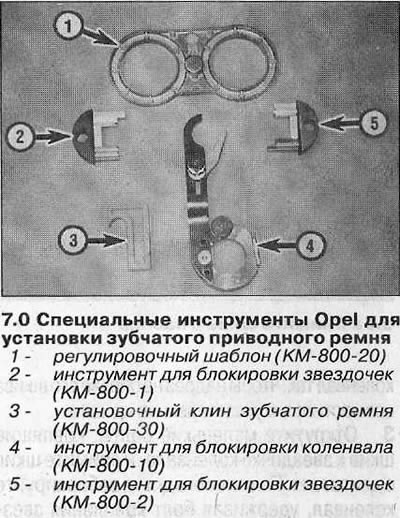
Attention! Removal and installation of the toothed belt can only be performed on a cold engine.
Removal
1. Disconnect the negative cable from the battery and move piston No.1 to TDC on the compression stroke (see Chapter 3).
Caution! On models with Opel Anti-Theft System (ATWS), the negative cable must be disconnected from the battery terminal within 15 seconds after the ignition is turned off, otherwise the alarm will be triggered.
2. Remove the crankshaft pulley as described in Chapter 5.
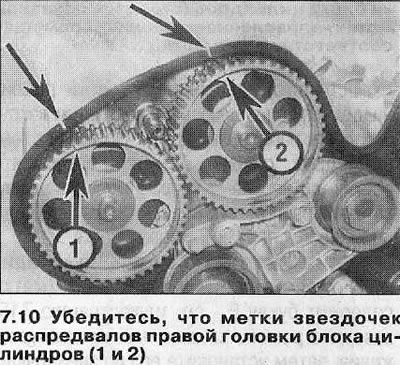
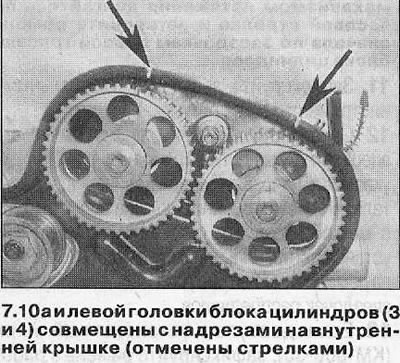
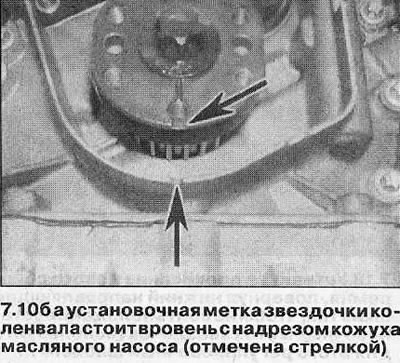
3. Make sure that the timing marks on the camshaft sprockets are aligned with the marks on the timing belt cover and that the crankshaft sprocket mark is flush with the notch on the oil pump housing.
4. Place the special tool KM-800-10 on the crankshaft sprocket and lock the shaft in this position by installing the tool grip around the water pump flange. Lock the camshafts with the appropriate tools, installing the latter with the "TOP" mark facing up. The sprockets of the right cylinder head should be locked with the KM-800-1 tool (it has numbers 1 and 2 on it, the handle of the tool is painted red), the left head sprockets - with the KM-800-2 tool (marked with numbers 3 and 4, handle painted green) (see illustrations).
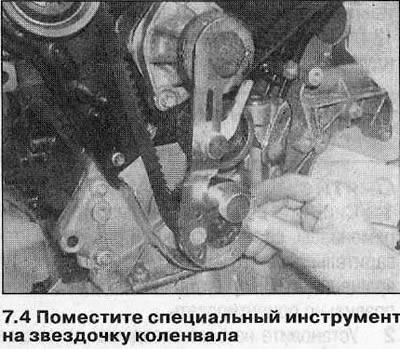
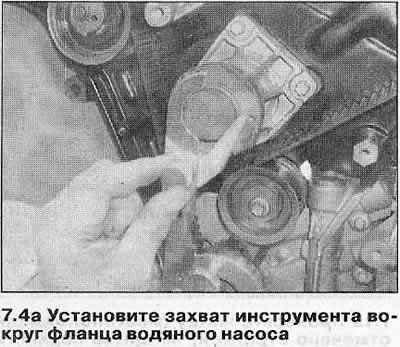
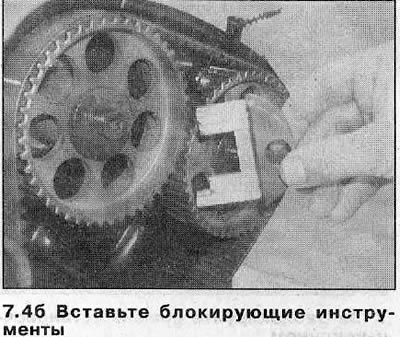
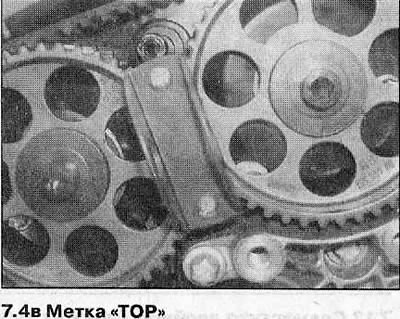
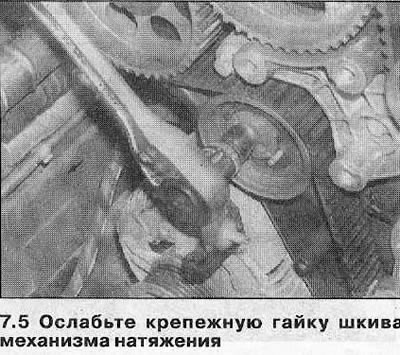
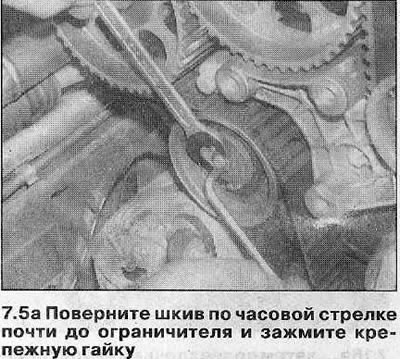
5. Loosen the timing belt tensioner pulley nut. Using a hex key, turn the tensioner pulley clockwise until it almost reaches the stop and tighten the pulley nut (see illustrations).
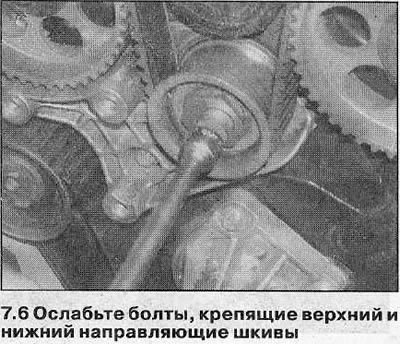
6. Loosen the upper and lower timing belt guide pulley mounting bolts (see illustrations).
Text was copied from the portal: www.opelbook.ru
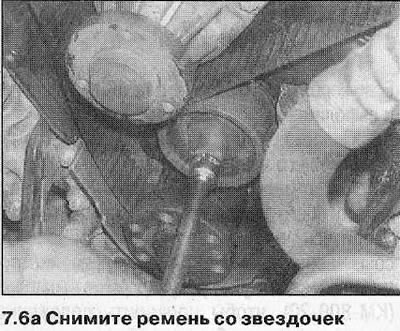
7. Pull the timing belt off the sprockets and remove it from the engine. If the belt will not be installed immediately and you do not have special tools, turn the crankshaft counter-rotating approximately 60° to move the pistons away from the valves.
8. Check the timing belt for signs of uneven wear, cracks, oil contamination and replace it if there is even the slightest doubt about the condition of the component. If the corresponding marks are no longer visible on the outside of the belt, the belt must be replaced regardless of its condition (see point 12). If the engine is due for overhaul, the vehicle's mileage has exceeded 65,000 km, or the belt has been in use for more than 4 years, replace the belt, regardless of its condition (since 1997, the belt replacement interval has been increased to 130,000 km or 8 years). If the belt is contaminated with oil, identify the source of the leak and repair it. Wash the belt and all associated components to remove oil.
Installation
Please note! The engines described have two different types of timing belts/tensioners and they are not interchangeable. The modified timing belt/tensioner assembly used in series production on later models (since 1997) requires less frequent belt replacement (every 130,000 km or 8 years). You can distinguish the modified assembly from the standard one by the letter stamped on the support plate of the upper guide roller/pulley of the tensioning mechanism. The standard tensioning mechanism is marked with the letter D, and the mark of the modified mechanism contains the letter E (EA or EB) (see illustration 7.15).
9. When assembling, thoroughly clean the timing belt sprockets and tensioner pulleys.
10. Make sure that the crankshaft sprocket timing mark is still aligned with the notch on the oil pump housing and that the camshaft sprocket marks are flush with the marks on the inner belt cover (see Chapter 3) (see illustrations). If the crankshaft has been moved 60°, return it to the TDC position.
11. Lock the sprockets with special tools as described in point 4.
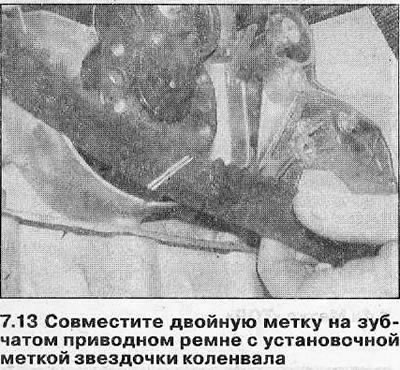
12. Orient the belt according to the marks on its outer surface. The arrows on the belt should indicate the direction of rotation of the engine shafts, and the double line should align with the crankshaft sprocket mark. If the belt is installed correctly, the four separate lines on the belt will align with the timing marks of the camshaft sprockets.
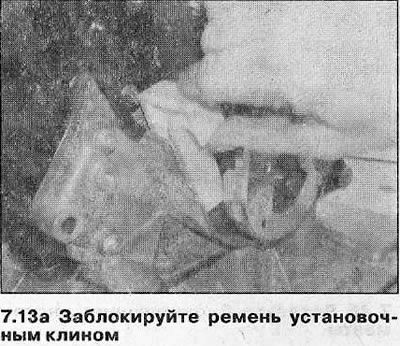
13. If a setting wedge (KM-800-30) is available, secure the belt in the working position by inserting the tool between the right belt run and the inner cover (see illustrations).
14. Check the identification mark on the upper guide pulley/tensioner pulley support plate (see note above).
15. On early model engines with a conventional tensioner (marked "D" - see illustration), install the timing belt on the lower idler pulley, then around the left cylinder head camshaft sprockets, aligning the marks. Install the belt over the upper idler pulley, then around the right cylinder head camshafts, again aligning the marks.
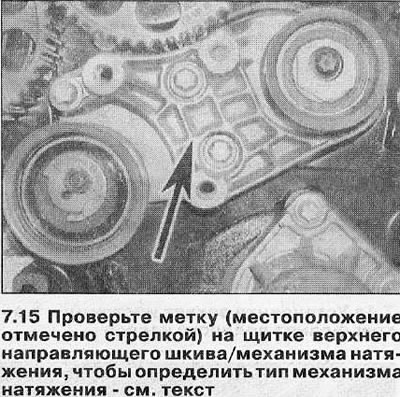
16. On engines with a modified tensioning mechanism (the mark contains the letter E - see Illustration 7.15), place the belt behind the tensioning mechanism pulley, then install it on the camshaft sprockets of the right cylinder head, aligning the corresponding marks. Install the belt on the upper guide pulley, then on the camshaft sprockets of the left cylinder head, also aligning the marks (see illustrations).
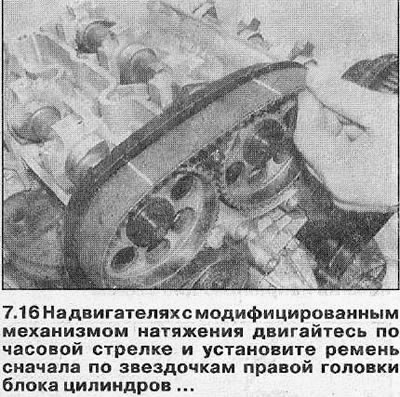
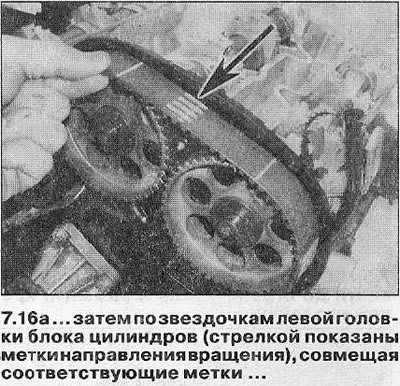
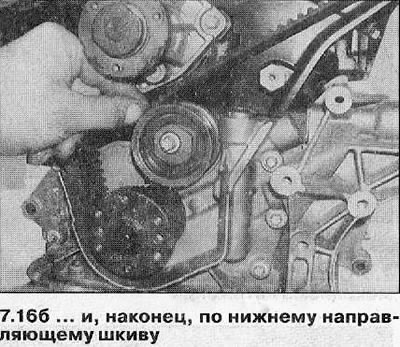
17. On all engines, ensure that the belt teeth are seated correctly in the sprockets and that the sprocket/belt timing marks are aligned.
If necessary, remove the belt from the sprockets and make the necessary adjustments.
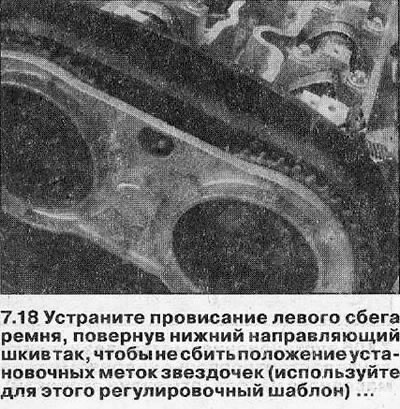
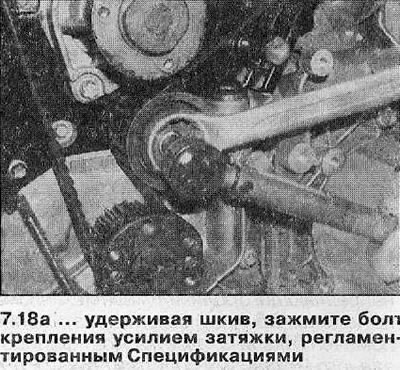
18. Loosen the lower guide pulley mounting bolt. Turn the pulley counterclockwise to remove the slack on the left side of the belt (but don't overtighten it). Make sure that the timing marks are still aligned, remove the locking tools and use the adjustment template (KM-800-20) to check the position of the sprocket marks. Tighten the pulley mounting bolt to the specified tightening torque Specifications (see illustrations).
19. Loosen the upper idler pulley mounting bolt. Turn the pulley counterclockwise to remove any slack from the upper belt run (but don't overtighten it). Make sure the timing marks on the sprockets are still aligned. Tighten the pulley mounting bolt to the specified torque Specifications (see illustration).
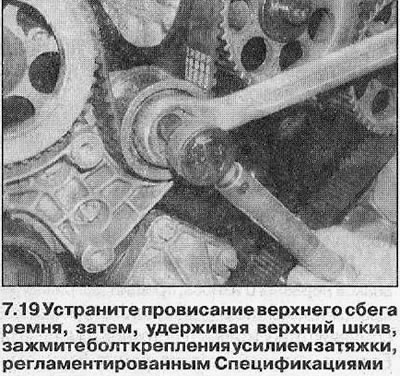
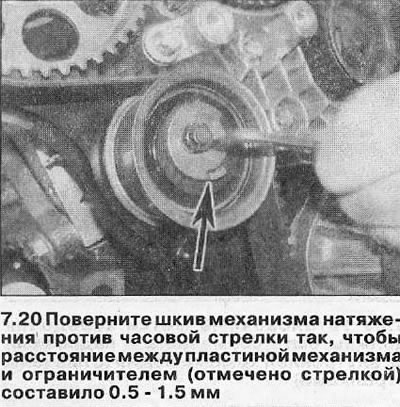
20. Loosen the nut of the toothed belt tensioner pulley, then use the Allen key to turn the tensioner lever counterclockwise so that the distance between the mechanism plate and the limiter is 0.5-1.5 mm (see illustration). While holding the tensioner pulley in this position, tighten the mounting nut securely.
21. Remove all special tools, then install the socket onto the crankshaft sprocket bolt and rotate the crankshaft two full turns (720°) in the direction of its rotation to adjust the position of the components.
22. Make sure that the timing marks of all sprockets are aligned with the corresponding marks, then loosen the tensioner nut again.
Attention! Please note that the timing marks on the belt should no longer be aligned with the sprocket marks; they serve only to provide initial orientation for the belt.
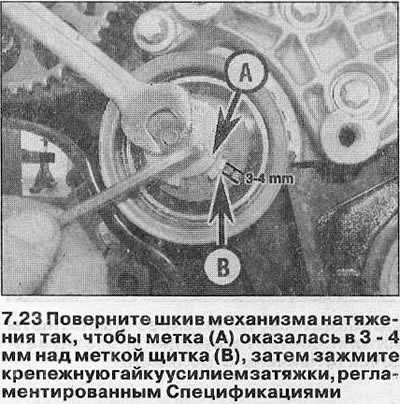
23. Using a hex key, turn the tensioner pulley so that the mark on the tensioner plate is 3-4 mm higher than the mark on the shield limiter (see illustration). While holding the tensioner in this position, tighten the fastening nut to the specified tightening torque Specifications.
24. Turn the crankshaft two more full revolutions along its stroke.
25. Lock the crankshaft in this position using the special tool KM-800-10 and check the alignment of the camshaft sprocket timing marks using the adjustment template (KM-800-20).
26. If special tools are not available, make sure that the crankshaft sprocket timing mark is aligned with the notch on the oil pump housing and that the sprocket marks on all camshafts are aligned with the notches on the inner belt cover.
27. If adjustment is necessary, repeat the steps described in points 18-26.
28. Once the timing marks are aligned, install the timing belt cover and crankshaft pulley as described in Chapters 5 and 6.
Caution: If installation was performed without using special tools, have your Opel dealer check the belt tension at the earliest opportunity.
Visitor comments