


Contents: Inspection ⬇ Installation ⬇
1. Remove the valve cover as described in Chapter 4.
2. Remove the camshaft sprockets (see Chapter 8). If it is necessary to remove the camshafts of the right cylinder head, turn both shafts counter-clockwise by approximately 60° to reduce the pressure of the valve springs on the bearing caps of the shafts. It is better to leave the camshafts of the left cylinder head at TDC.
3. Start with the intake camshaft. Working in a spiral from the outside to the inside, loosen the bearing cap bolts a half turn at a time to gradually relieve the valve spring pressure on the bearing caps. Loosen the bolts completely and remove them along with the caps. The bearing caps are numbered so that each one can be reinstalled in the same place (see illustration).
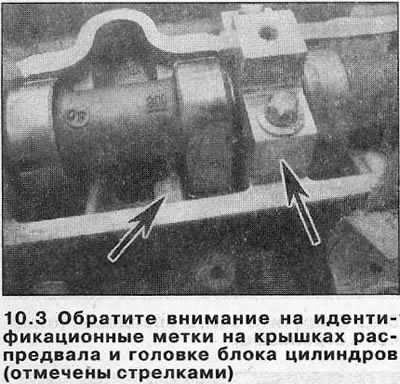
Caution! If the bearing cap mounting bolts were loosened carelessly, the caps could break. If damage is found on at least one of the caps, replace the complete cylinder head assembly - the caps are not sold separately.
4. Remove the camshaft from the cylinder head and pull out the oil seal. Mark the intake camshaft with paint or a marker to avoid mixing up the shafts during installation, which could increase the wear rate.
5. Repeat the steps described in points 3 and 4 on the exhaust camshaft. If the work is performed on the left cylinder head, unscrew the camshaft sensor bolts before removing the bearing covers (see the relevant section), move it away from the front bearing cover and release the knock sensor wiring.
6. Prepare twelve small clean plastic containers (by number of valves) and number them; alternatively, divide the large container into compartments. Remove the valve lifters one by one, placing them in the corresponding numbered container (see illustrations). Do not mix up components from different cylinders, this will lead to accelerated wear.
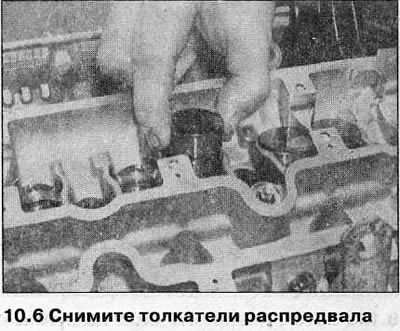
Caution: Store hydraulic tappets upside down or oil will leak out.
7. If necessary, repeat steps 1-6 and remove the camshafts and tappets from the other cylinder head. If all camshafts are to be removed at the same time, mark them and the bearing caps to avoid mixing up the components during installation.
Inspection
8. Inspect the bearing and camshaft cam surfaces for scratches and worn areas. Replace the camshaft if such damage is found. If the cylinder head surfaces are excessively worn, replace the head.
9. Inspect the tappet contact surfaces for wear and scratches. Check the tappet walls and tappet bores in the cylinder head for damage or signs of wear. If a tappet is suspected of being faulty or is visibly worn, it should be replaced.
Installation
10. Where removed, lubricate the tappets with clean engine oil and carefully insert each one into its original place in the cylinder head.
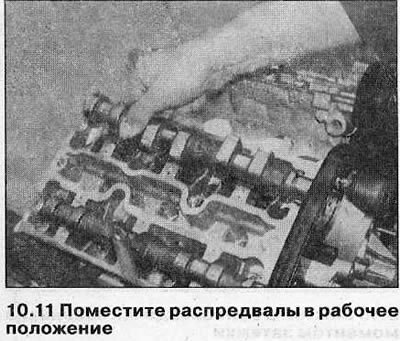
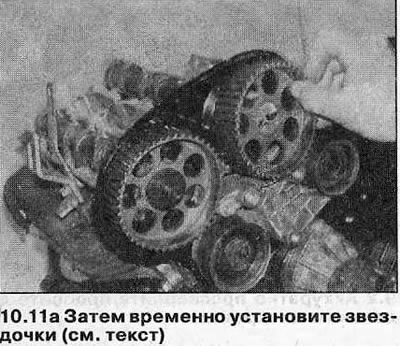
11. Place the camshafts in their operating position. Make sure the crankshaft is still approximately 60° BTDC, then temporarily install the camshaft sprockets (see Chapter 8) (see illustrations). On the left cylinder head, position the camshafts so that the timing marks on the sprockets are aligned with the notches on the inner belt cover, and on the right head, position the shafts so that the timing marks on the sprockets are approximately 60° (before TDC) from the notches on the cover. This will distribute the valve spring pressure evenly across each camshaft.
12. Make sure that the mating surfaces of the bearing caps and cylinder head are clean and dry and lubricate the camshaft cams and bearing journals with clean engine oil.
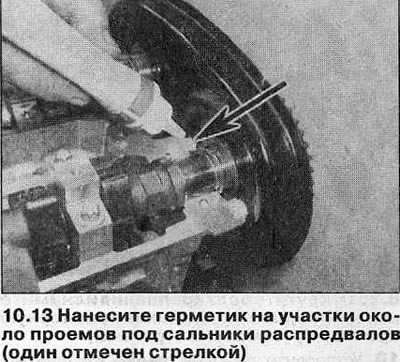
13. Apply a small amount of sealant (Opel recommends using composition 15 03170) on the contact surfaces of the cylinder head near the openings for the camshaft seals (see illustration).
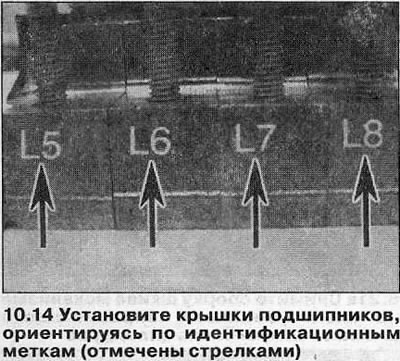
14. Install the camshaft bearing caps and mounting bolts, each component exactly in the same place. The exhaust camshaft caps are numbered from 1 to 4, and the intake camshaft caps are numbered from 5 to 8. The same numbers are stamped on the cylinder head (see illustration).
15. Fit the bearing cap mounting bolts onto the exhaust camshaft.
(Article posted on an online resource: Opelbook.ru)
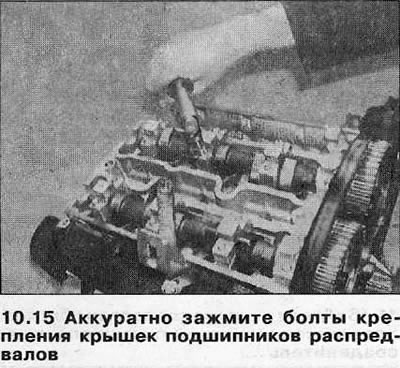
Moving in a spiral from the center to the periphery, gradually tighten the bolts (half a turn at a time) so that all the covers sit on the cylinder head. Then tighten the bolts to the specified tightening torque Specifications (see illustration).
Caution! If you tighten the bearing cap mounting bolts carelessly, the caps may break. In this case, you will have to replace the complete cylinder head assembly - bearing caps are not sold separately.
16. Tighten the intake camshaft bearing cap bolts as described in step 15.
17. If removed, install the camshafts of the opposite cylinder head in the same manner.
18. Install new camshaft seals as described in Chapter 9.
19. Install the camshaft sprockets (see Chapter 8).
20. Make sure that the timing marks on the camshaft sprockets are aligned with the notches on the inner belt cover, then carefully rotate the crankshaft in its direction of travel to align the sprocket mark with the notch on the oil pump housing.
21. Install the toothed belt as described in Chapter 7.
22. Install the valve covers and timing belt cover (see Chapters 4 and 6).
Visitor comments