


Contents: Engines Z10XE(P)/Z12XE/Z14XEP ⬇ Engines Z14XE/Z16XE/Z18XE ⬇ Z16SE Engine ⬇ Z13DT Engine ⬇ Engines Y17DT(L)/Z17DTH ⬇
Caution: Cylinder head removal operations should only be performed on a cold engine (ambient temperature) engine!
Note: The following is the procedure for removing the heads of engines equipped with a CV system.
Engines Z10XE(P)/Z12XE/Z14XEP
Removal
1. Disconnect the cable from the negative terminal of the battery (see Chapter 5) and remove the air cleaner (see Chapter 4), unscrew the mounting bolt on the upper front panel and remove the air intake.
2. On models equipped with Z12XE/Z14XEP engines, remove the front bumper cover (see Chapter 11).
3. Drain the coolant (see Chapter 3).
4. Heating system hoses from the throttle body, as well as the cooling system feed hose from the water pump.
5. Remove the brake booster vacuum line, disconnect the electrical wiring, and disconnect the heater return hose.
6. Release the pressure in the fuel system through the service nipple using a special tool KM-J-34730-9 1 (see accompanying illustration). Drain the fuel into a suitable container.
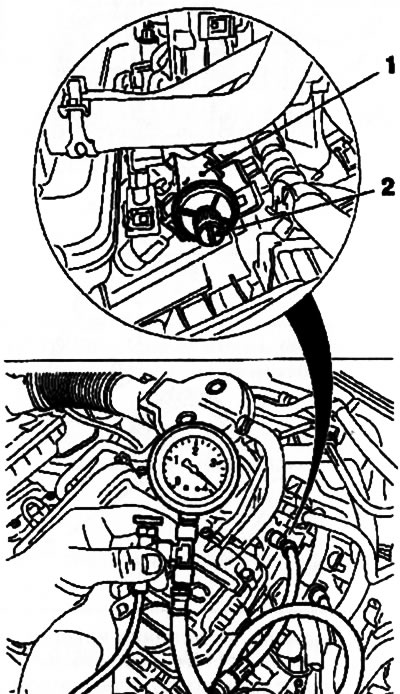
11.6. Installing the KM-J-34730-91 (2) device: 1. Service nipple; 2. Service nipple plug
7. Using the KM-796(-A) tool, disconnect the fuel line from the throttle body (see accompanying illustration) and close the holes with suitable plugs.
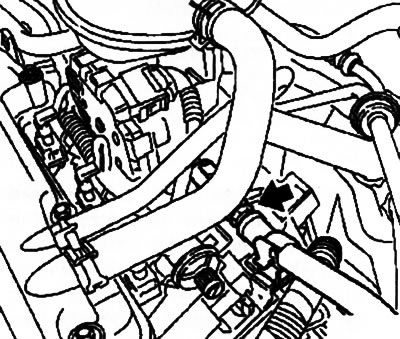
11.7 The arrow indicates the location where the fuel line is disconnected from the throttle body (Z10XE(P)/Z12XE/Z14XEP engines)
8. Disconnect the Fuel tank Ventilation System (EVAP) hose from the intake duct and pull it to the side.
9. Disconnect the wiring connectors shown in the accompanying illustration and move the wiring harnesses to the side.
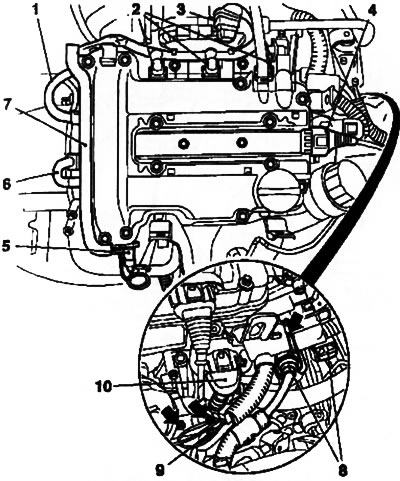
11.9. Connectors for electrical wiring of sensors and engine systems (using the Z10XEP engine as an example): 1. Camshaft sensor; 2. Injectors; 3. Throttle control systems; 4. Ignition module; 5. Engine oil pressure sensor; 6. Coolant temperature sensor; 8. Engine control module; 10. EGR valves. The arrows indicate the attachment points of the ground cable; 7. Cable channel; 9. Combination plug
Note: On Z10XEP and Z14XEP engines, the fuel rail cap must first be removed.
10. Remove the exhaust system (see Chapter 4).
11. Disconnect the electrical wiring from the starter, release the electrical wiring harness from the holders on the intake air duct.
12. Disconnect the electrical wiring from the air conditioning compressor, remove the 3 bolts and hang the compressor.
Warning: The air conditioning system must not be opened! Observe the safety precautions given in the relevant section of Chapter 3!
13. Remove the engine oil dipstick tube. Disconnect the pre-catalytic lambda probe wiring connector, then, using the special tool KM-6129 (see accompanying illustration), turn the probe out.
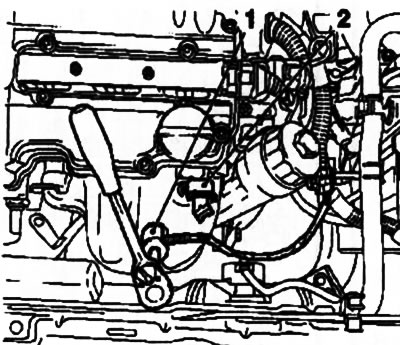
11.13. Using the KM-6129 tool (1), unscrew the lambda probe (using the Z10XE engine as an example): 2. Left rigging eye
14. Remove the bolt and the left engine lifting eye (see illustration 11.13), then unscrew the bolts securing the exhaust manifold heat shield and remove it.
15. Unscrew 7 nuts (on Z12XE/Z14XEP engines - 9 nuts), remove the washers and remove the exhaust manifold.
16. Remove the oil filter cover (see Chapter 1), and then unscrew the 3 bolts securing the filter housing (see accompanying illustration) and remove it from the cylinder block.
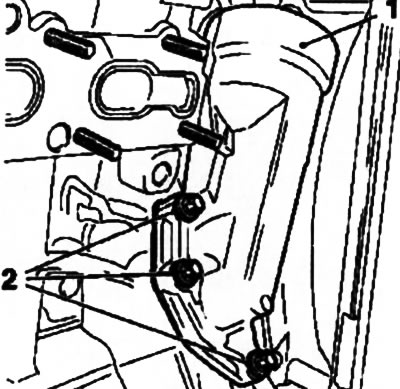
11.16. Bolts (2) for fastening the housing (1) of the oil filter (using the Z10XE engine as an example)
17. Remove the multi-rib belt (see Section 7).
18. Remove the 3 mounting bolts and remove the water pump pulley.
19. Remove 3 bolts and disconnect the cooling system hose from the water pump (see accompanying illustration).
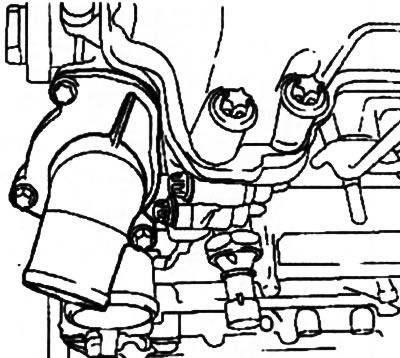
11.19. Cooling system pipe on the water pump (using the Z10XE engine as an example)
20. Remove the water pump and timing belt cover mounting bolts (see accompanying illustration).
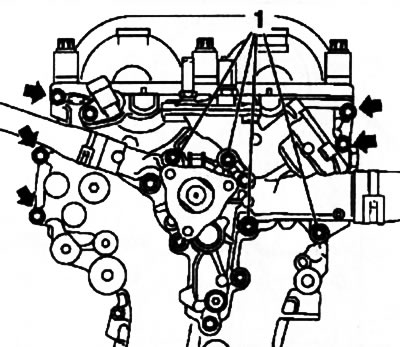
11.20. Bolts (1) for fastening the water pump housing - the arrows indicate the bolts for fastening the timing belt cover (using the Z10XE engine as an example)
21. Remove the ignition module (see Chapter 5).
22. Remove the 13 mounting bolts and remove the cylinder head cover.
23. Bring the piston of the first cylinder to the TDC position of the end of the compression stroke (see Section 6).
24. Remove the camshaft drive sprockets (see Section 8), carefully lower the chain into the timing drive housing.
25. Loosen the head mounting bolts in the reverse order to that shown in the accompanying illustrations, in 2 steps - in the first approach, loosen the bolts by 90°, and in the second - by 180°, then completely unscrew the bolts.
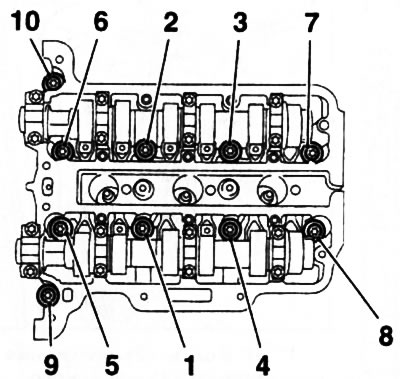
11.25a. Tightening order of the cylinder head of Z10XE(P) engines |
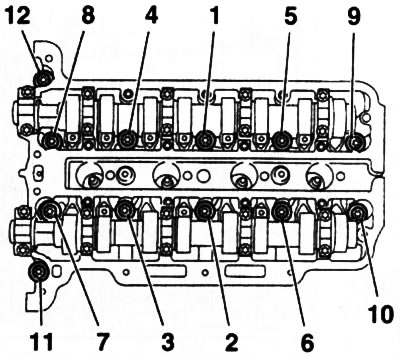
11.25b. Cylinder head tightening sequence for Z12XE/Z14XEP engines |
26. Using an assistant, remove the cylinder head - the chain tensioner should move along its guide. The removed head should be placed on a wooden surface.
27. Remove any remaining sealant from the mating surfaces, carefully pry up the gaskets at the points indicated by arrows in the accompanying illustration and remove them.
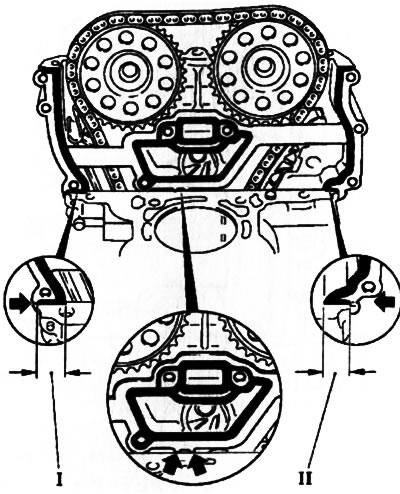
11.27. Timing belt drive cover inner side seals
Installation
28. Install new gaskets and trim the protruding edges (I) on the timing belt cover side (see accompanying illustration).
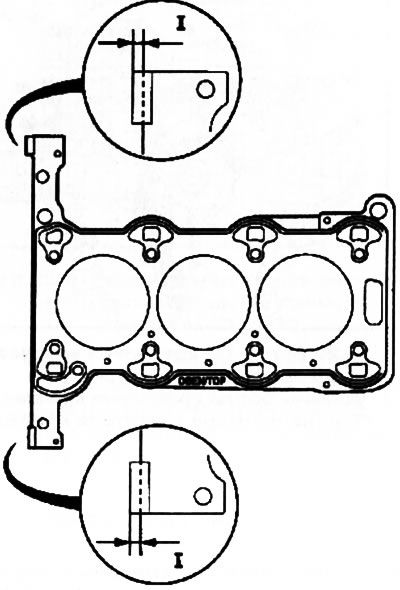
11.28. Installing new joint sealing gaskets
29. Apply a bead of sealant before installing the new head gasket (gray color) approximately 2 mm thick at the corners of the junction of the cylinder block with the timing belt housing (see accompanying illustration).
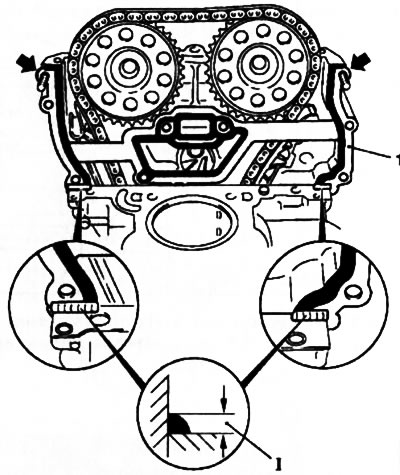
11.29. Installing new cylinder head gaskets: 1. Gasket of the vertical surface of the timing belt cover; 1. Places of sealant application
Attention: Installation of the head must be completed no later than 10 minutes after applying the sealant!
Install a new cylinder head gasket with the "TOP" marking facing up and press it into place where the sealant was applied. Insert the timing belt cover mounting bolts (see ibid), put the gaskets of the vertical surface of the timing cover on them and press the gaskets at the bottom, in the places where the sealant is applied.
30. Using the help of an assistant, install the cylinder head - place the chain tensioner on the guide and, using the KM-955-1 device, secure it.
31. Secure the cylinder head by tightening the new head mounting bolts a few turns, tap the head using a rubber mallet in the direction of the timing belt cover and tighten the 3 timing belt cover mounting bolts (see accompanying illustration).
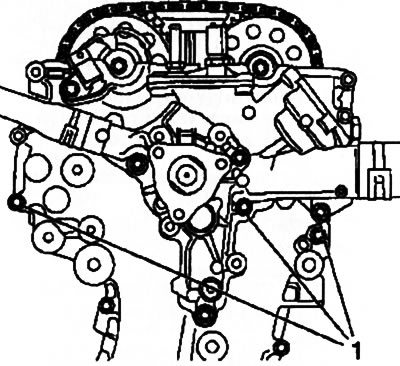
11.31. Before tightening the cylinder head mounting bolts, it is necessary to tighten the timing belt cover mounting bolts (1)
32. Tightening of the cylinder head mounting bolts is performed in the sequence shown in illustrations 11.25a and 11.25b, in 4 steps (see Specifications): on the first approach, tighten the bolts using a torque wrench, and on subsequent approaches, using a special angle measuring device.
33. Remove the 3 previously installed timing cover mounting bolts, install and tighten the removed water pump mounting bolts, and then all timing cover mounting bolts.
34. Install the remaining components in the reverse order of removal, replacing all removed sealing gaskets. After installing the drive sprockets, adjust the valve timing (see Section 6).
Engines Z14XE/Z16XE/Z18XE
35. Disconnect the cable from the negative terminal of the battery (see Chapter 5), if so equipped, remove the engine cover (see Section 2).
36. Drain the coolant (see Chapter 3).
37. Remove the timing belt (see section 8), however, if there is no need to replace the belt, the right engine support does not need to be removed. Unscrew the mounting bolt and remove the timing belt guide roller from the intake camshaft side.
38. Disconnect the electrical connectors of the oil pressure and level sensors and the crankshaft sensor.
39. Remove the exhaust system (see Chapter 4).
40. Loosen the generator mount by unscrewing the 2 upper bolts and separating the generator from the support, then loosen the mounting nut (see accompanying illustration).
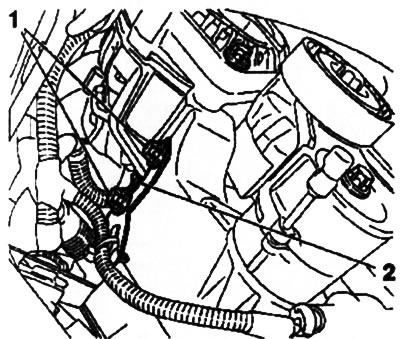
11.40. Upper bolts (1) and nut (2) for fastening the generator (engines Z14XE/Z16XE/Z18XE)
41. Remove the upper bolt, loosen the lower bolt and move the air intake bracket to the side (see accompanying illustration).
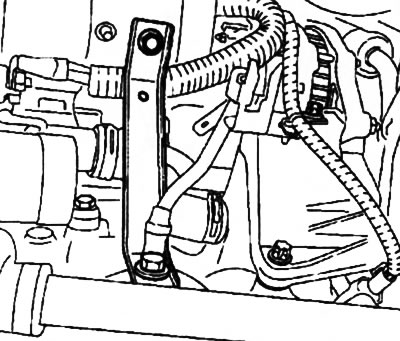
11.41. Air intake tract bracket (engines Z14XE/Z16XE/Z18XE)
42. Remove the ignition module (see Chapter 5).
43. Disconnect the lambda probe wiring, disconnect and move aside all hoses on the cylinder head cover. Unscrew the 10 mounting bolts and remove the head cover.
44. Remove the camshaft gears (see Section 5) and remove the rear timing belt cover.
45. Disconnect the ground cable, unscrew the mounting bolts and remove the generator mounting bracket (see accompanying illustration), then slide the generator back.
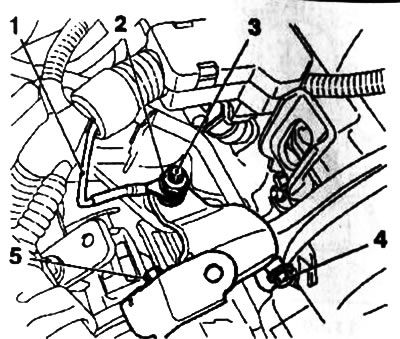
11.45. Bolts (3,4,5) of the generator mounting bracket (using the Z18XE engine as an example): 1. Grounding cable; 2 Cable fastening nut
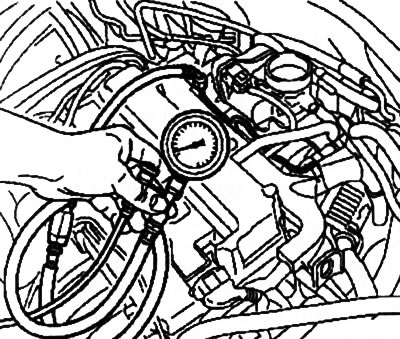
46. Release the pressure in the fuel system through the service nipple using a special tool KM-J-34730-91 (see accompanying illustration). Disconnect the fuel supply line.
11.46. Installation of the KM-J-34730-91 device (using the Z18XE engine as an example)
47. Disconnect the engine management system wiring and ground bus, move the wiring harnesses to the side.
48. Unscrew 2 bolts and remove the fuel distribution line, remove the injectors together with the electrical wiring.
49. Disconnect the power steering vacuum line and the heater return hose. Disconnect the heater return hose from the throttle body.
50. Loosen the 7 mounting nuts and remove the intake manifold/pipe.
51. Remove the mounting bolt (see accompanying illustration) and disconnect the cooling system hose. Disconnect the remaining hoses of the system that are attached to the engine head or obstruct access to it.
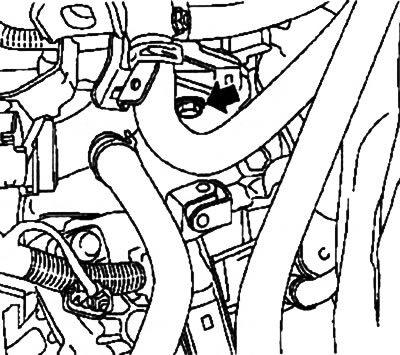
11.51. Bolt (indicated by the arrow) cooling system hose fastenings (using the Z18XE engine as an example)
52. Loosen the mounting bolt and remove the air intake from the front panel.
53. Disconnect the pre-catalytic lambda probe wiring connector, then, using the special tool KM-6129 (see accompanying illustration), turn the probe out.
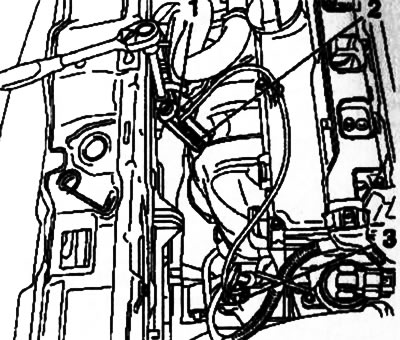
11.53. Removing the pre-catalytic lambda probe (2) using a special device KM-6129 (1): 3. Electrical wiring connector
54. Remove 3 bolts and heat shield of exhaust manifold, remove engine oil dipstick tube if necessary. Loosen 9 nuts (on the Z18XE engine - 10 nuts) and remove the exhaust manifold.
55. Loosen the cylinder head mounting bolts in the reverse order to that shown in the accompanying illustration in two steps - at the first approach, loosen the bolts by 90°, and at the second - by 180°, then completely unscrew the bolts and remove the cylinder head. If necessary, use the help of an assistant.
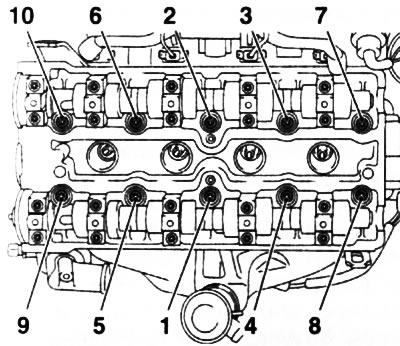
11.55. Cylinder head tightening procedure (engines Z14XE/Z16XE/Z18XE)
56. Installation is carried out in the reverse order of removal, replacing all sealing gaskets of the removed components. Tighten the threaded connections to the required force (see Specifications). When installing the cylinder head, use new mounting bolts. Tightening the cylinder head mounting bolts is performed in the sequence shown in Illustration 11.55 in 5 steps: during the first approach, tighten the bolts using a torque wrench, and during subsequent approaches, use a special angle measuring device.
Z16SE Engine
57. The cylinder head is secured with the same bolts as the camshaft housing - the operations for removing/installing the head are the same (see Section 10).
Z13DT Engine
58. Remove the camshaft housing (see Section 10).
59. Disconnect the air supply pipe from the intake manifold (see accompanying illustration).
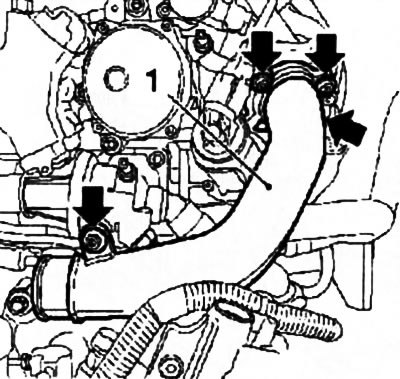
11.59. Bolts (indicated by arrows)air supply pipe fastenings (1) (z13DT engine)
60. Disconnect the 3 cooling system hoses, thermostat housing and coolant temperature sensor.
61. Separate the upper exhaust gas recirculation (EGR) valve from the mounting brackets (see accompanying illustration). Unscrew the 2 bolts securing the oil separator housing and move it away from the engine.
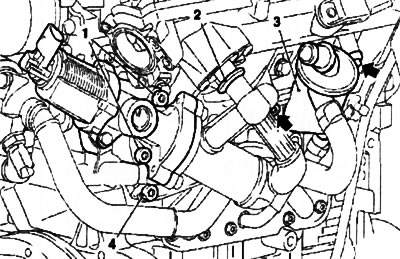
11.61. Fastening the upper EGR valve assembly (z13DT engine) - the arrows indicate the oil separator mounting bolts (3): 1, 4. Mounting bolts; 2. Retainer
62. Unscrew the bolt securing the cooling system pipe to the cylinder head and move the pipe away. Unscrew the bolt and remove the dipstick tube for measuring the engine oil level.
63. Remove the head mounting bolts in the reverse order to that shown in the accompanying illustration. Use an assistant to remove the head from the engine. The removed head should only be placed on a wooden surface.
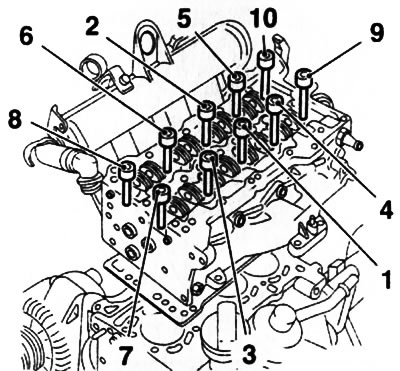
11.63. Cylinder head tightening procedure (z13DT engine)
64. Before installing the head, it is necessary to fix the crankshaft flywheel from turning using a special device (see Section 6).
65. For diesel engines, the thickness of the new cylinder head gasket is of particular importance. The procedure for performing measurements is given below (see "Y17DT(L)/Z17DTH Engines"), and the table of size correspondence is in the Specifications at the beginning of this chapter. The corresponding marks in the form of holes are applied to the gasket (see accompanying illustration).
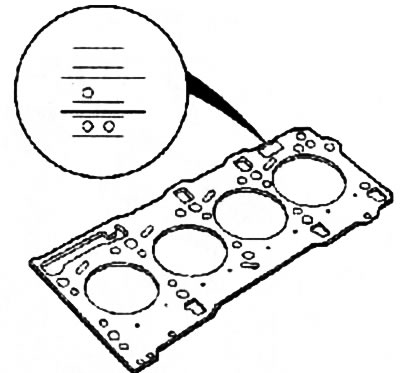
11.65. Cylinder head gasket marking for Z13DT engine
67. Tightening of the cylinder head mounting bolts is performed in the sequence shown in Illustration 11.63 from 1 to 10, in 4 steps (see Specifications): For the first and second approaches, tighten the bolts using a torque wrench, and for subsequent approaches, use a special angle measuring device. New bolts must be used.
68. Further installation is carried out in the reverse order of removal.
Engines Y17DT(L)/Z17DTH
Note: This section describes the procedure for removing the Z17DTH engine head. Depending on the engine model and configuration, some operations may differ from those described below.
Removal
69. The following describes the operations for removing the engine block head on models equipped with the A/C system. Before performing the work, it is necessary to remove the refrigerant from the A/C system using special service equipment. It is recommended to entrust this operation to specialists - safety measures are given in the relevant section Chapters 3.
70. Disconnect the battery (see Chapter 5) and drain the coolant (see Chapter 3).
71. Remove the air cleaner (see Chapter 4), multi-rib belt (see Section 7) and drain the engine oil from the crankcase (see Chapter 1).
72. Complete all the tasks listed in Section 10, up to and including the moment of removing the injectors.
73. Unscrew the 2 bolts securing the EGR system heat exchanger, lower the 2 nuts, unscrew the mounting bolt and remove the thermostat housing, having first disconnected all the hoses from it.
74. Disconnect the refrigeration line and electrical wiring from the compressor, separate the upper part of the engine oil dipstick tube.
75. Remove 2 fuses - 52, 53 (see Chapter 12), remove the relay holder and disconnect the cooling module (EGR) ground cable. Remove the upper air duct hose.
76. Remove the front bumper cover (see Chapter 11).
77. Disconnect the lower radiator hose, remove the lower air intake manifold pipe.
78. Loosen the cooling module support bracket, use an assistant and remove the module.
79. Remove the 3 mounting bolts and disconnect the front end of the exhaust pipe from the front catalytic converter. Disconnect the air hose from the turbocharger.
80. Remove the 3 bolts and the air conditioner. Then loosen and remove the air conditioner mounting bracket.
81. Loosen the 2 mounting clamps (see accompanying illustration), unscrew 5 bolts and remove the EGR system heat exchanger.
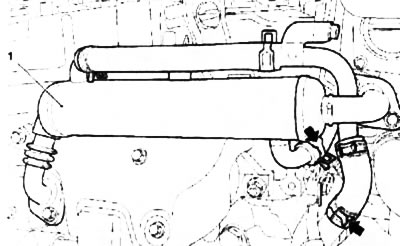
11.81. Clamps (indicated by arrows) eGR system heat exchanger mounts (z17DTH engine)
82. Remove the engine oil dipstick tube from the top of the oil pan by unscrewing the 2 bolts.
83. Unscrew 4 bolts and remove the exhaust manifold guard (see accompanying illustration).
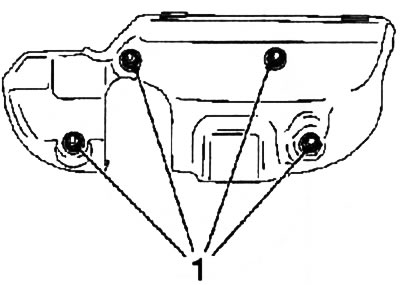
11.83. Mounting bolts (1) for exhaust manifold protection (z17DTH engine)
84. Disconnect the oil return line from the turbocharger, disconnect the turbocharger oil supply line from the engine block, and then from the turbocharger housing.
85. Disconnect the vacuum line from the turbocharger control sensor. Remove the 2 bolts and 7 mounting nuts and remove the exhaust manifold together with the turbocharger (see accompanying illustration).
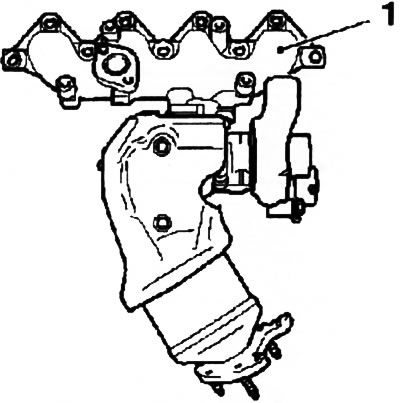
11.85. Exhaust manifold (1) with turbocharger housing (z17DTH engine)
86. Separate the oil pump housing from the engine block by disconnecting the hoses from it and unscrewing the mounting bolt (see accompanying illustration).
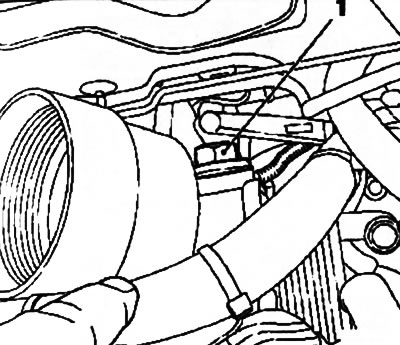
11.86. Fastening bolt (1) of oil pump housing (z17DTH engine)
87. Remove the 17 camshaft housing mounting bolts in the order shown (see accompanying illustration).
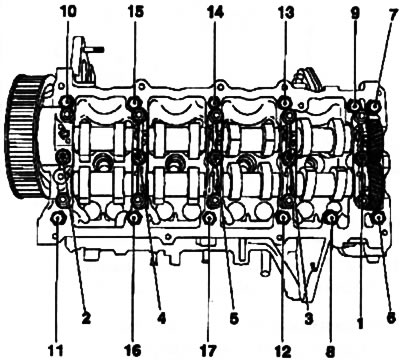
11.87. Procedure for loosening the camshaft housing mounting bolts (z17DTH engine)
88. Remove 16 cup tappets from the head - remember the order of their installation during assembly - they must be exactly in their places.
89. Loosen the cylinder head mounting bolts one by one in several steps, loosening them by 1-0.5 turns per approach, in the order shown in the accompanying illustration. Use the help of an assistant and remove the head.
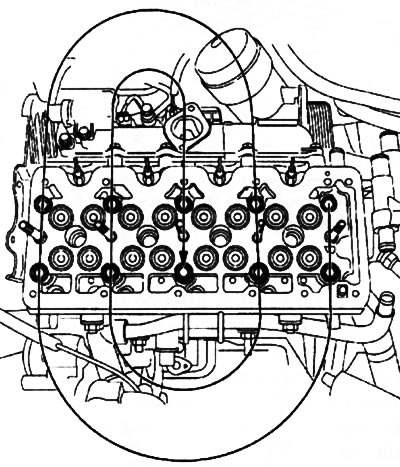
11.89. Procedure for loosening cylinder head bolts (z17DTH engine)
Examination
90. After removing the head, it is necessary to clean the mating surfaces of the head and engine block and check them for surface deformation using a device with a flat straight edge (see accompanying illustration).
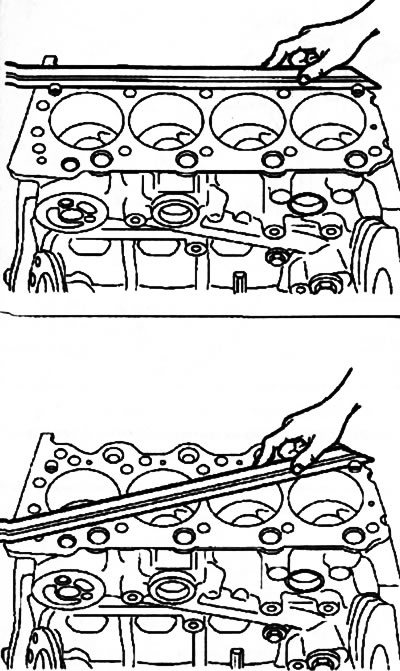
11.90. Checking the cylinder block surface for installing the head
91. For diesel engines, the thickness of the new cylinder head gasket is of particular importance. To obtain the optimum combustion chamber volume, the engine pistons protrude slightly above the block surface when at their TDC. To prevent the piston and timing valves from touching during operation, it is necessary to provide the appropriate clearance.
92. To measure the height of the piston protrusion above the block surface, it is necessary to install devices on the block surface (see accompanying illustration) and set "0" on the plunger-type meter scale at the moment when the meter probe touches the block surface.
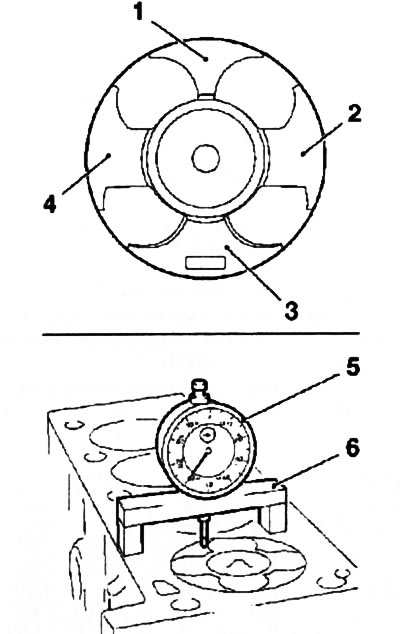
11.92. Measuring the height of piston protrusion and measurement points (1,2,3,4): 5. Measuring device MKM-571-V; 6. Device KM-301
93. Measure the protrusion height of all pistons one by one, taking measurements at two points on each piston - for measurement, select points (1) and (2) or another pair - (3) and (4). When measuring, the crankshaft should be turned smoothly to determine the highest point of piston lift. After completing the measurements, turn the crankshaft 60° counterclockwise.
94. Determine the thickness of the new gasket according to the table data (see Specifications). The gaskets are marked accordingly (holes) (see accompanying illustration).
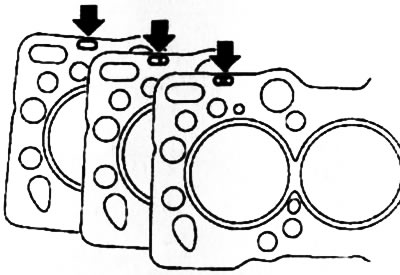
11.94. Marking of cylinder head gaskets (Z17DT (L/H) engines)
Installation
95. Installation is carried out in the reverse order of removal, replacing all sealing gaskets of the removed components. Tighten the threaded connections to the required force (see Specifications). Tightening of the cylinder head mounting bolts is performed in 3 or 5 stages (depending on the model): Tighten the bolts with a torque wrench the first time and a special angle measuring device the next time. Use new mounting bolts when installing the head. When tightening the cylinder head bolts, move in a spiral from the middle to the edges. Tighten the camshaft housing bolts in the reverse order to that shown in Illustration 11.89. Check the valve adjustment (see Section 9).
Visitor comments