


Contents: Emptying ⬇ Refueling ⬇
1. Replacement of the coolant is carried out during maintenance and repair of the vehicle in the above cases (see Section 2).
2. During maintenance, the condition of all hoses in the system must also be checked (see Chapter 1). Defective components are subject to replacement (see Section 4).
3. Do not forget about the precautions that must be taken when servicing the cooling system (see Section 2). You should only begin performing maintenance procedures after the engine has completely cooled down, i.e. several hours after the end of the trip.
Caution: When working with coolant, make sure that it does not come into contact with the toothed belt or multi-ribbed belt! The glycol contained in the coolant can damage the fabric of the toothed belt to such an extent that the belt will break after some time of operation, which in turn can lead to serious damage to the engine!
Emptying
4. Remove the expansion tank filler cap. Caution: If the engine is still warm, wrap the cap in a rag to avoid the risk of scalding (see Chapter 1, Section 4)!
5. If necessary, lift and place the vehicle on stands, remove the engine crankcase guard, (see Chapter 2, Section 5).
6. Place a clean container of appropriate volume under the radiator. For ease of draining the coolant, it is recommended to put it on the drain pipe (see accompanying illustration) place the hose and its other end into the prepared container.
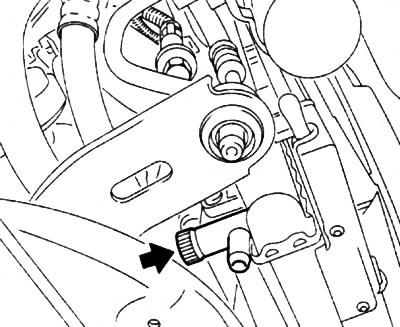
3.6. Drain valve (indicated by the arrow) cooling systems
7. Open the drain valve on the radiator and drain the liquid.
8. Close the valve and lower the vehicle.
Refueling
9. Check the condition and reliability of all cooling system hoses. Replace defective components, tighten clamps (see Section 4).
10. Fill the expansion tank with coolant to the level marked "KALT/COLD" (see accompanying illustration) on the translucent wall of the tank.
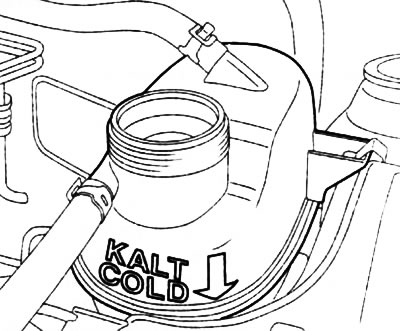
3.10. Expansion tank
11. Replace the expansion tank cap.
12. Start the engine and allow it to warm up to normal operating temperature until the thermostat valve opens (the lower radiator hose should be hot). Air from the cooling system during engine warm-up
[Source is on this resource: OpelBook]
13. On Z13DT/Z16XE/Z18XE engines, increase the engine speed to 2500 rpm so that the first stage of the fan comes on. After the fan has switched off, let the engine run for about 2 minutes at 2500-3000 rpm - during this time, the air from the cooling system will be completely removed through the expansion tank hoses.
14. Inspect the cooling system components for signs of developing leaks, then stop the engine and allow it to cool completely.
15. If equipped, install the crankcase guard.
16. Finally, check the coolant level again and make the appropriate adjustments if necessary (see Chapter 1). Tighten the expansion tank cap.
Visitor comments