
OpelBook.ru
Cars AvtoVAZ Cars Mitsubishi Cars BMW Cars Mercedes Cars Nissan Cars Toyota Cars Chevrolet
English Русский
Български
Беларускі
Український
Српски
Hrvatski
Română
Polski
Slovenský
Magyar
 |  Sitemap  |  Contacts  |    


Main Astra Corsa Insignia Kadett Omega Vectra Zafira Others Articles
Corsa B (1993-2000) Corsa C (2000-2006, petrol) Corsa C (2000-2006)
  • Main
  • Corsa
  • Corsa C
  • Power unit
  • Cooling system
  • Cooling system maintenance, flushing and leak testing

Cooling system maintenance, flushing and leak testing (Opel Corsa C)

            0

Contents: General information ⬇ Flushing ⬇ Leak testing ⬇

General information


1. When using the recommended types of coolant and proper operation, the cooling system of modern engines does not require additional maintenance.

2. If, due to the circumstances, it is necessary to pour water into the system instead of antifreeze, short-term operation of the system on water (within a few days) will not cause any serious changes in its functioning. At the first opportunity, fill the system with fresh antifreeze - it will dissolve small sediment residues and light scale, the next antifreeze change should be made in a shorter period than usual.

3. During long-term operation of the cooling system on water, especially hard water, a layer of scale will inevitably form on the walls of the cooling jacket and internal channels of the radiator, which will impede the circulation of liquid and worsen the heat exchange properties of the radiator. To remove it, it is necessary to use strong chemical solvents, while there is a significant risk of damage to the radiator and cylinder head, and flushing does not provide a 100% result. In order to save your money, use only recommended liquids in the cooling system (see Specifications).

4. It makes sense to flush in some cases after prolonged use of the coolant without replacement, when it has significantly changed its color and dirt particles have accumulated in it, or after the use and completion of the running-in of special sealants that were added to the cooling system to localize a minor leak in the radiator.


Attention: Be sure to consult with Opel service station specialists about the possibility of using specific sealants on this engine! When adding sealant, strictly follow the instructions included with it!


Flushing


5. The radiator is flushed separately from the system in order to prevent the risk of blocking its fine internal channels as a result of them becoming clogged with deposits washed out of the engine water jacket.

Note: It would be wise to also flush the heater heat exchanger separately.


6. Disconnect the upper and lower hoses from the radiator and insert a garden hose into the first hose. Turn on the water supply and continue flushing until a clear stream begins to flow from the lower hose.

7. In cases of severe contamination or obstruction of the radiator, remove the latter (see Section 7) and perform a reverse-flow flush by inserting a garden hose into the lower pipe - if you cannot achieve a positive result, take the radiator to a car service workshop for the necessary repair work.

8. Chemical treatment can be used to remove corrosion products and dense deposits from the radiator and cooling system. This should be done with extreme caution - follow the instructions of the manufacturer of the cleaning agent you purchased.

9. To flush the engine water jacket, remove the thermostat and disconnect the lower hose from the radiator.

10. Insert a garden hose into the hole for the thermostat mount in the cylinder head, turn on the water supply and continue flushing until a clear stream begins to flow from the lower hose.


11. Remove the expansion tank and rinse it with clean water (if necessary - with soap). Clean the level marks on the walls of the tank.

12. After completing the flushing, install all removed components back into place.

Leak testing


13. The system is checked for leaks using the Hazet 4800-1/2/7 device.

14. Warm up the engine to operating temperature. Check the coolant level and top up if necessary (see Chapter 1).
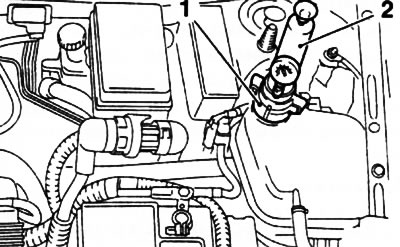
5.15. Installing the Hazet 4800-1/2/7 (2) device on the neck (1) of the expansion tank

5.15. Installing the Hazet 4800-1/2/7 (2) device on the neck (1) of the expansion tank


15. Open the expansion tank cap. Install the control device on the filler neck of the expansion tank (see accompanying illustration). Using the hand pump of the device, create a pressure of 1.0 bar in the system. A drop in pressure indicates the presence of leaks - identify and eliminate leaks, which after such a test procedure can be easily detected by the leakage of coolant. If, despite the drop in pressure, the leaks could not be identified, the cause may be an internal fluid leak in the engine, for example, through a damaged cylinder head gasket or a crack in the block - immediately seek help from specialists.


This article is available at russian, bulgarian, belarusian, ukrainian, serbian, croatian, romanian, polish, slovak, hungarian
Checking the article: Kornev Georgy

Share information:

Previous articles
Opel Corsa C: Cooling system
Next articles

Disconnecting and replacing cooling system hoses
Draining and filling the system with coolant
Antifreeze — General Information and Precautions
Engine cooling system — design description
Cooling and Heating System Specifications
Removal and installation the cooling system fan
Removal and installation the cooling system radiator
Removal and installation the water pump
Removal, installation and checking the thermostat


See similar ones from other Opel car manuals:
▶ Cooling system maintenance, flushing Opel Astra H (2004-2009)
▶ Cooling system maintenance, flushing Opel Vectra C (2002-2008)
▶ Flushing the cooling system Opel Insignia A (2008-2017)
▶ Cooling system — flushing Opel Omega A (1986-1993)
▶ Cooling system — routine maintenance Opel Ascona C (1981-1988)
Link to this page in different formats

Visitor comments


No comments yet


How much will 14 + 40 =


Corsa C (2000-2006) 
  • General information
  • Introduction to guide
  • Troubleshooting
  • Vehicle device
  • User manual
  • Maintenance
  • Power unit
  • Engine repair
  • Cooling system
  • Power and exhaust system
  • Control system
  • Engine electrical equipment
  • Transmission
  • Clutch
  • Mechanical gearbox
  • Automatic gearbox
  • Drive shafts
  • Chassis
  • Brake system
  • Wheel suspension
  • Steering
  • Body
  • Exterior
  • Interior
  • Doors and windows
  • Heating and air conditioning
  • Electrical equipment
  • Equipment and devices
  • Lamps and lighting
  • Electrical circuits
Corsa C (2000-2006, petrol) 
  • User manual
  • Car access
  • Governing bodies
  • Seat control
  • Heating and air conditioning
  • Driving and maintenance
  • Engines 1.0 and 1.2 l
  • Engine repair
  • Cooling and lubrication system
  • Injection system
  • Engines 1.4, 1.6 and 1.8 l
  • Engine repair
  • Cooling and lubrication system
  • Injection system
  • Transmission
  • Clutch
  • Mechanical gearbox
  • Automatic gearbox
  • Drive shafts
  • Chassis
  • Wheels and tires
  • Wheel suspension
  • Steering
  • Brake system
  • Body
  • Exterior
  • Doors and windows
  • Electrical equipment
  • Equipment and devices
  • Lighting system
  • Electrical circuits
Corsa B (1993-2000) 
  • General information
  • Introduction to guide
  • User manual
  • Maintenance
  • Power unit
  • SOHC gasoline engines
  • DOHC gasoline engines
  • Diesel engines
  • Engine repair
  • Cooling system
  • Supply system
  • Injection system (gasoline)
  • Injection system (diesel)
  • Exhaust systems
  • Control system (gasoline)
  • Preheat system (diesel)
  • Charge and launch system
  • Transmission
  • Mechanical gearbox
  • Automatic gearbox
  • Clutch and drive shafts
  • Chassis
  • Brake system
  • Front suspension
  • Rear suspension
  • Steering
  • Body
  • Ventilation and heating
  • Exterior
  • Interior
  • Doors and windows
  • Electrical equipment
  • Equipment and devices
  • Lamps and lighting
  • Electrical circuits
OpelBook.ru © 2017–2026 · Mobile version · · Sitemap: EN BG BY UA RS HR RO PL SK HU · Feedback · Site search
Astra F, petrol · Astra G, petrol · Astra G · Astra H · Astra J, petrol · Corsa B · Corsa C, petrol · Corsa C · Insignia A · Kadett D · Kadett E · Omega A · Omega B · Omega B2 · Vectra A, petrol · Vectra A · Vectra B, petrol · Vectra B · Vectra C · Zafira A, petrol · Frontera A, petrol · Frontera B · Ascona C · Vivaro A ·
We want your visit to be comfortable 🤝! We use cookies 🍪 to make that happen.