


General information
2. During engine operation, the parts of the power plant, and in particular the gas distribution mechanism (GRM), heat up to high temperatures, resulting in thermal expansion and some increase in the size of the parts. To compensate for thermal deformations, it is necessary to have a certain gap between the camshaft cams and valve tappets.
3. With small clearances, the valves may not close completely, which will lead to a decrease in engine efficiency, and in some cases to deformation of the valves or burning of their seats.
4. With large gaps, the efficiency of the engine also decreases, increased mechanical noise occurs, and the engine operation becomes uneven.
5. When adjusting the clearances, it is necessary to take into account the condition of the valves - the seal in the valves is satisfactory, the valves do not have excessive clearances in the guides and the ends of the valve stems are not broken. If these conditions are not met, it is not possible to correctly adjust the thermal clearances.
6. Checking and adjusting the valves is performed as necessary, usually during the next scheduled maintenance, as well as after repair/disassembly of the timing belt or if there is noise during valve operation.
Note: Valve clearances are checked and adjusted on a "cold" engine - the engine has cooled to ambient temperature.
7. When performing the clearance check procedure, it is recommended to draw up a table/diagram with valve numbers in advance for ease of recording the measurement results.
8. Before starting work, check the correct installation of the valve timing (see Section 6) and disconnect the battery (see Chapter 5).
Note: After each battery disconnection, it is necessary to adjust the steering wheel angle sensor (with appropriate equipment).
Checking the gaps
9. To check and adjust the valves, it is necessary to remove the injectors (see Chapter 4).
Attention: The fuel system is very sensitive to the ingress of even small particles of contamination - strictly follow all the instructions in the relevant section, otherwise the system may fail and costly engine repairs will be required!
10. Turn the crankshaft so that the cams of the corresponding pairs (see accompanying illustration) were directed upward.
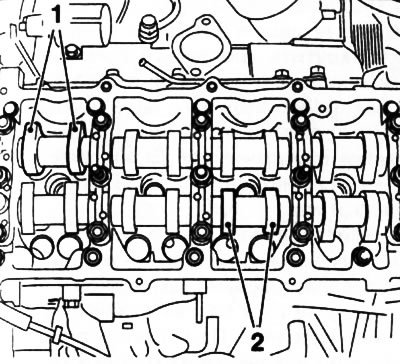
9.10. Turn the crankshaft so that the cams of pairs (1) and (2) are directed upwards
11. Check the valve clearances of the specified pairs using a set of blade feeler gauges - the appropriate feeler gauge (see Specifications) should fit into the gap very tightly with a slight "bite", otherwise the gap needs to be adjusted. If the gap value deviates from the standard values, it is necessary to determine the actual value of the gap - write down the measured value. Adjustment can be made immediately or after checking the gaps of all valves.
12. Then check and adjust the gaps in turn at the second and sixth, third and fifth, first and fourth (see accompanying illustration) pairs of cams, each time turning the engine crankshaft half a turn in the direction of rotation (clockwise) - the cams of both adjustable pairs must point upwards.
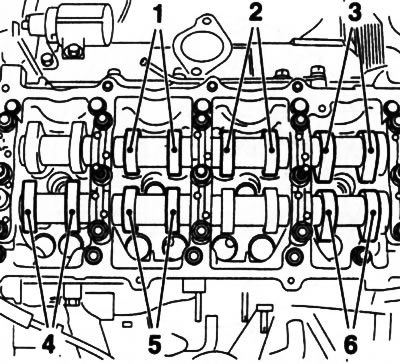
9.12. Numbering of camshaft cam pairs
(Text copied from this portal: «OpelBook»)
Adjusting the gaps
13. The valve clearance is adjusted by replacing the adjusting washers. Turn the crankshaft so that the cam of the valve to be adjusted is turned with the heel towards the tappet.
Note: Make sure the engine is not at TDC for the valve in question, as replacing the adjusting shim will require compressing the valve spring, which could cause the valve to hit the piston crown.
14. To remove old washers, turn the pusher so that the pusher groove points outward, then press the pusher using the special Opel-KM-6090 tool (see accompanying illustration).
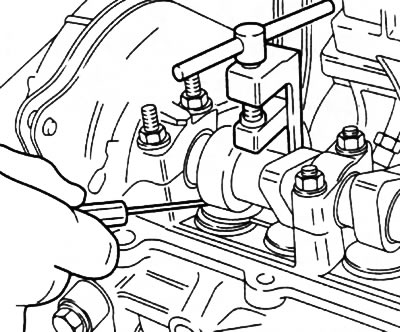
9.14. Replacement of adjustment washers(Y17DT (L)/Z17DTH engines))
Attention: When using this tool, pay attention to the marking: "1B" - for intake valves, "EX" - for exhaust valves!
15. If you don't have a special tool at hand, insert a large flat-tip screwdriver between the edge of the tappet and the base of the camshaft. Carefully, using the screwdriver as a lever, push the tappet down until you can remove the adjusting washer. It is easiest to use a magnet or a magnetized rod to remove the washer (see accompanying illustration).
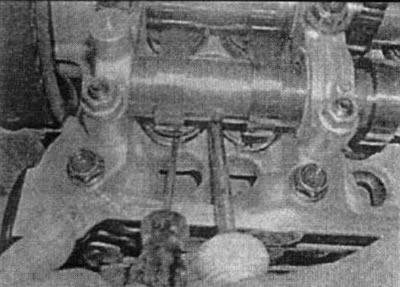
9.15. It is best to remove the adjusting washer using a magnetized rod
16. Wipe the washer and measure its thickness with a micrometer.
Note: The washers are marked (see accompanying illustration).
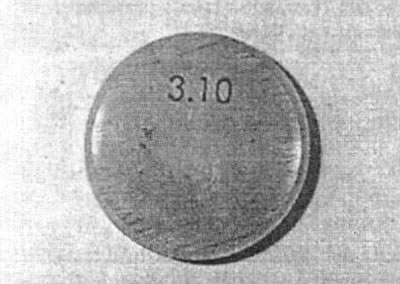
9.16. The thickness of the adjusting washers is usually stamped on one of their end surfaces (the washers should be installed with the marking facing the pusher)
17. The thickness of the new adjusting washer is calculated using the formula: N = T + A - S
T = thickness of the removed washer, (for example - 3.15 mm).
A = measured valve clearance (for example - 0.50 mm).
S = valve clearance adjustment value (for example - 0.40 mm).
For this example, the thickness of the new adjusting washer is N=3.25 mm.
Note: Shims may be reused if they show no obvious signs of wear. It may be possible to make the required adjustment by simply swapping the washers from one tappet to the other. Record and retain for future reference the thickness of all washers. If the thickness markings on a washer are worn off and illegible, further use of the washer is not recommended.
18. Prepare a washer of the required thickness, lubricate it with clean engine oil. Press the pusher and place the washer in it with the marking facing down.
19. Similarly, adjust the clearances of the remaining valves requiring adjustment, in the sequence indicated in paragraph 12 (see above).
20. Turn the crankshaft several times to seat the washers on the tappets, then perform a control check of the clearances before installing the camshaft housing cover, repeat the adjustment if necessary.
21. Reinstall all removed components. Connect the battery.
Visitor comments