


2. When performing the check, do not allow debris to enter the cylinders. Start the work by cleaning the spark plug niches and adjacent surfaces (if equipped, remove the engine cover), then blow them out with compressed air.
Note: A regular bicycle pump works well as a source of compressed air.
3. Warm up the engine to normal operating temperature (at least 80°C), - the battery must be fully charged. An assistant will be required to perform the work.
4. On a gasoline engine, remove the ignition module and spark plugs (see Chapters 1 and 5).
Attention: Work is carried out on a hot engine - do not touch the heated parts of the engine with your hands, use special handles/bolts to remove the module!
On diesel engines, disconnect the supply wiring from the glow plugs and remove the glow plugs (see Chapter 5).
5. Using the OBD on-board diagnostic system connector (see Chapter 5) and the TECH - 2 device (program "Compression test") open the engine throttle valve. On models not equipped with these connectors (earlier years of production), release the pressure in the fuel system (see Chapter 4) and de-energize it by removing the fuel pump relay from the mounting block installed in the luggage compartment (see Chapter 12) and fix the throttle valve in the fully open position or ask an assistant to press the gas pedal.
6. Install the compression gauge into the spark plug hole of the first cylinder (see accompanying illustrations), using the appropriate adapter for the engine. Note: When installing the compression tester, do not forget to check the adapter for the presence of a sealing rubber gasket. The compression tester measuring device must be set to the appropriate digit for taking measurements - for gasoline engines 1750 kPa (17.5 bar). In diesel engines, the compression ratio is much higher than in gasoline engines, so a special compression tester with a measurement range of 10 to 40 bar is required to check the pressure.
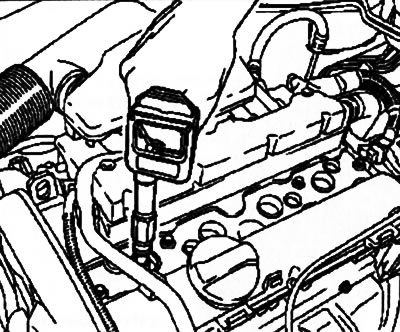
3.6a. Checking the compression pressure in the first cylinder of a gasoline engine (using the example of an engine Z14XE) |
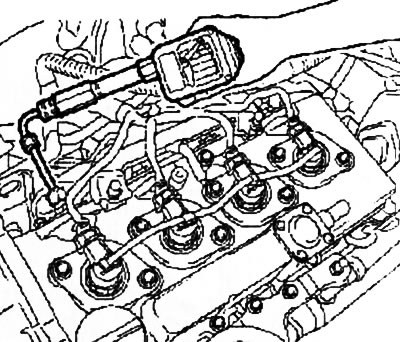
3.6b. Checking the compression pressure of a diesel engine (using the Z17DTH engine as an example) |
(Original posted on the website opelbook.ru)
7. Crank the engine with the starter for about four seconds (use the help of an assistant) in this case, the engine crankshaft rotation speed must be at least 300 rpm for gasoline engines and at least 150 rpm for diesel engines. Read and record the meter reading. Repeat the operation for the remaining cylinders. Compare the readings with the standard (see Specifications) - the pressure in any of the cylinders should not be less than 75% of the standard, while the pressure difference in different cylinders should not exceed 100 kPa (1 bar).
8. Equally low measurement results in all cylinders usually indicate wear of the compression rings in all cylinders and the need to replace them. Excessive pressure drop in one or more cylinders indicates the occurrence of local faults. When low compression pressure is detected in the engine cylinders, a more thorough check is carried out to accurately determine the cause - for example, a leak test (see below). Such a check is usually carried out in a car service workshop.
9. There are several practical ways to more accurately determine the cause of the malfunction. For example, if you add 2-3 teaspoons of engine oil to a cylinder in which excessively low pressure is determined, then an increase in pressure upon repeated measurement indicates wear of the piston rings. If the compression does not increase, the cause of its decrease is valve leaks or a leak in the head gasket.
10. If the compression pressure is equally low in two adjacent cylinders, then with a high degree of probability we can speak about a violation of the integrity of the head gasket within its bridge between these cylinders. The presence of coolant in the engine oil will confirm this assumption.
11. After completing the check, disconnect the compression gauge and reinstall the removed components.
Checking the block for leaks
12. During this test, the speed of the compressed air pumped into the cylinders and the leak locations are determined. This test is an alternative to the compression test. Moreover, from many points of view, it is much more effective, since it is easier to visually identify the source of the leak, but it requires a slightly larger volume of preparatory work and the use of a special device for measuring leaks, the handling of which requires certain skills, in addition, for the convenience of visual inspection, it is preferable to use a special lift.
13. The equipment required to check for leaks is not generally available, so it is recommended to entrust this check to service center specialists. If you perform the work yourself, strictly follow the operating instructions supplied with the measuring devices.
Visitor comments