


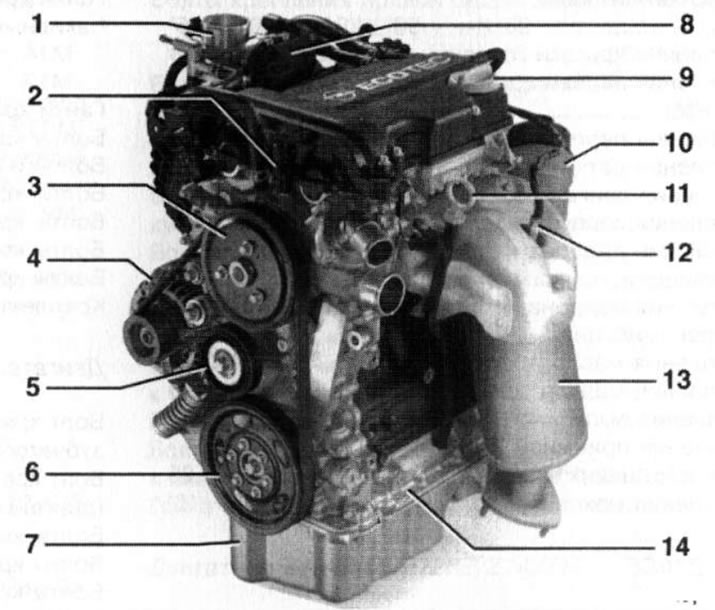
1.1a Petrol 3-cylinder engine 1.0 l (44 kW/60 hp): 1. Air intake duct; 2. Coolant temperature sensor; 3. Water pump drive pulley; 4. Generator; 5. Multi-rib belt tension roller; 6. Crankshaft pulley; 7. Engine oil pan; 8. Throttle control unit; 9. Oil filler cap; 10. Oil filter; 11. Engine oil level gauge; 12. Pre-catalytic lambda probe; 13. Catalytic converter; 14. Lower (aluminum) part of the cylinder block
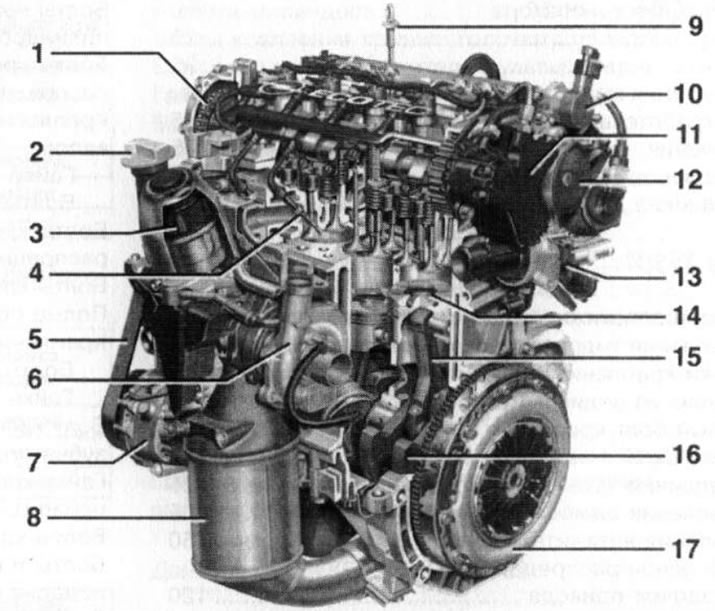
1.1b. Diesel 4-cylinder engine 1.3 l (51 kW/70 hp): 1. Timing chain; 2. Oil filler cap; 3. Oil filter; 4. Glow plug; 5. Multi-rib auxiliary drive belt; 6. Turbocharger; 7. Compressor of the air conditioning system; 8. Catalytic converter; 9. Engine oil level gauge; 10. Fuel supply system pressure regulator; 11. Fuel injection pump; 12. Vacuum pump; 13. Thermostat housing; 14. Piston; 15. Connecting rod; 16. Crankshaft; 17. Clutch basket
2. The models considered in this Manual are designed to be equipped with 3-cylinder (Z1 OXE(P)) and 4-cylinder in-line engines. Almost all engines are equipped with two overhead camshafts (DOHC) and four valves per cylinder (2 inlet and 2 outlet). The only exception is the 4-cylinder petrol engine Z16SE, which has 2 valves per cylinder and one camshaft (SOHC).
3. The engine is installed transversely in the front part of the car and is secured by means of rubber-metal mounts. Due to the shock-absorbing properties of the mounts, vibrations and oscillations of the power unit are damped and are not transmitted to the body, which allows comfortable driving at low engine speeds and, accordingly, reduces fuel consumption. The engine cooling system is a liquid type with forced cooling, the engine lubrication system is a closed type with a wet sump. The drive is carried out to the front wheels by means of a transmission assembly secured to the left of the engine.
4. The cylinder block consists of two parts: the upper part is made of gray cast iron, and the lower part is made of aluminum alloy. Both parts are connected to each other with bolted joints. The lower part of the crankcase with built-in bearings serves as a support for the crankshaft. The cast cylinder head is made of aluminum alloy and has a threaded connection with the cylinder block. Aluminum has higher thermal conductivity and a lower specific gravity compared to cast iron. Steel valve seats and guides are pressed into the head. Due to the presence of hydraulic compensators in most engines (except diesel with a working volume of 1.7 l) the valve clearance is maintained automatically, eliminating the need for adjustment during engine maintenance.
5. The basic diagram of the engine lubrication system is shown in the accompanying illustration. The lubrication system operates from an oil pump driven by the crankshaft journal.
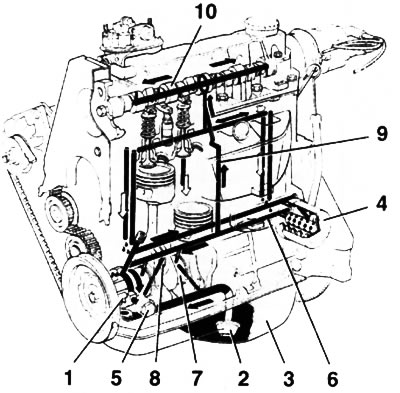
1.5. Schematic diagram of the engine lubrication system: 1. Oil pump; 2. Oil intake; 3. Boat tray; 4. Full flow oil filter; 5. Pressure reducing valve; 6. Main oil line; 7. Crankshaft main journal; 8. Crankshaft journal; 9. Vertical oil flow; 10. Camshaft journal
Note: On some engine models the pump may be driven by a toothed belt.
Oil is drawn through an oil intake equipped with a mesh filter from the engine oil pan and is filtered by a full-flow replaceable oil filter. The oil pump is equipped with a pressure-reducing valve. When a certain pressure value in the lubrication system is exceeded, the valve opens, and excess oil is drained into the boat's oil pan. Oil moves along oil flows provided in the block casting. From the oil filter, the main flow of oil under pressure is fed to the main oil line and then to the crankshaft bearings through special drillings in the shaft body, as well as to the piston bottoms and cylinder liner walls. At the same time, oil flows through vertical channels to the cylinder heads to lubricate the camshaft bearings. When the full-flow oil filter is clogged, the bypass valve opens, and oil is fed to the main oil line, bypassing the filter (unfiltered). Lubrication of the camshaft lobes and valve components, as well as other internal engine components, is carried out by the splash method.
6. Opel continues to improve the design of engines. This Guide provides a more detailed look at the modifications of earlier engines (up to and including 2004) release. Cars of later years of production may be equipped with modified engines.
7. For Corsa C models, the base engine is the 3-cylinder petrol Z10XE. On this engine, the camshaft drive is carried out by means of a chain and does not require constant maintenance. Since 2004, cars have been equipped with a modified Z10XEP engine with a Twinport system, a larger (by increasing the cylinder diameter) working volume and increased compression ratio. At the owner's request, the Corsa C models can be equipped with more powerful Z12XE/Z14XEP engines. Their design is similar to the Z10XE engine, but they have 4 cylinders.
8. The Corsa Combo and Meriva models are equipped with 16-valve petrol engines Z14XE/Z16XE/Z18XE or 8-valve engine Z16SE. The camshaft drive of these engines is carried out by means of a toothed belt. The impact on the angled inlet/outlet valves from the camshafts is transmitted via hydraulic tappets (compensators), and on the Z16SE engine, the vertically mounted valves are driven via rocker arms.
9. It is possible to install diesel engines on cars. The Z13DT engine is developed on the basis of a gasoline engine with a working volume of 1.0 l and is also equipped with a chain drive of camshafts. On diesel engines with a working volume of 1.7 l, the drive of the camshaft of the intake valves is carried out by a toothed belt, and then to the exhaust camshaft through a cylindrical gear transmission.
10. To check the technical condition of the engine, to carry out work on diagnosing the engine systems and mechanisms, its maintenance and repair, a fairly large range of special devices and instruments is required, as well as a certain amount of experience in working with such tools, therefore the authors of this Manual strongly recommend that you contact specialized service stations for maintenance and repair.
11. The format of this publication does not allow for a full description of all the operations for disassembling/assembling the engines installed on the models described in this Manual. The following sections provide the procedure for performing only the main operations most frequently performed during maintenance and current repairs without removing the engine. Some operations are quite simple or are constantly repeated when performing work - in some cases their description is omitted.
Note: Due to constant modification of the vehicle and engine design, some deviations from the procedures described below are possible. In this case, elementary ingenuity is required to dismantle/install parts or units - carefully inspect them and determine which additional elements need to be disconnected beforehand or what prevents their dismantling. It is unlikely that new options will be fundamentally different from those described below.
Visitor comments