


Contents: Removal ⬇ Installation ⬇
Note: This is a complex procedure, it is recommended to read the chapter carefully before starting work. During assembly, various components must be replaced, purchase replacements in advance. In addition, equipment is required to support the engine during the procedure and a special tool to insert the transmission input shaft into the clutch assembly during installation.
Removal
1. Disconnect the negative cable from the battery.
2. Working in the engine compartment, loosen the tie rod securing the gear selector shaft to the linkage. Move the gear selector shaft toward the engine compartment bulkhead to separate it from the linkage.
3. Remove the retaining clip, then separate the clutch cable from the release lever by moving the lever back toward the bulkhead. Move the cable retainer away from the bracket on the transmission case, then move the cable to the side, making a note of its correct location.
4. Disconnect the wiring from the reverse light switch, which is located on the front of the transmission housing, above the left mounting bracket.
5. Unscrew the mounting sleeve and disconnect the speedometer drive cable from the transmission.
6. Loosen and remove the three upper transmission-to-engine mounting bolts.
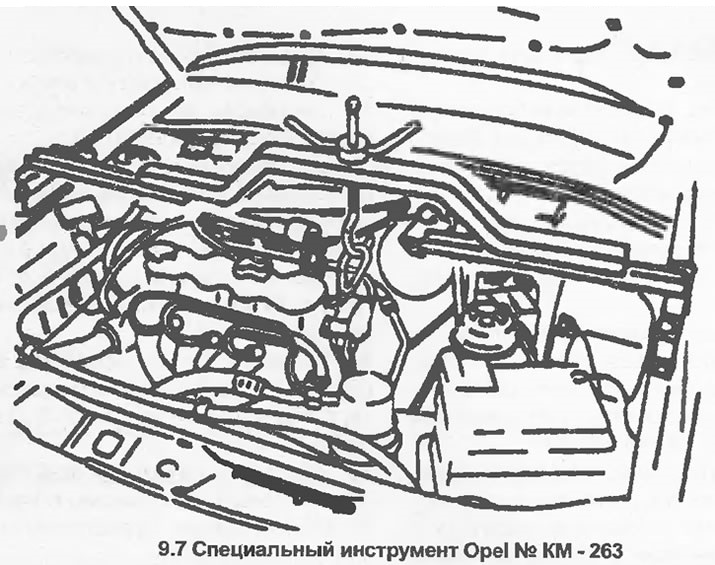
7. The engine should now be supported in the area of its left-hand bracket. Ideally, this should be done using a strong wooden or metal beam, installed securely in the recesses of the upper edges of the wing panels. An Opel tool specially designed for this purpose is shown in Illustration 9.7. Alternatively, the engine can be supported using a winch and lifting device. However, in this case, the winch must be designed to support the engine on the jacked-up vehicle.
8. Where applicable, remove the hubcaps, then loosen the front wheel bolts. Apply the handbrake, then jack up and support the front of the vehicle on axle stands. Note that the vehicle must be raised high enough to allow the transmission to be removed from underneath. Remove the front wheels.
9. Make sure the engine is supported securely, then remove the subframe as described in Section 10.
10. Disconnect the inner ends of the drive shafts from the differential (see Section 8). Be prepared for oil to leak and plug the differential openings to prevent further oil loss and dirt from entering the system. Tie the drive shafts to the body with wire or twine, do not let them hang under their own weight.
11. Loosen the retaining nut and disconnect the ground strap from the transmission end plate.
12. Place a container under the transmission end plate to catch any oil, then remove the mounting bolts and remove the plate. Note the location of the bolt securing the ground strap. For better access, remove the wheel arch liner as described in Section 11.
13. Remove the gasket.
14. Remove the retaining ring from the inner end of the input shaft using special pliers.
15. Remove the socket head cap screw from the end of the input shaft.
16. Remove the input shaft from the clutch friction disc hub as described in Section 6. There is no need to remove the clutch assembly unless replacement of its components is required.
17. Support the transmission with a jack, placing a piece of board between them.
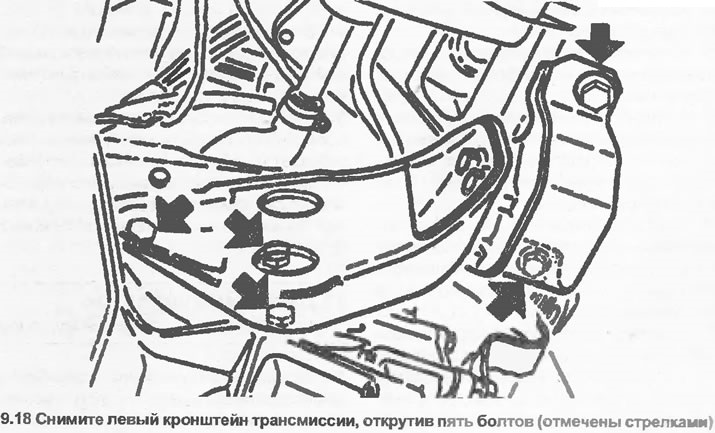
18. Remove the left transmission bracket by unscrewing the two bolts securing the rubber mount to the car body and the three bolts securing the mounting bracket to the transmission (see illustration).
19. Unscrew the mounting bolts and remove the protective cover from the base of the clutch housing.
20. Make sure the transmission is supported securely, then loosen and remove the remaining transmission-to-engine mounting bolts.
21. Lower the transmission and remove it from under the front of the vehicle.
The help of an assistant will make the work much easier.
Installation
22. Before installation, make sure that the two bolts you removed that secure the left transmission bracket cushion to the body rotate freely in the corresponding threaded holes in the body. If necessary, regrind the threaded holes using an M10x1.25 mm tap.
23. On models equipped with a "flat" (not cup-shaped) flywheel (see Section 6), it will be easier to assemble the clutch after installing the transmission.
24. Place the transmission under the front of the car, supporting it on a jack with a piece of wood between them.
25. Raise the transmission enough to allow the lower transmission to engine mount bolts to be installed, start the bolts but do not tighten them completely at this stage.
26. Install the left transmission bracket using two new bolts to secure the rubber mount to the vehicle body. Tighten all bolts to the specified torque Specifications.
27. Tighten the previously installed lower transmission-to-engine mounting bolts to the specified tightening torque Specifications, then remove the jack from under the transmission.
28. Where removed, install the clutch. Insert the transmission input shaft into the clutch friction disc hub as described in section 6.
29. Install the socket head cap screw into the end of the input shaft, then install the new snap ring.
30. Using a new gasket, install the transmission end plate and tighten the mounting bolts to the specified torque Specifications. Make sure the bolt securing the ground strap is installed in the correct location marked during removal,
31. Place the transmission ground strap on the bolt and install the mounting nut.
32. Install the protective cover onto the base of the clutch housing and tighten the mounting bolts.
33. Insert the inner ends of the drive shafts into the differential (see Section 8), using new retaining rings.
34. Install the subframe as described in Section 10.
35. Install the front wheels, but do not fully tighten the wheel bolts at this stage.
36. If a winch and lifting device were used, disconnect the lifting device or lower the winch enough to allow the vehicle to be lowered.
37. Lower the vehicle to the ground, then tighten the wheel bolts to the specified torque Specifications and install the caps (where are they applied).
38. Remove the engine support equipment (if not done yet).
39. Install the three upper transmission-to-engine mounting bolts and tighten them to the specified torque Specifications.
40. Connect the speedometer drive cable and tighten the mounting sleeve.
41. Connect the wiring of the reverse light switch.
42. Install the clutch cable holder onto the bracket on the transmission case, then connect the cable to the release lever and adjust the cable length as described in Section 6. Make sure the cable is routed as noted during removal.
43. Connect the gear selector rod to the rod, then adjust the rod as described in Chapter 2. Tighten the clamping bolt.
44. Top up the transmission oil level as described in Section 1.
45. Connect the negative cable to the battery.
Visitor comments