


2. The friction disc moves freely on the grooves of the transmission input shaft. It is held in position between the flywheel and the pressure plate and the pressure of the diaphragm spring.
Friction linings are riveted to both sides of the disc.
3. The diaphragm spring is mounted on pins and held in the clutch housing by support rings.
4. The release bearing is mounted on a guide sleeve at the front of the transmission. The bearing moves freely on the sleeve under the action of the release lever, which rotates inside the clutch housing.
5. The release lever is moved by the clutch pedal via a cable. As the friction disc wears, the clutch pedal gradually rises relative to its original position.
Manufacturers do not provide any information regarding the need for clutch cable adjustment.
6. When the pedal is pressed, the release lever moves the release bearing forward, displacing the center of the diaphragm spring. The peripheral part of the diaphragm spring moves in the opposite direction and moves the pressure plate away from the friction disc.
7. When the clutch pedal is not pressed, the diaphragm spring presses the pressure plate against the friction disk, which in turn rests against the flywheel. In this position, the drive from the crankshaft is transmitted to the gearbox.
8. This arrangement of components allows the clutch assembly, release bearing and guide bush seal to be replaced without removing the engine or transmission from the vehicle.
9. During 1992, the 1.8 and 2.0 L models were gradually equipped with a cup-shaped flywheel (see illustration).
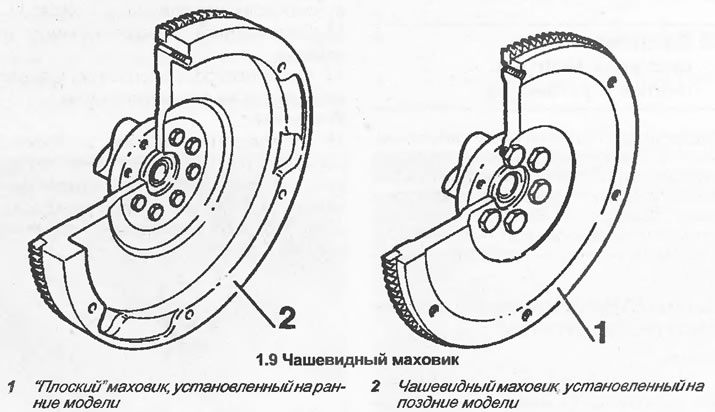
This shape smooths out rotation and reduces transmission vibration.
On these models, the transmission must be removed to replace the clutch.
Visitor comments