


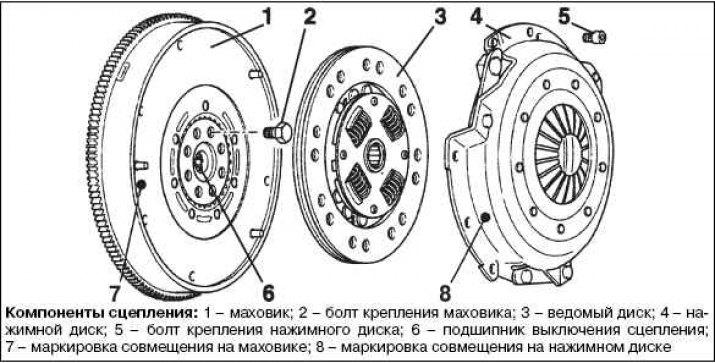
Opel vehicles with manual transmissions are equipped with a single-plate dry clutch with asbestos-free linings and a dual-mass flywheel. The clutch is controlled by a hydraulic drive. Vehicles with automatic transmissions are equipped with a hydraulic multi-plate clutch.
During operation, no clutch maintenance is required, since during its operation, the worn parts of the linings align themselves. The driven clutch disc should be replaced after approximately 100,000 km, but this largely depends on the vehicle's load conditions.
Depending on the engine model and gearbox type, the clutch design may vary slightly.
Flywheel
The flywheel is rigidly connected to the engine crankshaft. The dual-mass flywheel, using a spring-damper system, provides maximum damping of torsional vibrations.
Slave and pressure disks
The driven disk is mounted on the primary shaft of the gearbox. Linings are riveted to it on both sides.
The pressure plate is rigidly connected to the flywheel via a diaphragm spring and clutch housing. The pressure plate serves to press the driven disk to the flywheel. The surface of the pressure plate is treated with an anti-corrosion compound. When cleaning the pressure plate, only its working surface should be treated - this will extend the service life of the clutch.
Clutch release bearing
The clutch release bearing ensures that the driven disc is released from the driving disc when the clutch pedal is pressed.
Visitor comments