
OpelBook.ru
Cars AvtoVAZ Cars Mitsubishi Cars BMW Cars Mercedes Cars Nissan Cars Toyota Cars Chevrolet
English Русский
Български
Беларускі
Український
Српски
Hrvatski
Română
Polski
Slovenský
Magyar
 |  Sitemap  |  Contacts  |    


Main Astra Corsa Insignia Kadett Omega Vectra Zafira Others Articles
Vectra A (1988-1995, petrol) Vectra A (1988-1995) Vectra B (1995-2002, petrol) Vectra B (1995-2002) Vectra C (2002-2008)
  • Main
  • Vectra
  • Vectra A
  • Transmission
  • Clutch
  • Clutch (transmission removed) — removal and installation

Clutch (transmission removed) — removal and installation (Opel Vectra A)

            0

Contents: Removal ⬇ Installation ⬇

Removal


1. Remove the transmission or the entire power unit and separate the engine from the transmission. Then proceed as follows.

2. Note the position of the mark on the flywheel that aligns with the notch in the clutch housing. Gradually unscrew the six bolts with spring washers that secure the clutch housing to the flywheel.

3. Remove the clutch assembly. Be prepared to catch the friction disc, as it may fall out when removing the housing assembly. Remember the correct orientation of the disc - the side of the hub with the smaller protrusion should face the flywheel.

4. Inspect the clutch components for signs of wear and damage as described in Chapter 5.

Installation


5. If there is no need to install the engine and transmission assembly, it is recommended to install the engine into the vehicle first, then the clutch. This will eliminate the need for friction disc alignment.

6. If the entire powertrain has been removed, the clutch can be installed before connecting the engine and transmission as follows.

7. Make sure that there is no oil or grease on the friction disc linings and the surfaces of the pressure plate and flywheel. It is recommended that you install the clutch assembly with clean hands and wipe the surface of the pressure plate and flywheel with a clean cloth.

8. Install the friction disc onto the flywheel, ensuring that the disc is oriented correctly (the side of the hub with the smaller projection should face the flywheel).


9. Install the clutch housing assembly, aligning the mark on the flywheel with the notch in the housing (see illustration). Insert six bolts (with spring washers) and tighten them manually so that the friction disc is captured but still able to move.
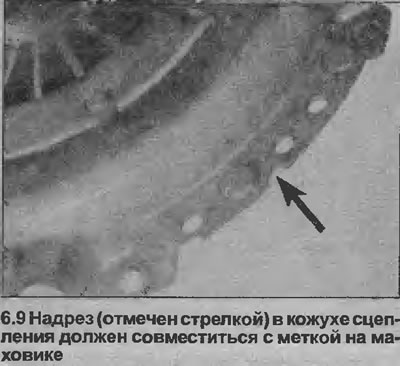
9. Install the clutch housing assembly, aligning the mark on the flywheel with the notch in the…


10. Center the friction disc so that when the transmission is installed on the engine, the slots in the transmission input shaft can fit into the slots in the friction disc hub.

11. To perform centering, insert a round rod or long screwdriver into the hole in the center of the friction disc so that the end of the rod enters the bearing in the center of the crankshaft.

If using a screwdriver, wrap the end of the screwdriver with tape to avoid damaging the bearing surface.

The displacement of the rod will move the friction disc in the same direction. Remove the rod and check by eye the centering of the friction disc hub relative to the hole in the end of the crankshaft and the circle formed by the ends of the sectors of the diaphragms of the other spring.

When the hub is perfectly centered, it is in the correct position. Alternatively, purchase a special centering tool, which eliminates the need for visual alignment.


12. Gradually tighten the cover mounting bolts (in diagonal sequence) tightening torque specified in the Specifications. Remove the alignment tool.

13. Connect the engine and transmission as described in Sections 2A, 2B or 7A (depending on the model),

14. Finally, check the clutch cable adjustment as described in Chapter 3.


This article is available at russian, bulgarian, belarusian, ukrainian, serbian, croatian, romanian, polish, slovak, hungarian
Checking the article: Chernov Alexander

Share information:

Previous articles
Opel Vectra A: Clutch
Next articles

Clutch (engine and transmission are located in the engine compartment) — removal, inspection and installation
Clutch pedal — removal and installation
Clutch cable — adjustment
Clutch cable — removal and installation
General description of the clutch
Clutch specifications
Release bearing and lever — removal and installation
Troubleshooting Clutch Problems


See similar ones from other Opel car manuals:
▶ Manual Transmission and Clutch Specifications Opel Astra H (2004-2009)
▶ Scheme No. 20: Manual transmission with automatic clutch… Opel Corsa C (2000-2006, petrol)
▶ Clutch — removal, inspection and installation (engine or… Opel Ascona C (1981-1988)
▶ Brake and clutch fluids Opel Insignia A (2008-2017)
▶ Clutch Opel Kadett E (1984-1995)
Link to this page in different formats

Visitor comments


No comments yet


How much will 26 + 32 =


Vectra C (2002-2008) 
  • General information
  • User manual
  • Vehicle device
  • Maintenance
  • Troubleshooting
  • Power unit
  • Engine repair
  • Cooling system
  • Power and control system
  • Engine electrics
  • Transmission
  • Clutch
  • Car gearbox
  • Drive shafts
  • Chassis
  • Car suspension
  • Steering
  • Brake system
  • Body
  • Exterior
  • Interior
  • Doors, locks and windows
  • Heating and ventilation
  • Electrical equipment
  • Equipment and devices
  • Headlights and lighting
  • Electrical circuits
Vectra B (1995-2002) 
  • General information
  • User manual
  • Weekly checks
  • Maintenance (gasoline)
  • Maintenance (diesel)
  • Troubleshooting
  • Power unit
  • SOHC gasoline engine
  • DOHC petrol engine
  • Diesel engine 1.7 liter
  • Diesel engine 2.0 liters
  • Engine repair
  • Cooling system
  • Fuel system (gasoline)
  • Fuel system (diesel)
  • Charging system
  • Launch system
  • Ignition and preheat
  • Transmission
  • Clutch
  • Mechanical gearbox
  • Automatic gearbox
  • Drive shafts
  • Chassis
  • Brake system
  • Wheel suspension
  • Steering
  • Body
  • Exterior
  • Interior
  • Doors and windows
  • Heating and ventilation
  • Electrical equipment
  • Equipment and devices
  • Electrical circuits
Vectra B (1995-2002, petrol) 
  • General information
  • Maintenance
  • Help with malfunctions
  • Power unit
  • Engine repair
  • Exhaust system
  • Cooling system
  • Fuel system
  • Multec injection system
  • Four point injection
  • Transmission
  • Clutch
  • Gearbox and drive
  • Chassis
  • Wheel suspension
  • Steering
  • Brake system
  • Wheels and tires
  • Body
  • Exterior
  • Interior
  • Electrical equipment
  • Fuses and electronics
  • Power devices
  • Ignition system
  • Lighting and signaling
  • Equipment and devices
  • Heating and ventilation
  • Electrical circuits
Vectra A (1988-1995) 
  • Power unit
  • Engine repair
  • Ignition system
  • Lubrication system
  • Cooling system
  • Injection system
  • Fuel system (carburetor)
  • Fuel system (diesel)
  • Exhaust system
  • Transmission
  • Clutch
  • Car gearbox
  • Chassis
  • Front suspension
  • Rear suspension
  • Steering
  • Brake system
  • Wheels and tires
  • Body
  • Exterior
  • Interior
  • Electrical equipment
  • Electrical circuits
Vectra A (1988-1995, petrol) 
  • General information
  • User manual
  • Maintenance
  • Power unit
  • SOHC engine
  • DOHC engine
  • Cooling and ventilation
  • Fuel system (carburetor)
  • Fuel system (injector)
  • Exhaust converter
  • Transmission
  • Clutch
  • Mechanical gearbox
  • Automatic gearbox
  • Drive shafts
  • Chassis
  • Brake system
  • Car suspension
  • Steering
  • Body
  • Body elements
  • Electrical equipment
  • Power devices
  • Equipment and devices
  • Electrical circuits
OpelBook.ru © 2017–2026 · Mobile version · · Sitemap: EN BG BY UA RS HR RO PL SK HU · Feedback · Site search
Astra F, petrol · Astra G, petrol · Astra G · Astra H · Astra J, petrol · Corsa B · Corsa C, petrol · Corsa C · Insignia A · Kadett D · Kadett E · Omega A · Omega B · Omega B2 · Vectra A, petrol · Vectra A · Vectra B, petrol · Vectra B · Vectra C · Zafira A, petrol · Frontera A, petrol · Frontera B · Ascona C · Vivaro A ·
We want your visit to be comfortable 🤝! We use cookies 🍪 to make that happen.