
OpelBook.ru
Cars AvtoVAZ Cars Mitsubishi Cars BMW Cars Mercedes Cars Nissan Cars Toyota Cars Chevrolet
English Русский
Български
Беларускі
Український
Српски
Hrvatski
Română
Polski
Slovenský
Magyar
 |  Sitemap  |  Contacts  |    


Main Astra Corsa Insignia Kadett Omega Vectra Zafira Others Articles
Vectra A (1988-1995, petrol) Vectra A (1988-1995) Vectra B (1995-2002, petrol) Vectra B (1995-2002) Vectra C (2002-2008)
  • Main
  • Vectra
  • Vectra A
  • Chassis
  • Brake system
  • Bleeding the brake system

Bleeding the brake system (Opel Vectra A)

            0

Air gets into the brake system whenever it is opened (for example, during repairs). It must be removed from the system. Otherwise, braking efficiency will deteriorate sharply. The presence of air is manifested in the "softness" of the brake pedal when it is pressed. In this case, you must immediately determine the leaky area and remove the air from the system.

Removing air from the brake system (bleeding) is done using the brake pedal. An assistant is needed to perform the work.

If you need to bleed the entire system, you must bleed each brake cylinder in turn. If only one caliper was replaced or repaired, it is usually sufficient to bleed it only.

Bleeding sequence: rear right brake caliper, rear left brake caliper, front right brake caliper, front left brake caliper.

Caution! For vehicles with brake fluid level alarm, turn off the ignition before bleeding.


Remove the cap from the air release valve on the brake cylinder. Clean the valve. Connect a clean hose to it, lower the other end of the hose into a bottle half filled with brake fluid so that the end of the hose is below the fluid level.

Have your assistant press the brake pedal until pressure builds up in the brake system. This will be felt as increased pedal resistance.

Once sufficient pressure has been reached, leave the pedal depressed.
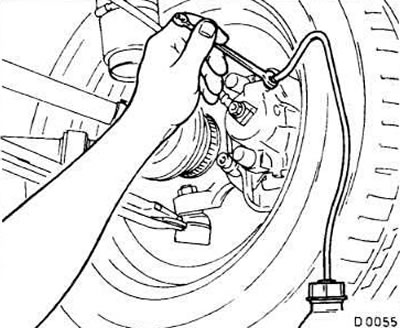
Once sufficient pressure has been reached, leave the pedal depressed.


Loosen the air release valve about half a turn. The brake fluid will flow into the bottle. Make sure that the end of the hose in the bottle is always below the fluid level.


Once the fluid pressure drops, tighten the air release valve.

Repeat the process of pressurizing the system. Loosen the air release valve again until the pressure drops, then tighten it.

Continue the process of removing air until no more air bubbles are released from the liquid flowing into the bottle.

After removing the air, disconnect the hose and put the cap on the valve.

Remove air from the remaining brake cylinders in the same way. Caution! When removing air, do not allow the fluid level in the reservoir to drop too much by adding fresh brake fluid. Otherwise, air will be sucked in through the reservoir.

After removing the air, fill the tank with liquid up to the "MAX" mark.


This article is available at russian, bulgarian, belarusian, ukrainian, serbian, croatian, romanian, polish, slovak, hungarian
Checking the article: Zinoviev Kirill

Share information:

Previous articles
Opel Vectra A: Brake system
Next articles

Brake fluid
Removal and installation rear wheel brake cylinders
Replacing brake linings of drum brakes
Removal and installation brake shoes for drum brakes
Removal and installation rear brake drums
Removal and installation brake calipers
Replacement of brake hoses and pipes
Replacing the front brake hose
Checking the brake booster
Brake force regulators
Checking, removing and installing the brake light switch
Removal and installation the parking brake lever


See similar ones from other Opel car manuals:
▶ Bleeding the brake system Opel Astra J (2009-2015, petrol)
▶ Bleeding the brake system Opel Corsa B (1993-2000)
▶ Bleeding the brake system Opel Insignia A (2008-2017)
▶ Bleeding the brake hydraulic system without special… Opel Kadett E (1984-1995)
▶ Brake system — bleeding Opel Omega B2 (1999-2003)
Link to this page in different formats

Visitor comments


No comments yet


How much will 37 + 31 =


Vectra C (2002-2008) 
  • General information
  • User manual
  • Vehicle device
  • Maintenance
  • Troubleshooting
  • Power unit
  • Engine repair
  • Cooling system
  • Power and control system
  • Engine electrics
  • Transmission
  • Clutch
  • Car gearbox
  • Drive shafts
  • Chassis
  • Car suspension
  • Steering
  • Brake system
  • Body
  • Exterior
  • Interior
  • Doors, locks and windows
  • Heating and ventilation
  • Electrical equipment
  • Equipment and devices
  • Headlights and lighting
  • Electrical circuits
Vectra B (1995-2002) 
  • General information
  • User manual
  • Weekly checks
  • Maintenance (gasoline)
  • Maintenance (diesel)
  • Troubleshooting
  • Power unit
  • SOHC gasoline engine
  • DOHC petrol engine
  • Diesel engine 1.7 liter
  • Diesel engine 2.0 liters
  • Engine repair
  • Cooling system
  • Fuel system (gasoline)
  • Fuel system (diesel)
  • Charging system
  • Launch system
  • Ignition and preheat
  • Transmission
  • Clutch
  • Mechanical gearbox
  • Automatic gearbox
  • Drive shafts
  • Chassis
  • Brake system
  • Wheel suspension
  • Steering
  • Body
  • Exterior
  • Interior
  • Doors and windows
  • Heating and ventilation
  • Electrical equipment
  • Equipment and devices
  • Electrical circuits
Vectra B (1995-2002, petrol) 
  • General information
  • Maintenance
  • Help with malfunctions
  • Power unit
  • Engine repair
  • Exhaust system
  • Cooling system
  • Fuel system
  • Multec injection system
  • Four point injection
  • Transmission
  • Clutch
  • Gearbox and drive
  • Chassis
  • Wheel suspension
  • Steering
  • Brake system
  • Wheels and tires
  • Body
  • Exterior
  • Interior
  • Electrical equipment
  • Fuses and electronics
  • Power devices
  • Ignition system
  • Lighting and signaling
  • Equipment and devices
  • Heating and ventilation
  • Electrical circuits
Vectra A (1988-1995) 
  • Power unit
  • Engine repair
  • Ignition system
  • Lubrication system
  • Cooling system
  • Injection system
  • Fuel system (carburetor)
  • Fuel system (diesel)
  • Exhaust system
  • Transmission
  • Clutch
  • Car gearbox
  • Chassis
  • Front suspension
  • Rear suspension
  • Steering
  • Brake system
  • Wheels and tires
  • Body
  • Exterior
  • Interior
  • Electrical equipment
  • Electrical circuits
Vectra A (1988-1995, petrol) 
  • General information
  • User manual
  • Maintenance
  • Power unit
  • SOHC engine
  • DOHC engine
  • Cooling and ventilation
  • Fuel system (carburetor)
  • Fuel system (injector)
  • Exhaust converter
  • Transmission
  • Clutch
  • Mechanical gearbox
  • Automatic gearbox
  • Drive shafts
  • Chassis
  • Brake system
  • Car suspension
  • Steering
  • Body
  • Body elements
  • Electrical equipment
  • Power devices
  • Equipment and devices
  • Electrical circuits
OpelBook.ru © 2017–2026 · Mobile version · · Sitemap: EN BG BY UA RS HR RO PL SK HU · Feedback · Site search
Astra F, petrol · Astra G, petrol · Astra G · Astra H · Astra J, petrol · Corsa B · Corsa C, petrol · Corsa C · Insignia A · Kadett D · Kadett E · Omega A · Omega B · Omega B2 · Vectra A, petrol · Vectra A · Vectra B, petrol · Vectra B · Vectra C · Zafira A, petrol · Frontera A, petrol · Frontera B · Ascona C · Vivaro A ·
We want your visit to be comfortable 🤝! We use cookies 🍪 to make that happen.