


Contents: Air box - removal and installation ⬇ Fuel injection device ⬇ Removal ⬇ Installation ⬇ Fuel injector ⬇ Removal ⬇ Installation ⬇ Fuel pressure regulator ⬇ Removal and installation ⬇ Throttle Position Sensor - Removal…⬇ Idle Speed Control Motor - Removal…⬇ Manifold Pressure Sensor - Removal…⬇ Crankshaft Position/Speed Sensor…⬇ Removal ⬇ Installation ⬇ Coolant temperature sensor ⬇ Exhaust Gas Oxygen Sensor ⬇
Air box - removal and installation
Disconnect the breather hose from the air box.
Disconnect the two vacuum tubes from the air box, noting their location.
Loosen the screw and disconnect the air ducts from the end of the air box.
Remove the two screws and separate the air box from the fuel injection unit. Remove the sealing ring.
Installation is carried out in the reverse order of removal, taking into account the following.
Check the sealing rings for damage or wear and replace them if necessary. Check that the sealing ring is correctly positioned in the air box groove.
Reconnect the vacuum tubes in the same position as they were before removal.
Fuel injection device
Removal
Relieve the pressure in the fuel system by removing the fuel pump relay, (chapter 12) and turning the crankshaft with the starter for 5 seconds.
Disconnect the negative battery terminal.
Remove the air box from the top of the fuel injection unit as previously described.
Remove the clamps and disconnect the wires from the fuel injectors.
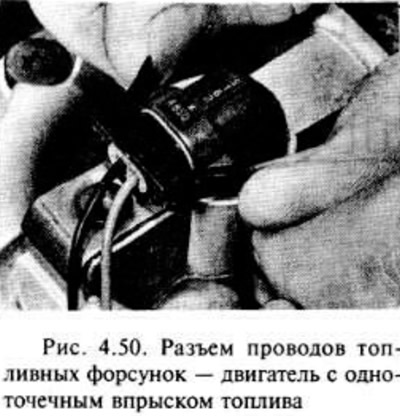
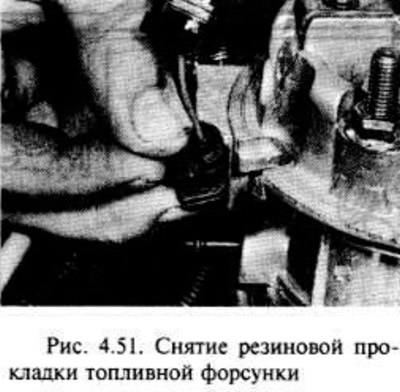
Remove the rubber gasket from the top of the fuel injector, then remove the fuel injector gasket from the groove. Slide the wiring to one side.
Disconnect the wiring from the idle speed control motor and throttle position sensor.
Disconnect the fuel supply and return hoses, noting their location. The possibility of fuel leakage requires taking fire safety measures. Clamp the hoses to reduce fuel loss.
Disconnect the vacuum hoses from the fuel injection unit.
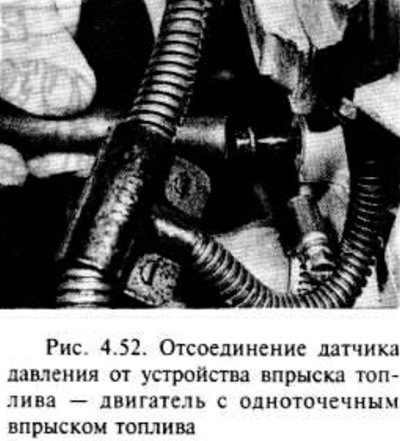
Disconnect the pressure sensor from the rear of the fuel injection unit.
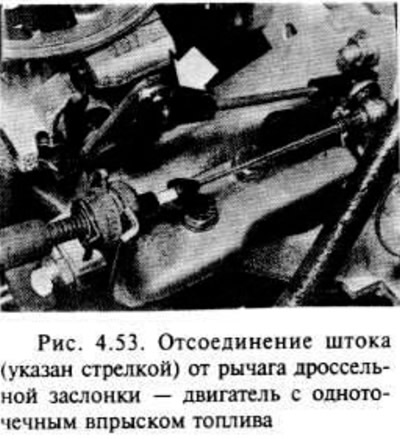
Disconnect the rod from the throttle lever.
Make sure all relevant hoses and wires are disconnected to allow removal of the fuel injection unit.
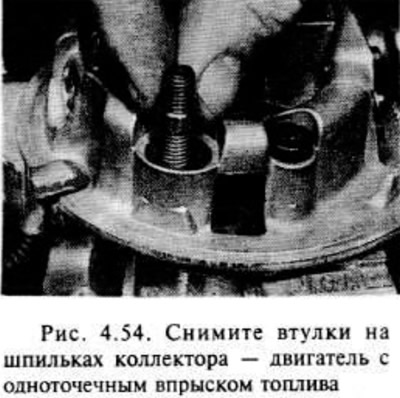
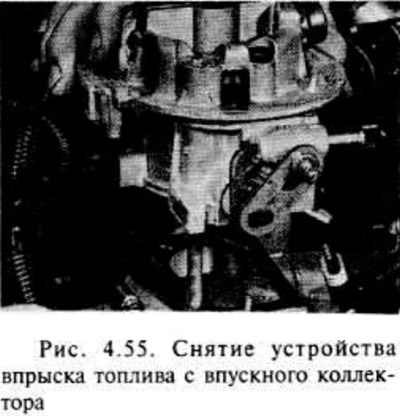
Remove the two nuts, remove the washers, remove the bushings that are on the manifold bolts, then carefully separate the fuel injection device from the intake manifold. Remove the gasket.
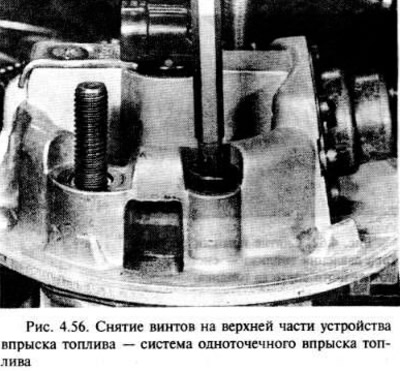
If desired, the fuel injection unit can be separated into upper and lower sections by removing two mounting screws (see fig. 4.56). You can remove the vacuum flange and fuel hose fittings.
Installation
Installation is carried out in the reverse order of removal, taking into account the following.
If required, install a new gasket when assembling the two sections of the fuel injection unit, as well as a new gasket when installing the vacuum hose flange. If the fuel hose fittings were removed, check that the gaskets are in place.
Install the fuel injection unit onto the manifold with a new gasket, making sure the bushings are in their manifold mounting locations. Apply sealant to the nut threads before installing. Make sure there are washers under the nuts.
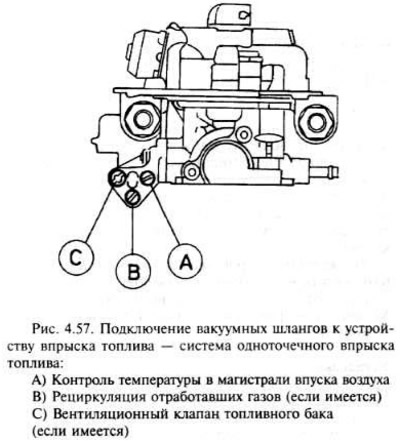
Check that all hoses are connected correctly and positioned in the same way as before removal. Vacuum hoses should be connected as shown in Fig. 4.57.
Check and, if necessary, adjust the throttle cable free play.
Fuel injector
Removal
Relieve the pressure in the fuel system by removing the fuel pump relay (chapter 12), turning the engine crankshaft with the starter for about 5 seconds.
Disconnect the negative battery terminal.
Remove the air box from the top of the fuel injection unit as directed in this section.
Squeeze the clamps and disconnect the fuel injector wires.
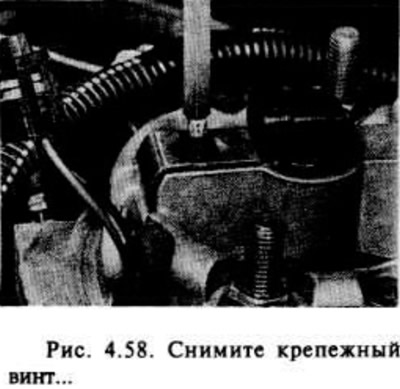
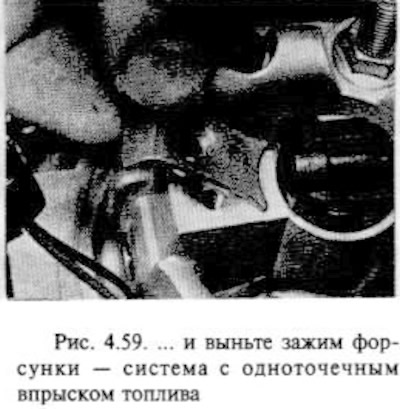
Remove the Torx countersunk screw and remove the injector clamp.
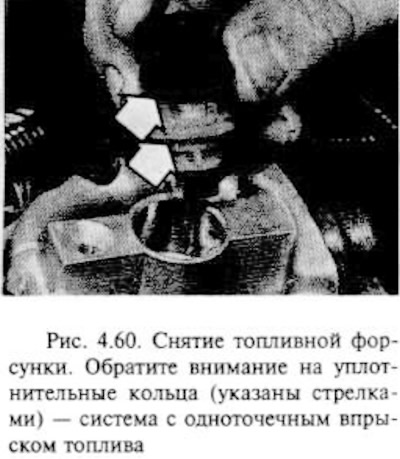
Carefully pull out the nozzle.
Installation
If the same injector is being installed, replace the two sealing rings at its base.
Carefully install the injector into the fuel injection unit so that the socket with the wire is directed towards the socket of the clamp screw.
Install the injector clamp, checking that it is connected to the injector correctly (it should engage with the slots in the wire socket).
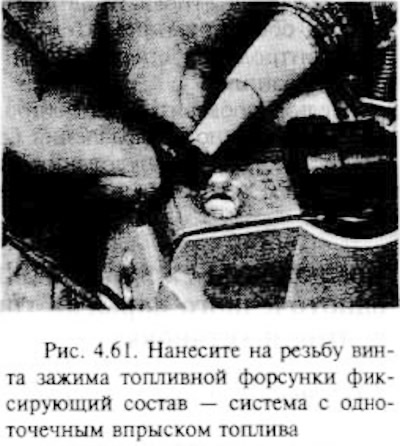
Apply locking compound to the threads of the clamp screw, then tighten the screw.
Connect the injector wiring and connect the negative battery terminal.
Fuel pressure regulator
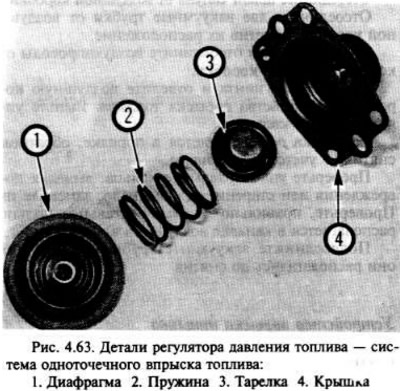
Note: The pressure regulator diaphragm is replaced in any case when the regulator is removed. Use a suitable compound to secure the threads of the regulator cover mounting bolts.
Removal and installation
Relieve the pressure in the fuel system by removing the fuel pump relay (see chapter 12) and turning the crankshaft with the starter for about 5 seconds.
Remove the air box from the top of the fuel injection unit as previously described.
Remove the four Torx bolts on the fuel pressure regulator cover and carefully remove the cover.
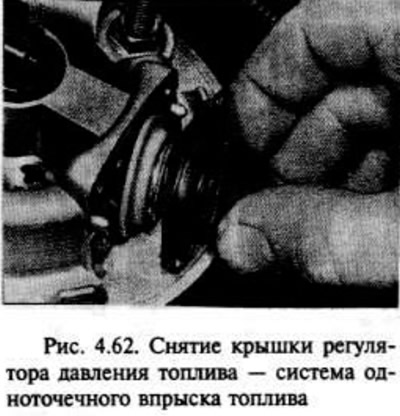
Remove the plate and spring and take out the diaphragm.
Installation is carried out in the reverse order of removal, taking into account that the diaphragm must be correctly positioned in the groove of the fuel injection device, and apply the appropriate thread locking compound to the threads of the cover mounting bolts.
Throttle Position Sensor - Removal and Installation
Disconnect the negative battery terminal.
Remove the air box from the top of the fuel injection unit as shown above.
Disconnect the connector from the throttle position sensor.
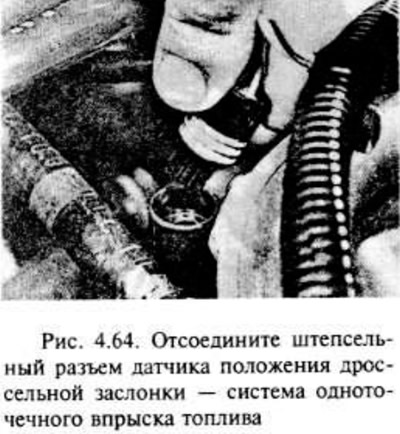
Remove the two screws and pull the sensor out of its socket in the fuel injection unit.
Check that the throttle valve is closed, then install the sensor into the socket, making sure that the sensor lever is properly engaged with the throttle shaft.
Apply thread locking compound to the sensor bolts and tighten them.
Installation is carried out in the reverse order of removal.
Idle Speed Control Motor - Removal and Installation
Disconnect the negative battery terminal.
Remove the air box from the top of the fuel injection unit as shown above.
Remove the clamp and disconnect the plug from the idle speed control motor.
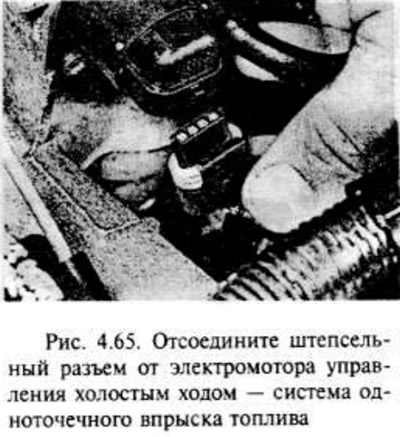
Remove the two mounting screws and lift the electric motor out of the side of the fuel injection unit. Remove the O-ring if necessary.
Installation is carried out in the reverse order of removal, taking into account the following.
In order not to damage the housing during installation, the distance between the end of the electric motor piston and the end surface of the electric motor housing flange must not exceed 28.0 mm. Measure the specified distance and, if the distance is greater than specified, carefully push the piston into the electric motor housing.
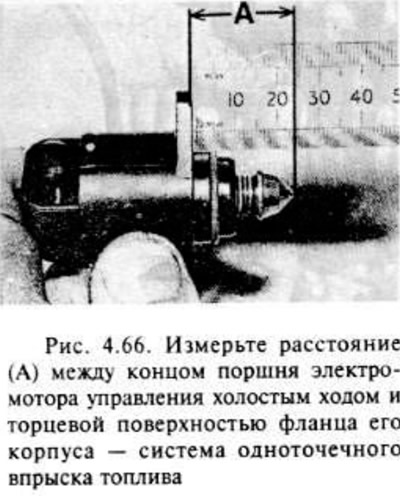
Install the motor with a new sealing ring so that the plug socket faces downward.
Before installation, apply a suitable thread locking compound to the threads of the electric motor mounting bolts.
Manifold Pressure Sensor - Removal and Installation
The sensor is located on the bulkhead of the engine compartment under the water deflector (Fig. 4.67).
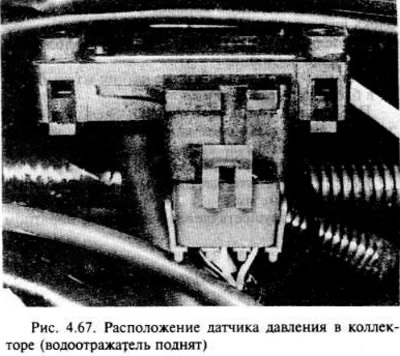
Disconnect the negative battery terminal.
Lift the water deflector to access the sensor. Disconnect the sensor plug from the vacuum tube.
Pull the sensor up to release it from the bracket and remove it from the vehicle.
Installation is carried out in the reverse order of removal.
Crankshaft Position/Speed Sensor (1.8L engine)
Removal
The sensor is located on the side of the exhaust manifold on the engine, at the bottom of the cylinder block, behind the oil pump.
Disconnect the negative battery terminal.
If necessary, loosen the clamps securing the appropriate outer distributor belt cover and disconnect the sensor wire from the distributor belt cover.
Disconnect the sensor plug, noting its location.
Loosen the screw and remove the sensor from the cylinder block.
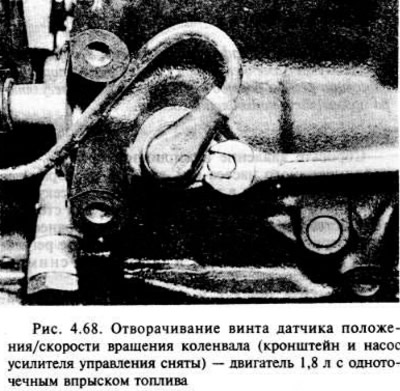
Installation
Check the sensor sealing ring and replace it if necessary.
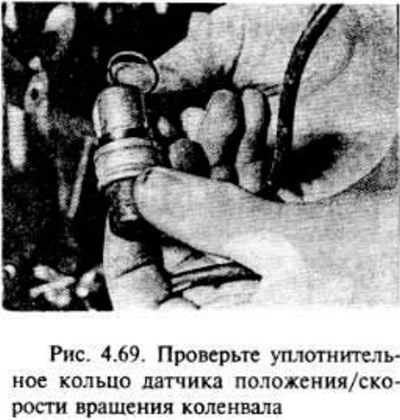
Installation is carried out in the reverse order of removal. It is necessary to ensure that the sensor wire is correctly positioned on the timing belt cover (where necessary), and that the plug is also installed correctly.
Coolant temperature sensor
The sensor is located behind the intake manifold on the right side.
Disconnect the negative battery terminal.
Partially drain the refrigerant from the cooling system.
Disconnect the sensor plug (see fig. 4.70).
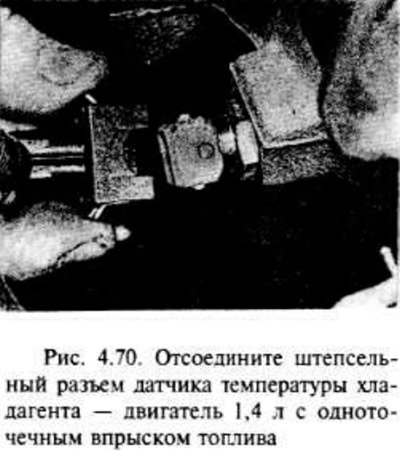
Unscrew the sensor screws and remove it from the intake manifold. Remove the sealing ring, if necessary.
Installation is carried out in the reverse order of removal, however, it is necessary to use a new sealing ring, and after completion, fill the cooling system.
Exhaust Gas Oxygen Sensor
Disconnect the negative battery terminal, then disconnect the oxygen sensor connector, noting its location (Fig. 4.71).
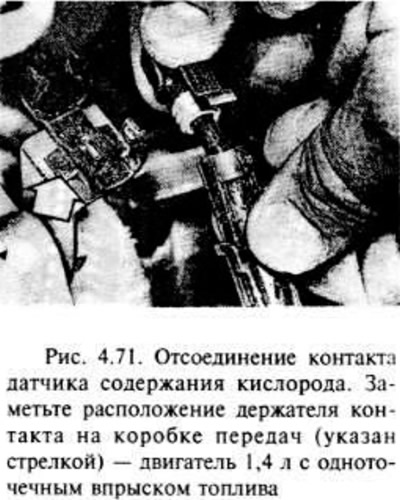
Using a suitable wrench, remove the sensor from the intake manifold (wear gloves when working with a hot exhaust system).
Remove the sensor and its wires, being careful not to burn the wiring when touching the exhaust system.
The sensor is installed when the engine and exhaust system are still at normal operating temperature.
If a new sensor is installed, the bolt threads are coated with a special grease to prevent the sensor from "seizing" in the exhaust pipe.
If the old sensor is being installed, carefully wipe the threads. They should be coated with a special consistent lubricant from Vauxhall/Opel. N 19 48 602. Use only a special lubricant that contains graphite and glass beads.
Installation is carried out in the reverse order of removal.
Visitor comments