


Contents: Multec single point fuel injection…⬇ Multec multi-point fuel injection…⬇ Bosch Motronic fuel injection system ⬇ Fuel Injection System Components -…⬇
Multec single point fuel injection system
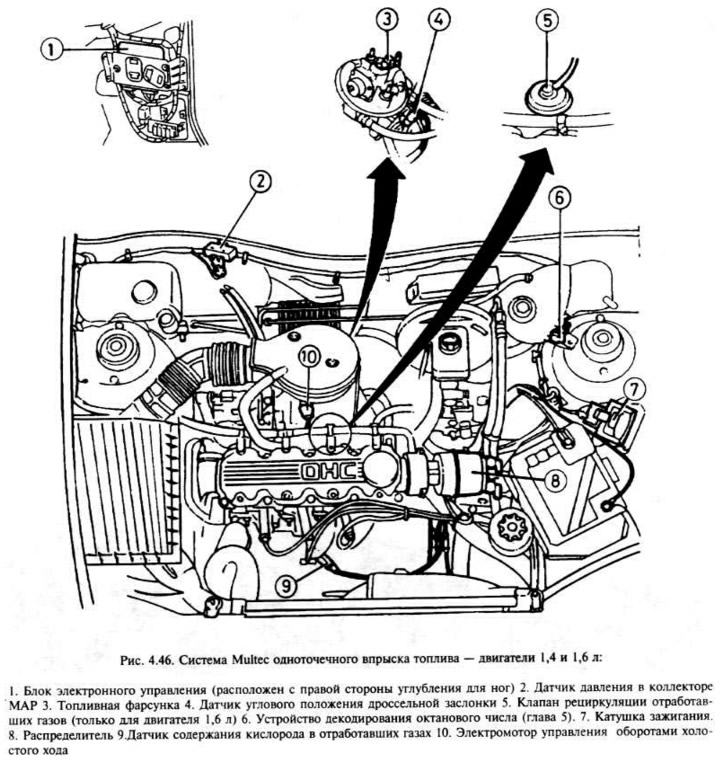
The fuel injection system consists of a throttle valve, an idle speed control motor, a throttle position sensor, fuel injectors and a pressure regulator.
The duration of the electrical pulse sent to the fuel injector determines the amount of fuel injected and is processed in the Multec Electronic Control Unit (ECU) based on information received from various sensors.
This includes the throttle position sensor, manifold pressure sensor, distributor (in 1.4 and 1.6 l engines provides information on the position/speed of the crankshaft), crankshaft position/speed sensor (1.8L engine only), coolant temperature sensor and exhaust gas oxygen sensor.
The idle speed is controlled by an electric motor, which regulates the amount of air passing through the throttle valve. The electric motor is controlled by an electronic control unit. The model is equipped with a catalytic converter.
Multec multi-point fuel injection system
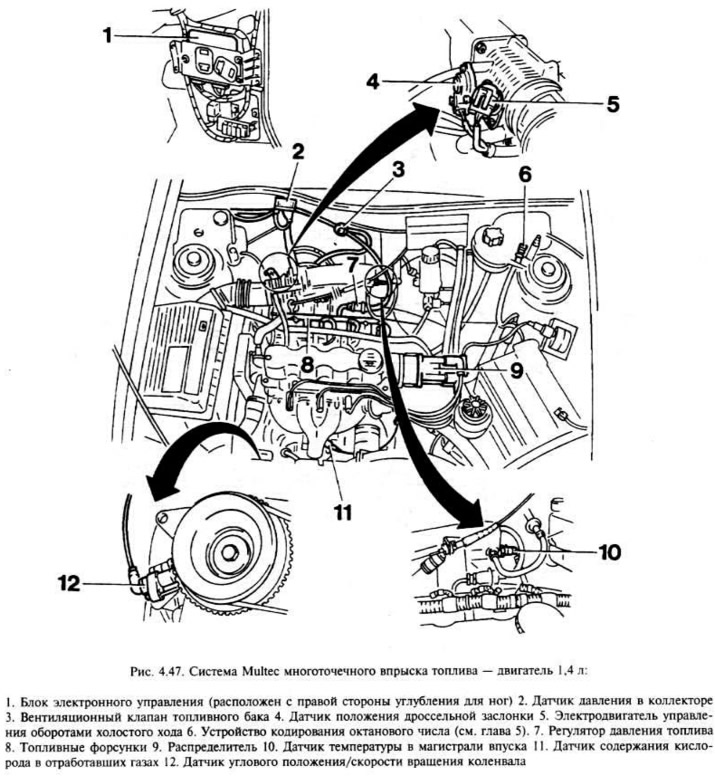
This system is under the overall control of the engine management system (chapter 5).
Fuel is supplied from the tank through a filter and pressure regulator to the fuel distributor (excess fuel is returned to the tank), which acts as a reservoir for all four fuel injectors, which operate in pairs(for cylinders NN 1 and 2 simultaneously, as well as for cylinders NN 3 and 4).
The duration of the electrical pulses going to the fuel injectors determines the amount of fuel supplied and is processed by the Multec unit (ECU) based on information received from various sensors.
The system components are shown in Figure 4.47.
Bosch Motronic fuel injection system
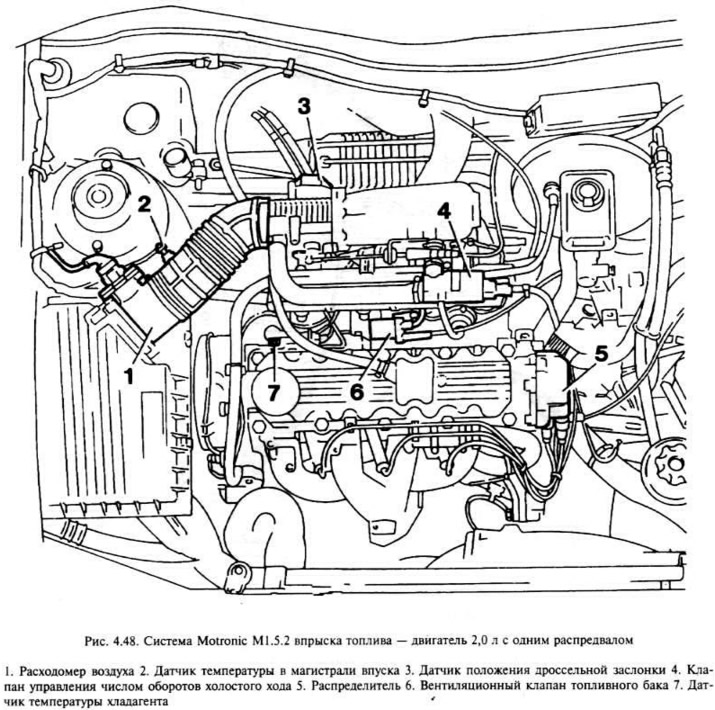
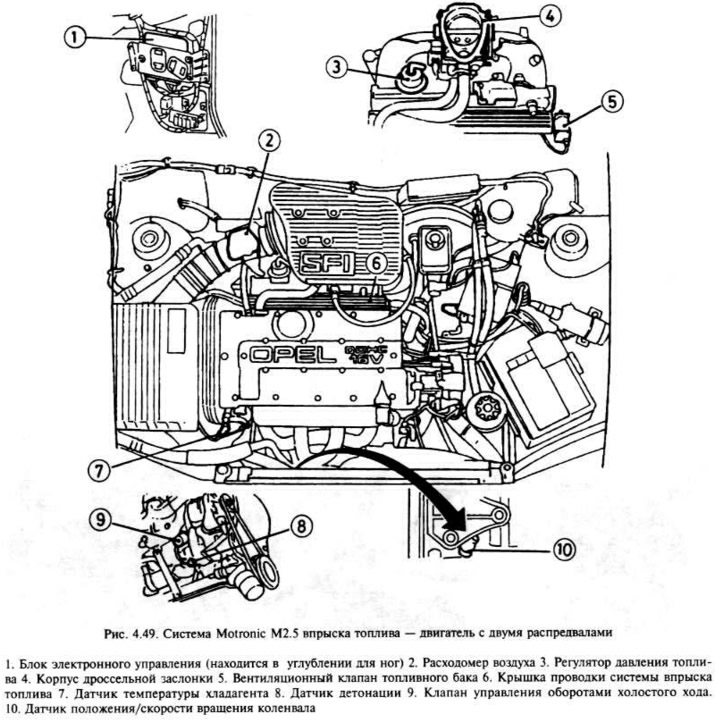
There are two versions of this system. The Motronic M1.5.2 system is used on engines with one camshaft, and the Motronic M2.5 on engines with two such shafts.
On engines with M1.5.2, the injectors receive 1 electrical pulse/1 crankshaft revolution, which simultaneously activates all four injectors. On engines with two camshafts, sequential fuel injection is used, so each injector receives a separate electrical pulse, which allows for more precise control of fuel supply to each cylinder.
[Source is on the website: OPELBOOK]
On engines with one camshaft, the incoming air flow is carried out by a thermoanemometer. The same system is installed on engines with two camshafts.
The models are equipped with a catalytic converter. All engines run on unleaded gasoline. Leaded gasoline cannot be used.
Fuel Injection System Components - Checking
Except for electrical systems testing (chapter 12) and ignition systems (chapter 5), individual components of the injection system are difficult to test under normal conditions.
In the event of a breakdown, most often the electronic engine control unit allows it to operate (using the data accumulation program), although with reduced efficiency and reduced drivability. Fault codes can be deciphered using special Vauxhall/Opel equipment.
If a defect appears (indicated on the instrument panel) and the cause cannot be immediately determined, a check should be carried out as indicated below.
Make sure the spark plugs are in good condition and properly gapped, the PCV hoses are not clogged or damaged, and the throttle cable is adjusted.
If the engine runs rough, check the compression (chapter 2) and keep in mind that one of the hydraulic valve lifters may be damaged.
If you suspect a clogged fuel injector, try a proprietary cleaner (which is usually added to the fuel tank) according to the manufacturer's instructions.
If the defect persists, check the ignition system components as described in chapter 5.
If necessary, check the entire system one by one, checking all fuses, wiring, vacuum hoses, damage, contamination, leaks and other defects.
After checking the system components for faults, take the vehicle to a Vauxhall/Opel service specialist for testing using specialist diagnostic equipment.
Do not test any parts, especially the electronic control unit, without the proper equipment, as this may result in costly component failure.
Visitor comments