


Contents: Throttle body ⬇ Removal ⬇ Installation ⬇ Fuel injectors ⬇ Removal ⬇ Installation ⬇ Fuel pressure regulator - removal…⬇ Throttle Position Sensor - Removal…⬇ Electric motor for simplifying idle…⬇ Manifold pressure sensor ⬇ Crankshaft Position/Speed Sensor -…⬇ Coolant temperature sensor ⬇ Intake Air Temperature Sensor -…⬇ Exhaust Gas Oxygen Sensor ⬇ Electronic control unit ⬇ Fuel Evaporative System Parts ⬇
Throttle body
Removal
Disconnect the negative battery terminal.
Loosen the screws securing the air duct to the throttle body and air cleaner cover, then remove the air duct.
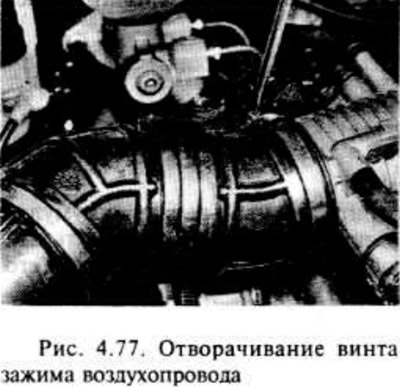
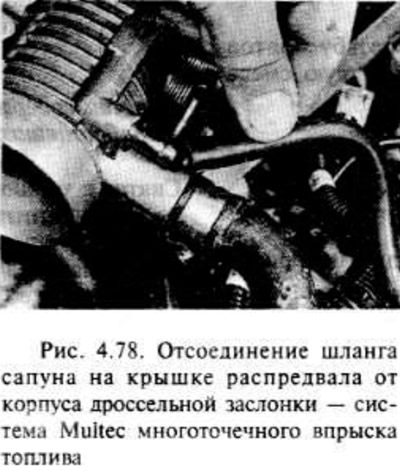
Disconnect the camshaft cover breather hoses from the throttle body.
Disconnect the fuel tank vent valve vacuum hose from the throttle body.
Disconnect the manifold pressure sensor vacuum hose from the throttle body.
Disconnect the coolant hoses from the throttle body. Possible fluid leakage requires precautions, clamp the hoses to prevent leakage.
Disconnect the electrical connector from the throttle position sensor and the idle speed control motor.
Article posted on Internet portal www.opelbook.ru
After loosening the clamp, remove the swivel joint at the end of the cable from the throttle lever.
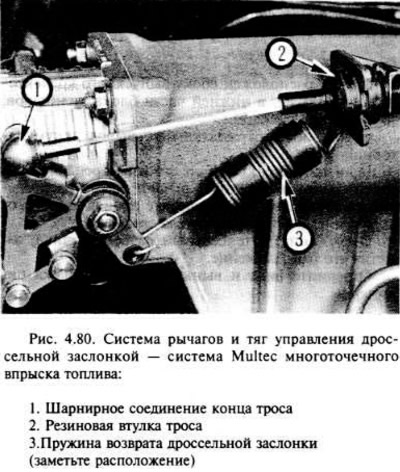
Remove the throttle cable bushing from the bracket located on the intake manifold, then unhook the throttle return spring hook from the bracket. If necessary, unhook the spring from the gasket in the throttle control system and set the spring aside (in this case it is necessary to note the location of the spring for its correct installation).
Check and make sure all hoses and wires are disconnected to allow removal of the throttle body.
Remove the four nuts and remove the throttle body from the intake manifold.
Remove the gasket.
If desired, the throttle position sensor and idle speed control motor can be removed from the throttle body as shown below.
Installation
Installation is carried out in the reverse order of removal, taking into account the following.
Where required, install the throttle position sensor and/or idle speed control motor as shown below.
Thoroughly clean the mating surfaces of the throttle body and intake manifold and install a new gasket.
Check that all hoses and wires are installed correctly.
Check the level and, if necessary, add refrigerant.
After completing the work, check and, if necessary, adjust the free play of the throttle cable.
Fuel injectors
Removal
Disconnect the negative battery terminal.
Place a rag under the fuel line nipple at the fuel pressure regulator and relieve pressure in the fuel system by slowly loosening the fuel line nipple. You will need two wrenches so that one can support the regulator while loosening the nipple. Fuel leaks are possible, so take fire prevention measures. After relieving pressure, tighten the nipple.
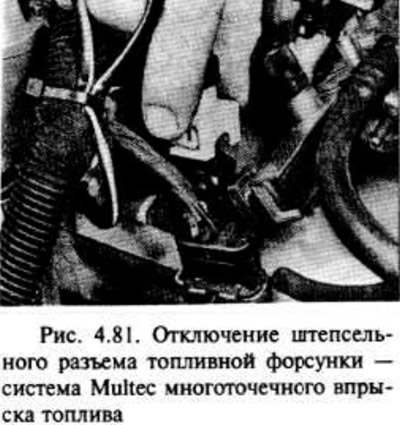
Disconnect the plug from the fuel injectors and move the wires to the side.
Disconnect the vacuum line from the fuel pressure regulator.
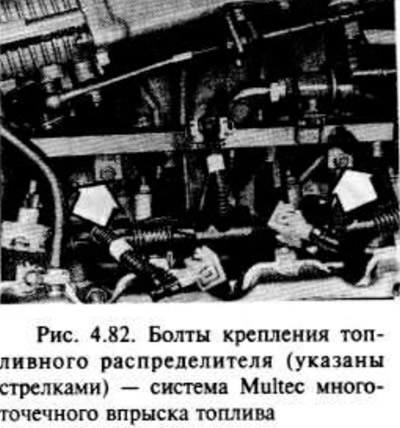
Remove the two fuel distributor mounting bolts, then lift it up with the injectors so that the injectors can be removed. Try not to stretch the fuel hoses. Fuel leakage is possible, take fire safety measures.
To remove the injectors from the fuel rail, pry out the metal clip with a screwdriver or pliers, then pull out the injector.
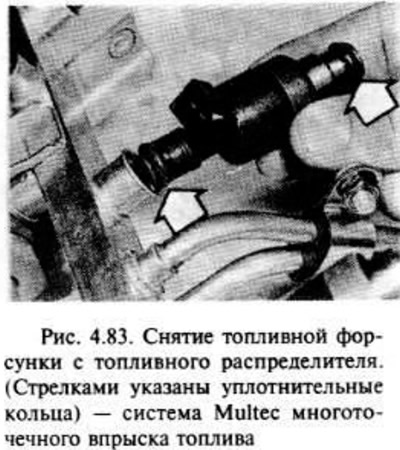
Fuel injectors cannot be repaired, there are no spare parts for them. If they are defective, they must be replaced with new ones.
If desired, the fuel rail assembly can be removed after the two hoses have been disconnected. The hoses are most easily accessed from underneath the vehicle. Note the location of the hoses before disconnecting them so that they can be reinstalled correctly.
Installation
Begin installation by replacing the gaskets with new ones on both ends of the fuel injector.
Installation is carried out in the reverse order of removal, but check that all tubes and wires are connected correctly.
Fuel pressure regulator - removal and installation
Disconnect the negative battery terminal.
Disconnect the vacuum hose from the pressure regulator.
Place a rag under the fuel line nipple on the pressure regulator, then release the pressure in the fuel system by slowly unscrewing the nipple. Fuel may leak, take fire safety measures. You will need two wrenches to hold the regulator with one of them. After the pressure has dropped, disconnect the fuel line from the regulator. Plug the line to prevent fuel leakage.
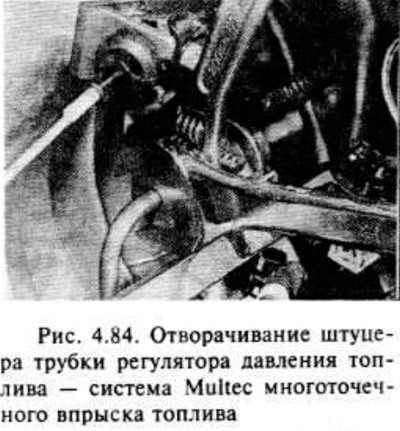
Loosen the bolt and remove the pressure regulator from the fuel line and fuel distributor.
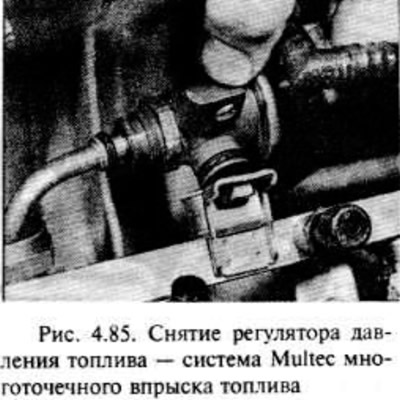
Installation is carried out in the reverse order of removal, however, it is necessary to use new sealing rings when connecting the regulator to the fuel line and distributor.
Throttle Position Sensor - Removal and Installation
Disconnect the negative battery terminal.
Release the clamps and disconnect the plug from the throttle position sensor.
Remove the three screws and remove the sensor from the throttle body.
Installation is carried out in the reverse order of removal, however it is necessary to ensure that the sliding contact of the sensor is correctly engaged with the throttle shaft and that the sensor is seated correctly in place.
Electric motor for simplifying idle speed - removal and installation
Disconnect the negative battery terminal.
Release the clamp and disconnect the plug from the idle speed control motor (see fig. 4.86).
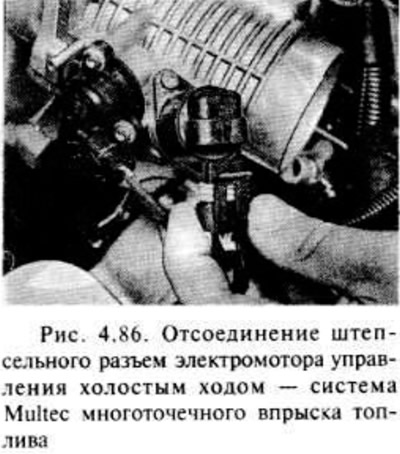
Remove the two screws and the electric motor. If necessary, remove the sealing ring.
Before installing the electric motor, check the condition of the sealing ring and replace it if necessary.
Installation is carried out in the reverse order of removal, but it is necessary to make sure that the sealing ring is installed correctly and the electric motor plug is facing downwards.
Manifold pressure sensor
The procedure for performing the work is the same as described in the previous section for engines with single-point fuel injection
Crankshaft Position/Speed Sensor - Removal and Installation
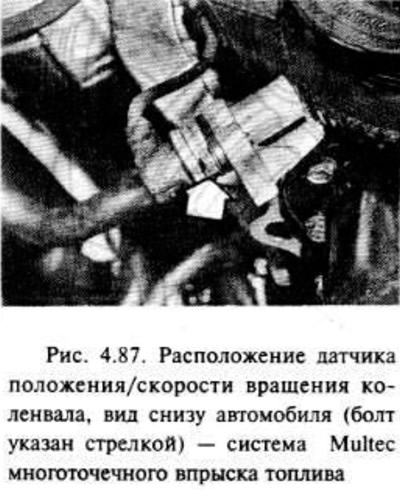
The sensor is located on the bracket of the lower part of the cylinder block, on the side of the engine intake manifold, next to the crankshaft pulley.
Disconnect the negative battery terminal.
Disconnect the sensor contact connector on the bracket located on the camshaft cover.
The easiest way to access the sensor is from underneath the vehicle. If desired, the vehicle can be lifted and secured with stands under the bridge.
Remove the screw and separate the sensor from the bracket. Note the wiring location to facilitate installation.
Check the condition of the sealing ring and replace it if necessary.
Installation is carried out in the reverse order of removal. Check that the wiring and connections are located correctly.
After finishing the work, check the gap between the working surface of the sensor and the gear sensor on the crankshaft pulley using a set of feeler gauges. The gap should correspond to the one specified in the specification. If the gap is not maintained, the bracket must be replaced, since adjustment in this case is impossible.
Coolant temperature sensor
The procedure is the same as in the previous section for single-point fuel injection engines. Note that the sensor is located on the left side of the cylinder head end face, under the distributor (or a coil) ignition.
Intake Air Temperature Sensor - Removal and Installation
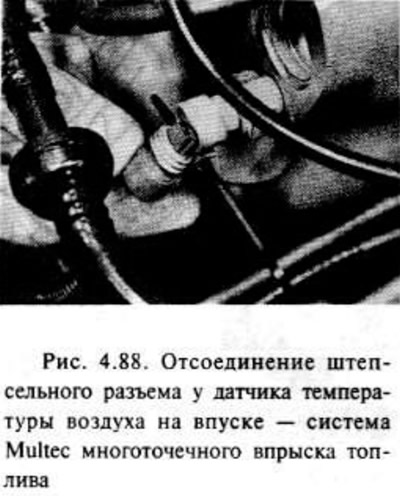
The sensor is located on the left side of the intake manifold receiver.
Disconnect the negative battery terminal.
Disconnect the sensor plug. Remove the sensor from the intake manifold. Installation is carried out in the reverse order of removal.
Exhaust Gas Oxygen Sensor
The procedure for performing the work is the same as described in the previous section for engines with single-point fuel injection.
Electronic control unit
The procedure is the same as in the previous section for single-point fuel injection engines. Remember that the control unit and program storage unit can be replaced separately.
Fuel Evaporative System Parts
See the relevant section in Part C of this chapter.
Visitor comments