


Contents: Throttle body ⬇ Installation ⬇ Fuel injectors ⬇ Removal ⬇ Installation ⬇ Fuel pressure regulator - removal…⬇ Air flow meter ⬇ Removal ⬇ Installation ⬇ Throttle position sensor ⬇ Idle Speed Control Valve - Removal…⬇ Crankshaft Position/Speed Sensor ⬇ Coolant temperature sensor ⬇ Incoming air temperature sensor ⬇ Exhaust Gas Oxygen Sensor ⬇ Electronic control unit ⬇ Fuel Evaporative System Components ⬇
Throttle body
Disconnect the negative battery terminal.
Loosen the clamp and disconnect the plug connector from the intake air temperature sensor. Do not pull on the wire while disconnecting.
Loosen the screws securing the air duct to the throttle body and air flow meter, then remove it.
Disconnect the idle air control valve hose from the throttle body.
Disconnect the camshaft cover breather hose from the throttle body.
Disconnect the fuel tank vent valve vacuum hose from the throttle body.
Disconnect the coolant hoses from the throttle body. Coolant may leak, so clamp the open ends of the hoses to prevent leakage.
Loosen the clamp and disconnect the plug from the throttle position sensor.
Loosen the clamp, then disconnect the swivel end of the cable from the throttle lever.
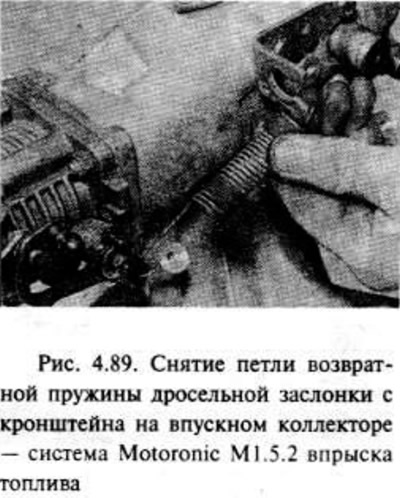
Remove the throttle cable bushing from the bracket located on the intake manifold, then unhook the throttle return spring hook from the bracket. If necessary, the spring can be unhooked from the bushing in the throttle control system, noting its location for easier assembly (Fig. 4.89).
[Article published on the website: OPELBOOK]
Make sure all hoses and wires are disconnected and will not interfere with removal of the throttle body.
Remove the four nuts and lift the throttle body out of the intake manifold. Access to the lower nuts may be restricted by the two fuel hoses and may need to be moved aside. Try not to put tension on the hoses.
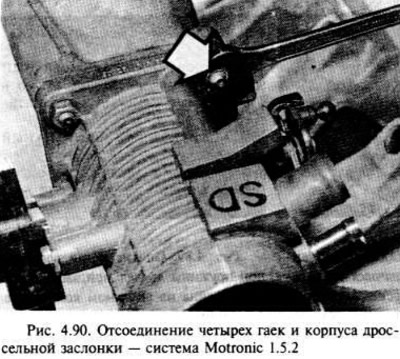
Remove the gasket.
If desired, the throttle position sensor can be removed from its housing as described in this section.
Installation
Installation is carried out in the reverse order of removal, taking into account the following.
Where required, install the throttle position sensor as shown below.
Thoroughly clean the mating surfaces of the throttle body and intake manifold and install the body with a new gasket.
Make sure all wires and hoses are connected correctly.
Check and, if necessary, top up the coolant to the correct level.
After completing the work, check and, if necessary, adjust the throttle cable free play as indicated earlier.
Fuel injectors
Note: During installation, it is necessary to replace the seals at both ends of the fuel injectors.
Removal
Disconnect the negative battery terminal.
Loosen the union nut and disconnect the brake servo vacuum hose from the intake manifold.
Remove the idle air control valve along with the hose as shown below.
Disconnect the fuel pressure regulator vacuum hose.
Disconnect the wiring harness from the fuel injectors and set it aside, being careful not to put tension on the wires. Pull the wiring harness and squeeze the contact clips to disconnect the wiring harness from the injectors.
Place a rag under the fuel pressure regulator. Then relieve the pressure in the fuel system by slowly loosening the screws that secure the fuel supply hose to the pressure regulator. Leakage possible, take fire safety measures.
Remove the four screws from the fuel rail mounting brackets to the intake manifold, then lift the rail and injectors up so that they can be removed. Try not to strain the fuel lines. Fuel leakage is possible, take fire safety precautions.
To remove the injector from the fuel distributor, use a screwdriver to remove the metal clip, then remove the injectors.
Fuel injectors cannot be repaired, there are no spare parts for them. A faulty unit must be replaced with a new one.
Installation
Installation begins with replacing the seals on both sides of the fuel injector.
Installation is carried out in the reverse order of removal, taking into account checking that all hoses, tubes and wires are installed correctly.
Fuel pressure regulator - removal and installation
Disconnect the negative battery terminal.
For better access, remove the idle air control valve as described later in this section, then disconnect the wiring harness from the fuel injectors and position it aside, being careful not to put tension on the wires. Pull on the wiring harness cover and squeeze the connector clamp to disconnect the wiring harness from the injectors.
Place a rag under the pressure regulator to absorb any fuel spilled from the disconnected regulator.
Slowly loosen the screws and disconnect the fuel hoses from the regulator. Leaks may occur, take fire safety precautions.
Disconnect the vacuum hose from the top of the regulator and remove the regulator.
Installation is carried out in the reverse order of removal.
Air flow meter
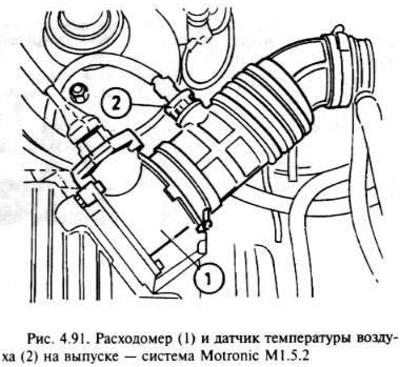
Note: When installing it, you will need to install a new seal and sealant will be required to cover the bolt threads.
Removal
Disconnect the negative battery terminal.
Loosen the clamp and disconnect the plug connector from the temperature sensor located in the pipeline. Do not pull on the wire when disconnecting.
Disconnect the plug from the air flow meter in the same manner.
Loosen the screws securing the air duct to the throttle body and air flow meter, then remove the air duct.
Remove the air cleaner cover together with the air flow meter as described earlier.
Remove the two bolts and the flow meter from the air cleaner cover. Remove the sealing ring.
Installation
Installation is the reverse of removal, however, a new sealing ring must be used when installing the flow meter on the air cleaner cover and the bolt threads must be coated with sealant.
Throttle position sensor
The operating procedure is as described in the previous section for Multec multi-point fuel injection engines, taking into account that the sensor is secured with two screws.
Idle Speed Control Valve - Removal and Installation
Disconnect the negative battery terminal.
Loosen the clamp and disconnect the plug from the idle speed control valve (Fig. 4.92).
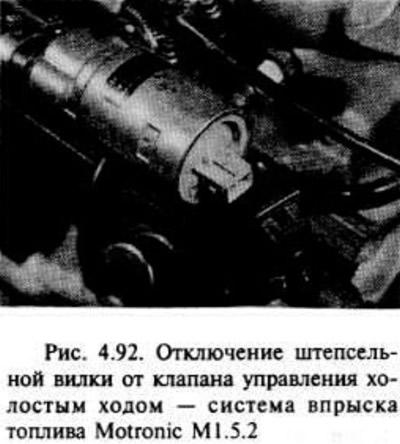
The valve can be removed together with its hoses or separately, leaving the hoses in place.
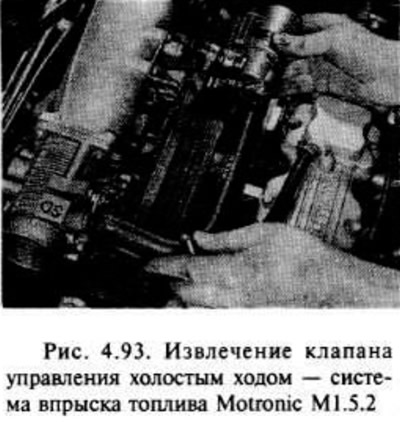
Loosen the clamp screws, then disconnect the hoses and remove the valve (Fig. 4.93).
Installation is carried out in the reverse order of removal.
Crankshaft Position/Speed Sensor
The order of execution of the work is as indicated earlier in the section "Multec Single Point Injection System Components" for 1.8 l engines.
Coolant temperature sensor
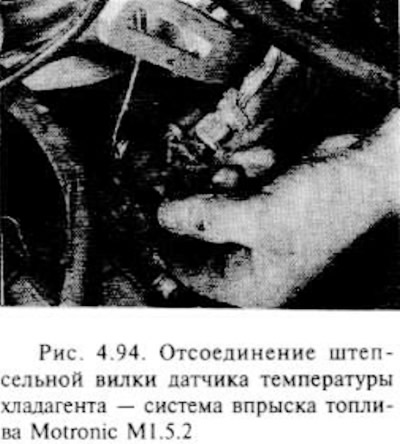
The order of work is as indicated in the section "Multec Single Point Injection System Components". However, please note that the sensor is located in the thermostat housing on the side of the engine on the intake manifold side, under the upper generator bracket (Fig. 4.94).
Incoming air temperature sensor
The order of work is as indicated in the section "Multec System Components" for engines with Multec multi-point fuel injection, but remember that the sensor is located in the air duct between the intake manifold and the flow meter. Try not to damage the air duct.
Exhaust Gas Oxygen Sensor
The order of work is as indicated in the section "Multec System Components" for engines with single-point fuel injection, but please note that the sensor is mounted in the front section of the exhaust tract and can be accessed from under the car. If desired, the front of the car can be raised, securely fastened to stands under the axle.
Electronic control unit
The order of work is as indicated in the section "Multec System Components" for engines with single-point fuel injection, not taking into account what applies to the main control unit and the program memory.
Fuel Evaporative System Components
See the last section in part "C" of this chapter.
Visitor comments