


Contents: Air box ⬇ Removal ⬇ Installation ⬇ Main throttle body ⬇ Removal ⬇ Installation ⬇ Casing of the neutron control unit…⬇ Fuel injectors ⬇ Removal ⬇ Installation ⬇ Fuel pressure regulator ⬇ Removal ⬇ Installation ⬇ Air flow meter - removal and…⬇ Throttle Position Sensor - Removal…⬇ Idle Speed Control Valve - Removal…⬇ Crankshaft Position/Speed Sensor ⬇ Coolant temperature sensor…⬇ Exhaust Gas Oxygen Sensor ⬇ Knock sensor - removal and…⬇ Electronic control unit ⬇ Fuel Evaporative System Components ⬇
Air box
Removal
Loosen the screw securing the air duct to the left side of the air flow meter.
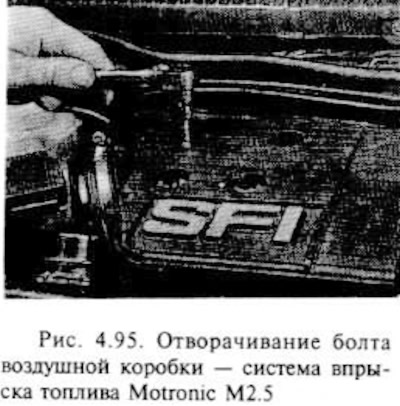
Using a socket wrench, unscrew the four bolts securing the air box to the throttle body (Fig. 4.95).
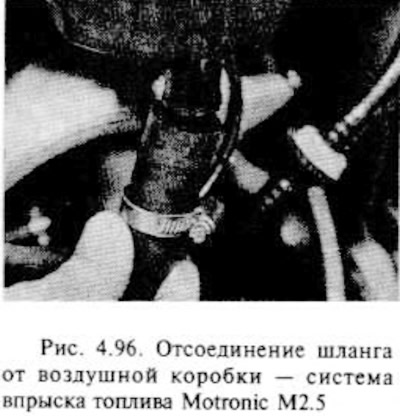
Remove the air box from the top of the throttle body and disconnect the hose from the base of the air box (Fig. 4.96).
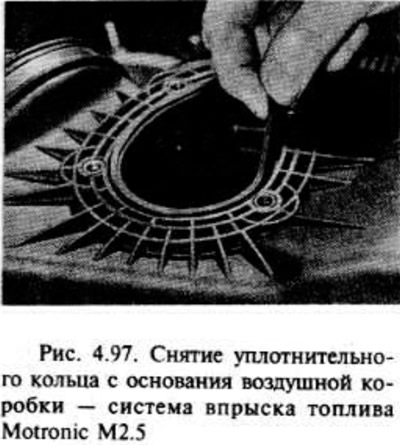
Remove the air box and remove the sealing ring from its base if it is not tightly seated on the surface (Fig. 4.97).
Installation
Before installation, remove the sealing ring from the airbox base if it has not already been removed.
Check the sealing ring and replace it if damaged or worn.
Thoroughly clean the sealing ring area in the air box, then lubricate the end face well with a suitable sealant (Vaushall/Opel N 15 04 851 or equivalent).
Install the sealing ring onto the air box, checking that it is installed correctly, then reassemble in the reverse order of removal.
Main throttle body
Removal
Disconnect the negative battery terminal.
Remove the air box/air flow meter assembly from the top of the throttle body as directed in this section.
Release the clamp and disconnect the plug connector from the throttle position sensor. When disconnecting, pull on the plug, not the wire.
Unscrew the nut and disconnect the fuel hose mounting bracket from the left side of the throttle body.
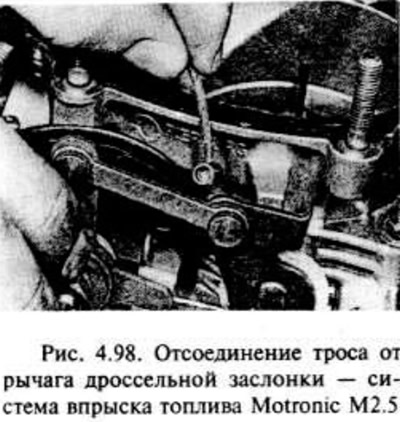
Disconnect the end of the cable from the throttle lever (Fig. 4.98).
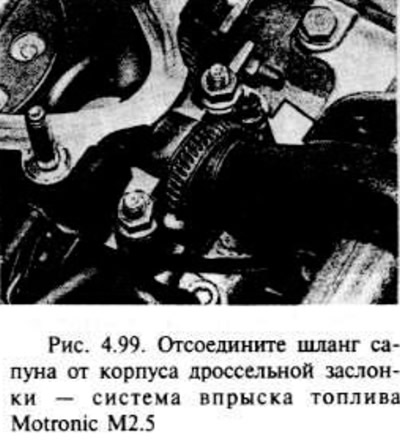
Disconnect the breather hose from the front of the throttle body (Fig. 4.99).
Make sure all hoses, tubes and wires are disconnected and positioned away from the throttle body.
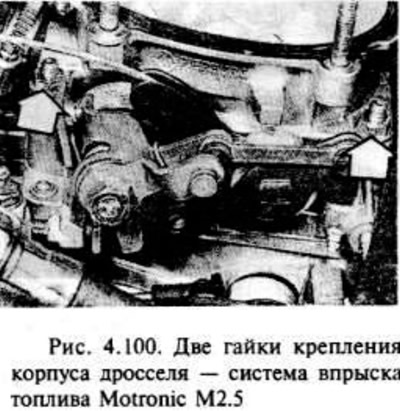
Remove the four nuts and the throttle body from the intake manifold. Remove the gasket (fig. 4.100).
If desired, you can remove the throttle position sensor from its housing as described in this section.
Under no circumstances should you attempt to adjust the throttle control levers and rods. If the system needs to be adjusted, please contact your Vauxhall/Opel car repair specialists.
Installation
Installation is carried out in the reverse order of removal, taking into account the following.
Before installing the throttle body, check the throttle position sensor adjustment as described below in the "Throttle Position Sensor" subsection.
Carefully remove dirt from the surface of the coupling of the throttle body with the casing of the electronic control unit for the traction control system (RTU) and install a new gasket.
Check that all hoses, lines and wires are connected correctly.
Install the air box as previously described.
At the end of the work, check and, if necessary, adjust the free play of the throttle cable as indicated earlier in the relevant section.
Casing of the neutron control unit of the RTU system
See the relevant section below.
Fuel injectors
Removal
Disconnect the negative battery terminal.
Remove the air box as described earlier.
Place a rag under one of the fuel hose fittings located on the fuel rail to absorb any leaking fuel.
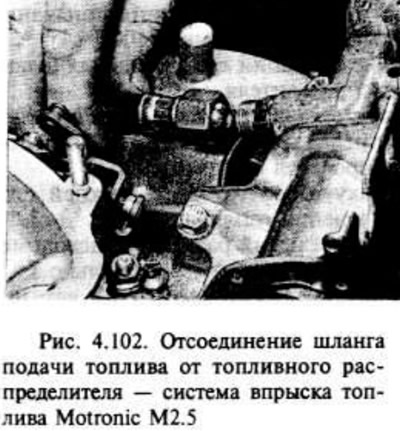
Slowly loosen the fuel line nipple to relieve pressure in the fuel line. Then disconnect the hose from the fuel rail. Fuel may leak, so take fire prevention measures. Clamp the end of the fuel hose to prevent dirt from entering and causing fuel leakage (fig. 4.102).
Repeat these operations for the remaining fuel distributor hoses.
Disconnect the two breather hoses from the back of the camshaft cover. Disconnect the large hose from the throttle body and remove.
Disconnect the vacuum line from the top of the fuel pressure regulator.
Disconnect the plug from the air flow meter and remove the sealing ring.
Disconnect the electrical connector from the throttle position sensor.
Disconnect the end of the cable from the throttle lever, then remove the cable bracket bolts from the intake manifold and move the bracket to the side.
Disconnect the wiring from the fuel injectors and lay it aside, being careful not to stretch the wires. Lift the wiring harness housing and squeeze the connector clamps to release the housing from the injectors.
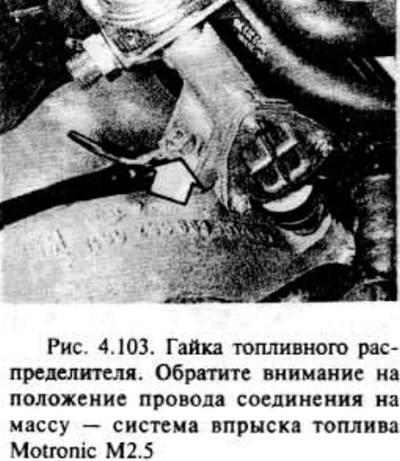
Unscrew the two fuel distributor mounting nuts and remove it and the injectors from the intake manifold. Note the position of the ground wires on the distributor studs (fig. 4.103).
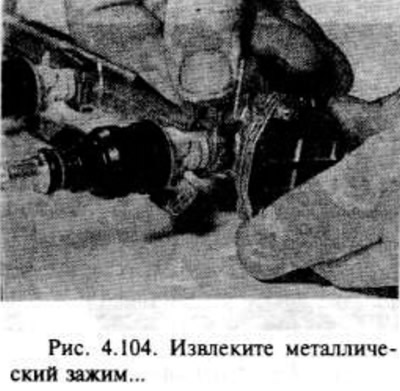
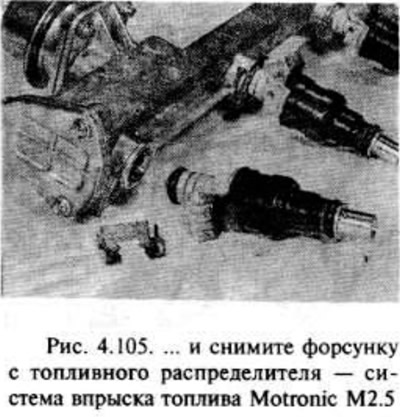
To remove the injector from the fuel distributor, remove its metal clamp and the injector itself (fig. 4.104, 4.105).
Installation
Begin installation by replacing the old seals with new ones on the ends of the fuel injectors.
Further installation is carried out in the reverse order of removal, taking into account the following.
Make sure all hoses, wires and tubes are connected properly.
Install the air box as previously described.
After completing the work, check and, if necessary, adjust the throttle cable free play as described earlier in the section "Throttle cable".
Fuel pressure regulator
Removal
Disconnect the negative battery terminal.
Remove the air box from the top of the throttle body as shown above.
Release the clamp and disconnect the plug connector from the air flow meter. When disconnecting, pull on the plug, not the wire. If necessary, remove the O-ring.
Release the clamp and disconnect the plug from the throttle position sensor.
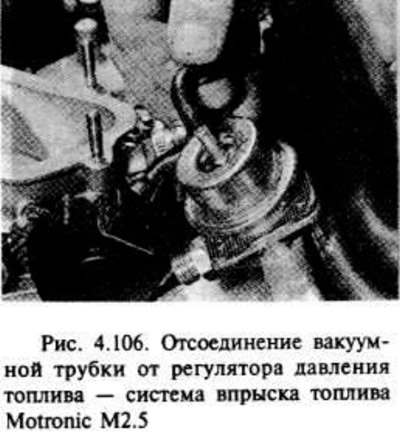
Disconnect the vacuum line from the top of the fuel pressure regulator (fig. 4.106).
Place a rag under the fuel line nipple located on the fuel distributor, then relieve the pressure in the fuel system by slowly loosening the nipple. Fuel may leak, so take fire safety measures. After the pressure has been relieved, tighten the nipple.
Place a rag under the regulator to absorb any leaking fuel while removing the regulator.
Using a wrench, loosen the Torg bolts (with a recess in the head), then remove the regulator. Due to possible fuel leakage, take fire safety measures
Installation
Installation is carried out in the reverse order of removal, taking into account the following.
Check that all wires, tubes and hoses are connected correctly.
Install the air box as previously described.
Air flow meter - removal and installation
Disconnect the negative battery terminal.
Release the clamp and disconnect the plug connector from the flow meter. Pull on the plug, not the wire. Remove the O-ring if necessary (fig. 4.107).
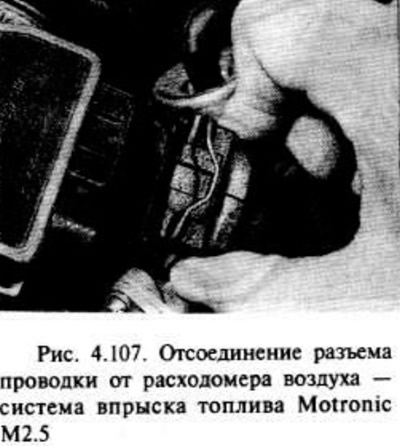
Disconnect the screws and wire harnesses from the flow meter, then remove it.
Installation is carried out in the reverse order of removal. Check the condition of the plug connector sealing ring and replace it if necessary.
Throttle Position Sensor - Removal and Installation
Disconnect the negative battery terminal.
Remove the air box and air flow meter as described earlier.
Release the clamp and disconnect the plug from the throttle position sensor (fig. 4.108).
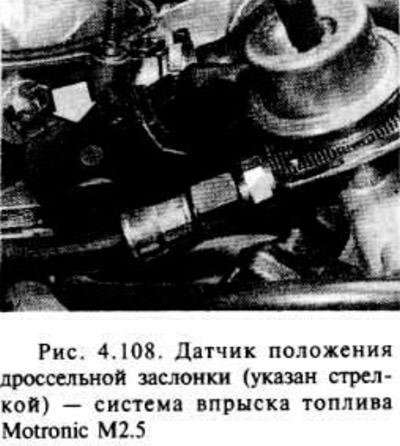
Remove the two screws and pull the sensor out of the throttle body.
Install the sensor, but before tightening the screws, adjust its position as follows.
Turn the sensor housing counterclockwise until it stops, then tighten the screws.
When the throttle valve opens, a characteristic click should be heard, which should be repeated when the valve closes.
If necessary, adjust the position of the sensor so that a click can be heard in it as soon as the throttle valve begins to open.
Install the air box as shown above.
Idle Speed Control Valve - Removal and Installation
Disconnect the negative battery terminal.
Loosen the clamp screw and disconnect the hose from under the air box located on the throttle body. Remove the clamp from the hose.
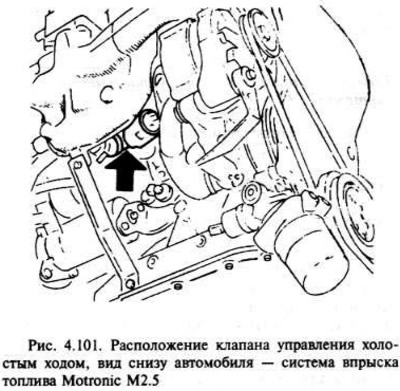
Apply the handbrake, then jack up the front of the car, supporting it securely with a stand under the axle.
Remove the lower engine splash shield as shown in chapter 11.
Working underneath the vehicle, disconnect the plug from the idle air control valve, which is located under the intake manifold above the starter (fig. 4.109).
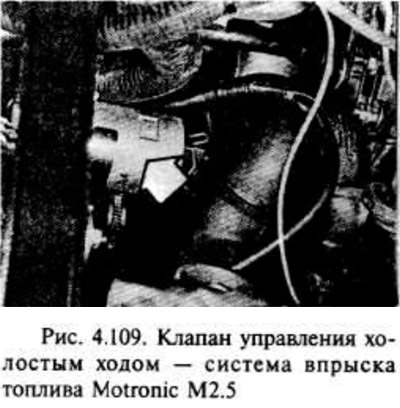
Loosen the clamp screw and disconnect the other end of the idle air control valve hose from the intake manifold, then move the valve down along with the hoses.
If the hoses need to be removed from the valve, mark their position before removing them so that they can be reinstalled correctly. Once the valve is installed, it is very difficult to reposition the hoses.
Installation is the reverse of removal, but make sure the valve is installed horizontally and the wires are routed above the coolant hose. If the wires are routed under this hose, the valve may tilt downwards, which in turn can cause the air hose to the intake manifold to become compressed or torn.
Crankshaft Position/Speed Sensor
Operating procedure: as specified in the section "Multec System Components" for engines with a working volume of 1.8 l.
Coolant temperature sensor (precipitating liquid)
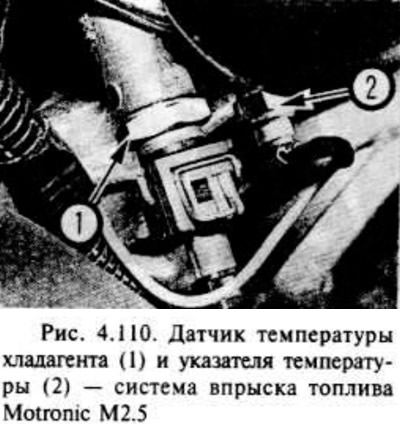
Operating procedure: as specified in the section "Multec System Components" for engines with single-point fuel injection, however, please note that the sensor is located in the thermostat housing on the exhaust manifold side of the engine (fig. 4.110).
Exhaust Gas Oxygen Sensor
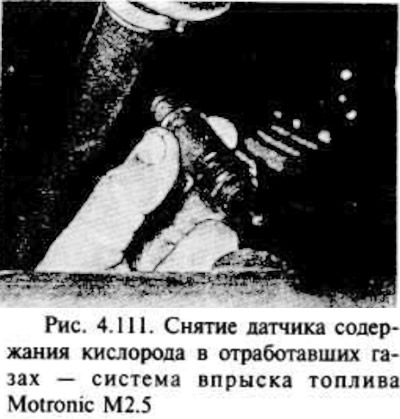
Operating procedure: as specified in the section "Multec System Components" for single-point fuel injection engines, but note that the sensor is located in the front section of the exhaust manifold and is accessible from underneath the vehicle after removing the lower engine mudguard hatch cover. If desired, raise the front of the vehicle by supporting it securely on a stand under the drive axle (fig. 4.111).
Knock sensor - removal and installation
The sensor is located on the underside of the cylinder block intake manifold below the idle air control valve and, unless the intake manifold is removed, can only be accessed from underneath the vehicle.
Disconnect the negative battery terminal.
Apply the handbrake, then use the jack to raise the front of the car, securely supporting it on a stand under the drive axle.
Remove the lower engine splash shield as shown in chapter 11.
Disconnect the sensor plug.
Loosen the bolt and remove the sensor from the cylinder block.
Installation is carried out in the reverse order of removal, but make sure that the sensor and its installation site are absolutely clean and that it is securely fastened. Failure to comply with these requirements may result in engine malfunction, since an incorrectly installed sensor will not register the occurrence of detonation and it will be impossible to adjust the ignition.
(Text was copied from the portal: OpelBook)
Electronic control unit
Operating procedure: as specified in the section "Multec System Components" for engines with single-point fuel injection, without taking into account the instructions regarding the main control unit and the program memory.
Fuel Evaporative System Components
See the relevant section in part "C" of this chapter.
Visitor comments