


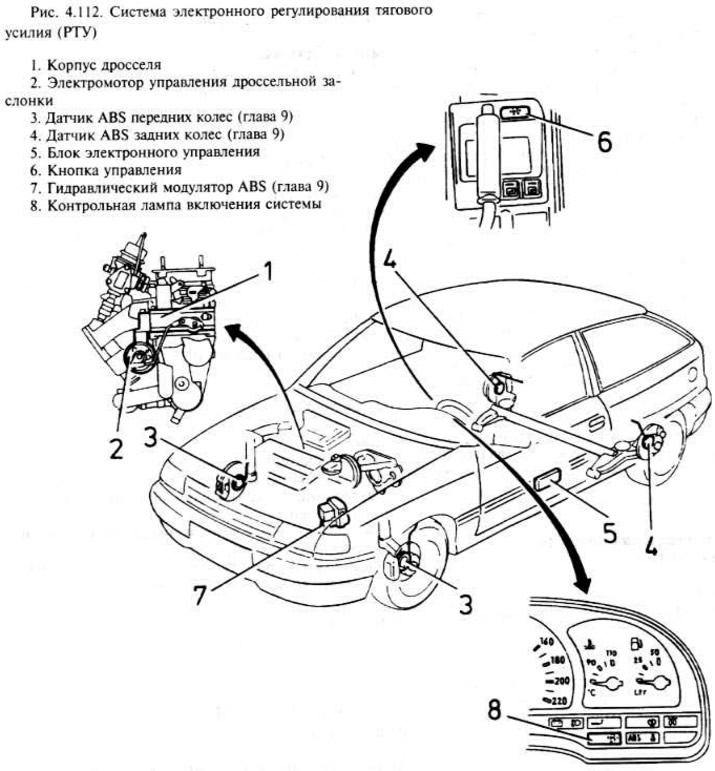
The electronic RTU system is installed on cars with engines with two camshafts and controls the force of adhesion to the ground of the drive wheels, thereby preventing wheel slippage regardless of the road or tire conditions. This is especially important when driving on slippery roads.
The RTU system is controlled by an electronic control unit that receives information from the electronic control units of the anti-lock braking system (ABS) and Motronic (engine). Four ABS sensors mounted on the wheels (chapter 9), constantly monitor the force of adhesion of the front wheels by comparing their rotation speeds with the speeds of the rear wheels. The corresponding signal is sent to the electronic control unit RTU, which activates the auxiliary throttle, reducing the speed (and torque) engine to the optimum level.
The throttle of the RTU system is installed in a housing located between the main throttle housing and the intake manifold. The throttle valve is driven by a control electric motor through a connecting rod. The control electric motor contains a potentiometer that supplies information to the RTU control unit about the position of the throttle valve.
If desired, this system can be switched off using a button on the central console. In some cases, this may be justified, for example, when driving a car in deep snow or on soft ground (sand).
Visitor comments