


Contents: Liquid crystal instrument cluster ⬇ Oil pressure gauge ⬇ Battery charge indicator ⬇ Coolant temperature gauge ⬇ Fuel level indicator ⬇ Speedometer and trip meters ⬇ Tachometer ⬇
Liquid crystal instrument cluster
Some vehicles use a combination of instruments with liquid crystal screens instead of pointer indicators and warning lights for oil pressure, battery charge and coolant temperature, which are arranged as follows:
- on the left side of the combination there are four screens, shown from top to bottom; oil pressure, battery charge, coolant temperature, fuel level;
- in the center of the combination there is a screen showing the speed of movement, the total mileage of the car in kilometers, the daily mileage of the car;
- on the right side of the combination there is a square screen showing the engine crankshaft speed in rpm.
When the ignition is turned on, an automatic check of the liquid crystal instruments is performed, the sectors and scales of which move from minimum to maximum readings within 2 seconds, which are displayed for the next 3 seconds. The speed indicator screen displays the number 125 for 2 seconds, then the number 228.
If the readings do not change in the specified sequence, this indicates a system malfunction. The automatic check of serviceability stops at the moment the engine is started.
Oil pressure gauge
The oil pressure gauge is located on the left at the top of the cluster. The indicator light comes on when the ignition is turned on and goes out when the engine speed exceeds idle.
Oil pressure is indicated by light strokes. When the oil pressure drops below the minimum permissible value, the control lamp starts to flash. In this case, it is necessary to immediately stop the engine, check the oil level and, if necessary, contact a service station
Battery charge indicator
This indicator is located under the oil pressure gauge screen.
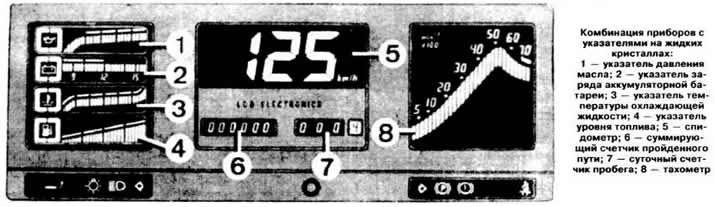
When the ignition is turned on, before starting the engine, the indicator lamp located on the left side of the screen lights up, and after starting the engine at idle, it goes out. Flashing of the lamp while the car is moving indicates the absence of charging current of the battery. Find the cause of the malfunction and, if necessary, urgently contact the service station.
The battery charging voltage is shown as light bars. When starting the engine, the voltage should not fall to the left of the red horizontal bar. When the car is moving, it should be to the right of the orange horizontal bar, i.e. above 12 V. When the charging voltage is above 15 V and below 9 V, the indicator lamp starts to flash.
Coolant temperature gauge
The third screen from the top on the left side of the instrument cluster is the coolant gauge.
The coolant temperature is shown as light bars that form three color sectors:
- blue sector cold or warm engine;
- orange sector: normal operating temperature of coolant;
- red sector: engine overheating.
Fuel level indicator
The lower screen on the left side of the instrument cluster serves as a fuel gauge
The fuel level is shown proportionally to the height of the light bars. When the leftmost sector lights up, the low fuel warning light also lights up.
Speedometer and trip meters
The digital speed indicator with readings from 7 to 250 km/h is located in the center of the instrument cluster. At speeds below 7 km/h, the readings are zero. Within the range from 7 to 60 m/h, the reading step is 1 km/h, and at speeds above 60 km/h, it is 2 km/h.
Below the speedometer are a trip meter (on the left) and a trip meter with a zero-setting knob.
Tachometer
3 on the right side of the instrument cluster is the tachometer screen. Depending on the engine crankshaft speed, the light strokes light up sequentially, forming a curve consisting of three sectors:
[Material copied from this resource: opelbook]
- yellow sector: normal engine mode;
- orange sector: short-term permissible mode, for example during fast overtaking;
- red sector: dangerous engine operating mode.
Below the screens on the left side of the instrument cluster are the control lamps (from left to right): trailer direction indicators (on some cars); turning on outdoor lighting; turning on high beam headlights; left turn signals.
Below the tachometer screen are control lamps (from left to right): right turn signals; parking brake engagement and brake fluid level (on some cars); unfastened seat belts (on some cars).
Visitor comments