


To perform the work, you will need a pressure gauge to check the fuel pressure with a set of adapters for fuel lines of foreign cars, preferably an inspection ditch or overpass.
Warning! Before performing the operation, be sure to read the section "Safety precautions for maintenance and repair of the engine management system".
Sequence of execution
1. Prepare the car for work (see "Preparing the car for maintenance and repair").
2. On 1.8 DOHC engines, remove the decorative engine cover (see "Engine trim panel - removal and installation").
3. Unscrew the protective cap of the diagnostic fitting on the fuel rail.
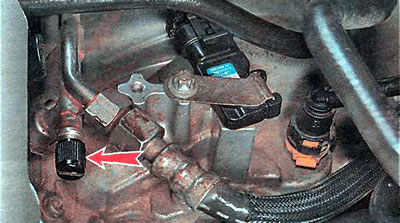
Engines 1.4 and 1.6 DOHC
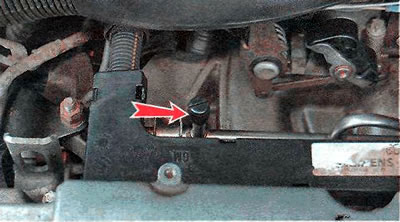
Engine 1.8 DOHC
4. Connect a special pressure gauge to the fitting on the fuel rail according to the operating instructions for the device.
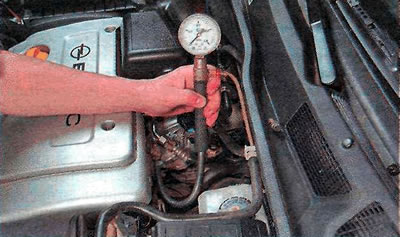
Engines 1.4 and 1.6 DOHC
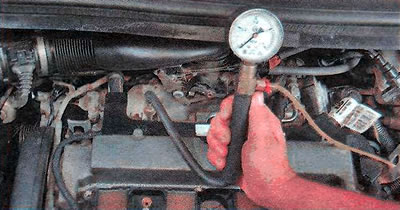
Engine 1.8 DOHC
5. Measure the fuel pressure according to the operating instructions for the device. The pressure should be within 300-380 kPa. The following malfunctions are possible.
Material copied from this portal (www.opelbook.ru)
Blood pressure is below normal (but not completely absent). The most probable causes are clogging of the fine or coarse fuel filter, fuel supply line, malfunction of the fuel pressure regulator or fuel pump. In this case, first blow out the fuel line with compressed air, having previously disconnected it from the fuel rail, fuel module (see "Fuel pump - check and replacement") and fuel filter (see "Fuel filter - replacement"). If the pressure does not return to normal, check the coarse fuel filter (see "Fuel pump - check and replacement"), replace the fuel filter (see "Fuel filter - replacement"). If the above steps did not help, then the fuel pump or pressure regulator is faulty. To determine which element is faulty, disconnect the return fuel line from the fuel module and insert, for example, a securely plugged nipple of the old fuel filter into it. Measure the pressure in the fuel rail again.
Warning! If the pressure exceeds 380 kPa, you must immediately turn off the ignition to avoid damaging the fuel lines! At the same time, this will indicate a malfunction of the fuel pressure regulator (see "Fuel Pressure Regulator - Checking and Replacing").
If the pressure does not increase, then the fuel pump is faulty (see "Fuel pump - check and replacement").
Note: There is another way to check the pressure regulator, but it requires removing the regulator (see "Fuel Pressure Regulator - Checking and Replacing").
The pressure is higher than normal. The most likely causes are: the return fuel line is clogged or the fuel pressure regulator is faulty. In this case, first blow out the return fuel line, having previously disconnected it from the fuel filter and fuel tank (you should blow from the fuel tank to the filter). If it doesn't help, check the regulator (see "Fuel Pressure Regulator - Checking and Replacing").
There is no pressure. If there is no pressure, the fuel pump or its electrical circuit is faulty (see "Fuel pump - check and replacement").
Visitor comments