


Checking the technical condition
1. Make sure there are no errors in the engine management system. The electronic control unit (ECU) of the engine management system has a self-diagnostic mode. When the ignition is turned on, the engine management system malfunction indicator lamp should light up (see "Controls and instruments"), which indicates that the diagnostic system is working properly. If the engine management system is working properly, the lamp should go out after the engine is started. During operation, the ECU monitors the serviceability of all elements and circuits of the engine management system. The use of a large number of information sensors allows for the most efficient operation of the engine, as well as increasing the reliability of the engine management system. In the event of failure of any of the sensors, the ECU will switch to the backup mode, which will result in deterioration of engine performance to a greater or lesser extent (see "Possible car malfunctions and their causes"), but will allow you to get to the repair site under your own power. In this case, the fault code is recorded in the ECU memory, and the engine management system fault indicator lamp lights up on the instrument panel. Before reading fault codes (see below, "Fault diagnostics"), we recommend that you perform the following operations to determine the technical condition. If faults are detected, they must be eliminated (see relevant sections). If no faults are detected during the technical condition check, further fault diagnostics must be carried out.
Note: Engine malfunctions are not always accompanied by the glow of the control system malfunction indicator lamp and vice versa.
2. Check the reliability of the connections of the connectors of the engine control system elements (for the arrangement of elements read above).
3. Check the integrity of the wiring harnesses in the underhood space.
Material provided by this website: opelbook
4. Check all air supply and vacuum hoses for cracks, kinks and tightness of their connections.
5. Check the high-voltage tips of the ignition module (see "Ignition module for 1.4 and 1.6 DOHC engines - checking and replacement" or "1.8 DOHC Engine Ignition Module - Checking and Replacing"),
6. Check for the absence of odor and traces of fuel leaks.
Note: Further checks are necessary if the engine does not start.
7. Check fuse Ef6 (see "Fuse and relay mounting blocks"). If the fuse is intact or burns out again after replacement, there is a short circuit in the engine control system circuit, it must be eliminated (see "Checking and repairing electrical circuits").
8. Check relay E4 (see "Fuse and relay mounting blocks" and "Checking the relay"). We replace the faulty relay. If the relay is working properly, then the engine control system circuit is faulty (see "Checking and repairing electrical circuits").
9. Turn off the ignition for at least 10 seconds. Then turn on the ignition and listen to the operation of the fuel pump: after turning on the ignition, it should work for about two seconds.
Note: The fuel pump makes a soft humming sound when in operation, and in order to hear it, you need to minimize any extraneous noise (turn off the audio system, raise the door windows, etc.)
If this does not happen, it is necessary to check the fuel pump (see "Fuel pump - check and replacement").
Troubleshooting
1. When the engine management system malfunction indicator lamp lights up with the engine running, the diagnostic code can be used to determine the cause of the malfunction. To read the malfunction codes, an external diagnostic device, a scanner, must be connected to the engine management system. To connect the scanner, the vehicle has a diagnostic connector located in the floor tunnel trim next to the gearshift lever of vehicles with a manual transmission or the mode selector of an automatic transmission.
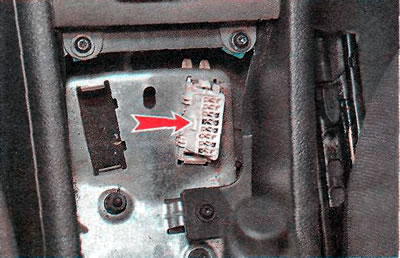
Astra
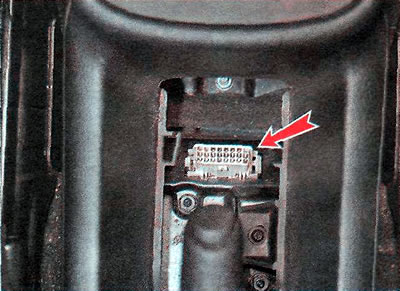
Zafira
To access it, you need to remove the decorative trim of the floor tunnel (see "Parking brake system drive lever - replacement") and remove the protective cover from the connector.
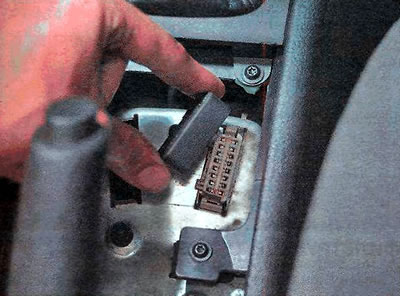
You can read the fault codes at a service center that has the necessary equipment. Depending on the fault code, we check the corresponding elements of the control system and their electrical circuits (see relevant sections).
If the malfunction indicator lamp goes out after the engine is started but the engine runs unsteadily, further operations are required.
2. Check the spark plugs (see "Spark plugs - checking and replacing").
3. Check the operating pressure in the fuel rail (see "Fuel pump - checking operating pressure and troubleshooting").
4. We assess the technical condition of the engine (see "Engine - technical condition check").
Visitor comments