
OpelBook.ru
Cars AvtoVAZ Cars Mitsubishi Cars BMW Cars Mercedes Cars Nissan Cars Toyota Cars Chevrolet
English Русский
Български
Беларускі
Український
Српски
Hrvatski
Română
Polski
Slovenský
Magyar
 |  Sitemap  |  Contacts  |    


Main Astra Corsa Insignia Kadett Omega Vectra Zafira Others Articles
Vectra A (1988-1995, petrol) Vectra A (1988-1995) Vectra B (1995-2002, petrol) Vectra B (1995-2002) Vectra C (2002-2008)
  • Main
  • Vectra
  • Vectra A
  • Chassis
  • Brake system
  • Removal and installation rear brake discs (all-wheel drive vehicles)

Removal and installation rear brake discs (all-wheel drive vehicles) (Opel Vectra A)

            0

Contents: Removal ⬇ Installation ⬇

Removal


Mark the position of the rear wheels relative to the hub so that the balanced wheels take their original position when installed. To mark, it is enough to make a stroke with chalk or paint on the disk and hub.

Raise the rear of the car and remove the wheels.

Release the parking brake.

Remove the brake pads.
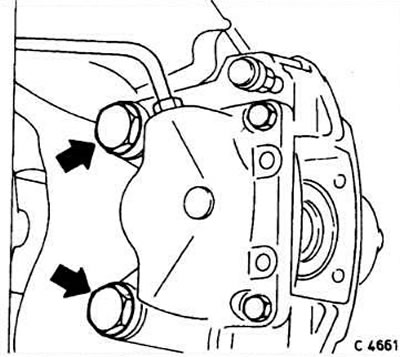
Remove the brake pads.


Remove the brake caliper.
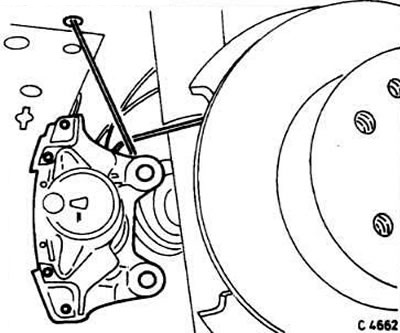
Remove the brake caliper.


Hang the brake caliper on the wire hook without twisting or pulling on the brake hose.

Caution! Do not disconnect the hose, otherwise you will have to bleed the brake system later.
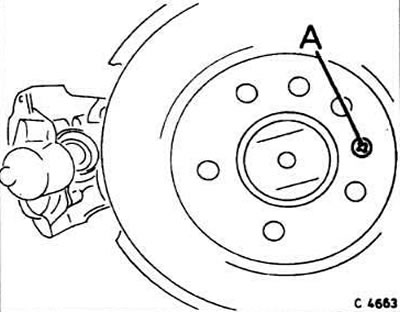

Caution! Do not disconnect the hose, otherwise you will have to bleed the brake system later.


Remove the locking screw from the hub.


Remove the brake disc.

Installation


To ensure uniform braking on both sides, both brake discs must be of the same thickness and have surfaces with the same roughness. Therefore, it is necessary to replace or grind both discs.

The brake disc runout can be checked in the workshop. The maximum permissible axial runout measured on the working surface is 0.03 mm on the removed disc and 0.1 mm on the installed disc. The maximum permissible roughness is 0.4 mm, and the permissible difference in thickness between discs is 0.1 mm.

Measure the thickness of the brake disc.
Measure the thickness of the brake disc.


Clean the parking brake shoes and brake caliper as much as possible.

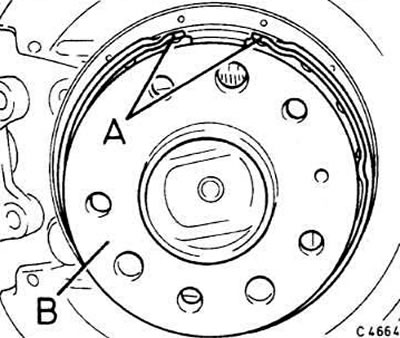
Check the wear of the brake pads A of the parking brake, replace the pads if necessary.

Remove traces of corrosion (if any) from the brake disc flange and hub B.

Clean new brake discs with solvent.

Clean the threaded hole of the fixing bolt, using a tap if necessary. Coat the fixing bolt with sealant, for example, Opel 1510177.

Place the brake disc on the hub and tighten to a torque of 8 Nm.

Secure the brake caliper to the lever with a torque of 80 Nm.

Install the brake pads.


Install the wheels, lower the vehicle and tighten the wheel bolts crosswise to 110 Nm.

Attention! Press the brake pedal several times until resistance appears.


Turn the steering wheel so that the caliper comes out.

Check the brake fluid level in the reservoir, if necessary, top up the fluid to the "MAX" mark.

Front wheel drive cars
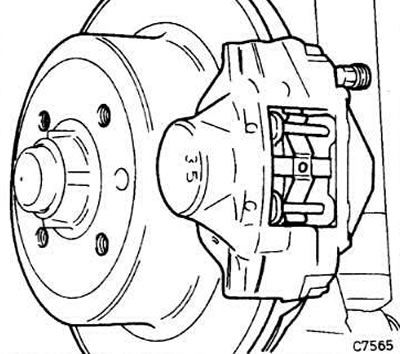


Front wheel drive cars


In principle, the brake discs are removed in the same way. Special instructions for removing the hub are given in the chapter "Rear suspension" in the section "Removal and installation rear wheel hub bearings".


This article is available at russian, bulgarian, belarusian, ukrainian, serbian, croatian, romanian, polish, slovak, hungarian
Checking the article: Zinoviev Kirill

Share information:

Previous articles
Opel Vectra A: Brake system
Next articles

Removal and installation front brake discs
Checking the thickness of brake discs
Making a brake piston template
Removal and installation rear disc brake pads
Brake calipers with pin-mounted pads
Removal and installation front disc brake pads
Removal and installation brake calipers
Removal and installation rear brake drums
Removal and installation brake shoes for drum brakes
Replacing brake linings of drum brakes
Removal and installation rear wheel brake cylinders
Brake fluid


See similar ones from other Opel car manuals:
▶ Rear Brake Wheel Cylinder — Removal, Repair and Installation Opel Astra F (1991-1998, petrol)
▶ Pressure regulator valve in the hydraulic circuits of the… Opel Corsa B (1993-2000)
▶ Checking the technical condition of the rear brake discs Opel Insignia A (2008-2017)
▶ Removal and installation of the wheel cylinder of the rear… Opel Kadett E (1984-1995)
▶ Rear wheel brake caliper — removal, overhaul and… Opel Omega B2 (1999-2003)
Link to this page in different formats

Visitor comments


No comments yet


How much will 21 + 30 =


Vectra C (2002-2008) 
  • General information
  • User manual
  • Vehicle device
  • Maintenance
  • Troubleshooting
  • Power unit
  • Engine repair
  • Cooling system
  • Power and control system
  • Engine electrics
  • Transmission
  • Clutch
  • Car gearbox
  • Drive shafts
  • Chassis
  • Car suspension
  • Steering
  • Brake system
  • Body
  • Exterior
  • Interior
  • Doors, locks and windows
  • Heating and ventilation
  • Electrical equipment
  • Equipment and devices
  • Headlights and lighting
  • Electrical circuits
Vectra B (1995-2002) 
  • General information
  • User manual
  • Weekly checks
  • Maintenance (gasoline)
  • Maintenance (diesel)
  • Troubleshooting
  • Power unit
  • SOHC gasoline engine
  • DOHC petrol engine
  • Diesel engine 1.7 liter
  • Diesel engine 2.0 liters
  • Engine repair
  • Cooling system
  • Fuel system (gasoline)
  • Fuel system (diesel)
  • Charging system
  • Launch system
  • Ignition and preheat
  • Transmission
  • Clutch
  • Mechanical gearbox
  • Automatic gearbox
  • Drive shafts
  • Chassis
  • Brake system
  • Wheel suspension
  • Steering
  • Body
  • Exterior
  • Interior
  • Doors and windows
  • Heating and ventilation
  • Electrical equipment
  • Equipment and devices
  • Electrical circuits
Vectra B (1995-2002, petrol) 
  • General information
  • Maintenance
  • Help with malfunctions
  • Power unit
  • Engine repair
  • Exhaust system
  • Cooling system
  • Fuel system
  • Multec injection system
  • Four point injection
  • Transmission
  • Clutch
  • Gearbox and drive
  • Chassis
  • Wheel suspension
  • Steering
  • Brake system
  • Wheels and tires
  • Body
  • Exterior
  • Interior
  • Electrical equipment
  • Fuses and electronics
  • Power devices
  • Ignition system
  • Lighting and signaling
  • Equipment and devices
  • Heating and ventilation
  • Electrical circuits
Vectra A (1988-1995) 
  • Power unit
  • Engine repair
  • Ignition system
  • Lubrication system
  • Cooling system
  • Injection system
  • Fuel system (carburetor)
  • Fuel system (diesel)
  • Exhaust system
  • Transmission
  • Clutch
  • Car gearbox
  • Chassis
  • Front suspension
  • Rear suspension
  • Steering
  • Brake system
  • Wheels and tires
  • Body
  • Exterior
  • Interior
  • Electrical equipment
  • Electrical circuits
Vectra A (1988-1995, petrol) 
  • General information
  • User manual
  • Maintenance
  • Power unit
  • SOHC engine
  • DOHC engine
  • Cooling and ventilation
  • Fuel system (carburetor)
  • Fuel system (injector)
  • Exhaust converter
  • Transmission
  • Clutch
  • Mechanical gearbox
  • Automatic gearbox
  • Drive shafts
  • Chassis
  • Brake system
  • Car suspension
  • Steering
  • Body
  • Body elements
  • Electrical equipment
  • Power devices
  • Equipment and devices
  • Electrical circuits
OpelBook.ru © 2017–2026 · Mobile version · · Sitemap: EN BG BY UA RS HR RO PL SK HU · Feedback · Site search
Astra F, petrol · Astra G, petrol · Astra G · Astra H · Astra J, petrol · Corsa B · Corsa C, petrol · Corsa C · Insignia A · Kadett D · Kadett E · Omega A · Omega B · Omega B2 · Vectra A, petrol · Vectra A · Vectra B, petrol · Vectra B · Vectra C · Zafira A, petrol · Frontera A, petrol · Frontera B · Ascona C · Vivaro A ·
We want your visit to be comfortable 🤝! We use cookies 🍪 to make that happen.