


Contents: Removal ⬇ Installation ⬇
Attention! There are different types of brake calipers. Depending on the design, the brake pads are either secured with springs or pins. Below is a description of how to remove and install pads for calipers with spring-type pad fastening. At the end of the section is a description of how to remove and install pads for calipers with pin-type pad fastening.
Removal
Mark the position of the front wheels relative to the hub so that the balanced wheels take their original position when installed. For marking, it is enough to make a stroke with chalk or paint on the disk and hub.
Loosen the front wheel mounting bolts, raise the front of the vehicle, and remove the wheels.
Important! If the brake pads are to be reused, they must be marked before removal. Do not swap the pads from the outer to the inner side and vice versa, or from the right to the left wheel. This may result in uneven braking. It is strongly recommended to use only genuine Opel brake pads. It is essential to replace all front disc brake pads at the same time, even if only one has reached the wear limit.
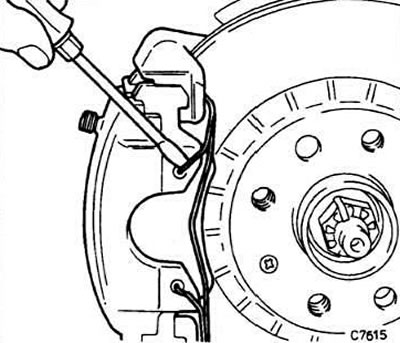
Use a screwdriver to pry the bracket away from the brake caliper.
Use a screwdriver to pry the two caps off the guide bolts.
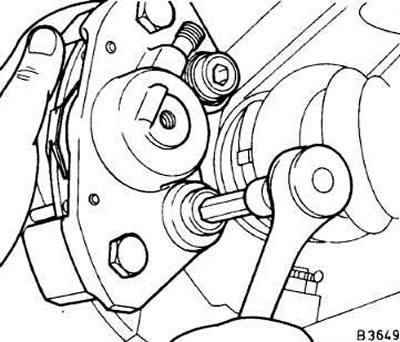
Loosen and remove the guide bolts with an Allen key.
Attention! Leave the brake hose connected, otherwise you will have to bleed the brake system later.
Remove the brake caliper housing with the inner brake shoe and hang it on a wire hook. Do not twist or stretch the brake hose.
Remove the outer brake shoe.
Press the inner brake shoe away from the piston. The shoe is attached to the piston with a bracket.
Installation
Caution! When the brake pads are removed, do not press the brake pedal, otherwise the piston will fly out of the housing.
Clean the guide surfaces and the pad mounting areas in the housing with a soft metal bristle brush or wash with a cloth soaked in alcohol. Do not use any solvents containing mineral oils or sharp tools.
Before installing the pads, check the brake disc by hand for grooves. If necessary, the discs can be turned if they are thick enough.
Measure the thickness of the brake discs.
Check the boot for ruptures. Replace a damaged boot immediately, as penetrating dirt will quickly cause the caliper to lose its seal.
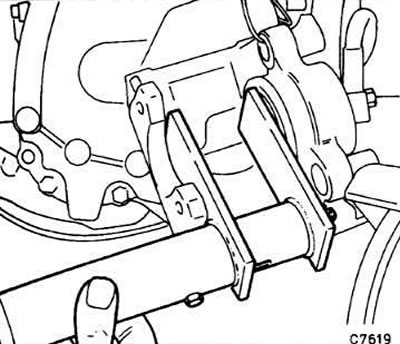
Press the piston with a pressing device. If there is no device, this can be done with a rod made of hard wood, paying attention to the fact that there is no distortion and so as not to damage the surface of the piston and dust cover.
Attention! When the piston is pressed, the brake fluid is squeezed out of the brake cylinders into the reservoir. Monitor the fluid level in the reservoir, pump out the excess if necessary.
When pumping out, use a plastic bottle that is used only for brake fluid. Do not use beverage bottles!
Warning! Brake fluid is poisonous! Never suck it out through the hose with your mouth!
After replacing the pads, the brake fluid level in the reservoir should not exceed the "MAX" mark, since the fluid expands when heated. Leaking brake fluid gets on the main brake cylinder, destroys the paintwork and causes corrosion.
Attention! If the pads are heavily worn, check the ease of movement of the piston by inserting a wooden block into the caliper and asking an assistant to slowly press the brake pedal. The piston should move easily. For comparison, install another brake caliper. Make sure that the piston does not jump out of the caliper. If movement is difficult, repair the piston.
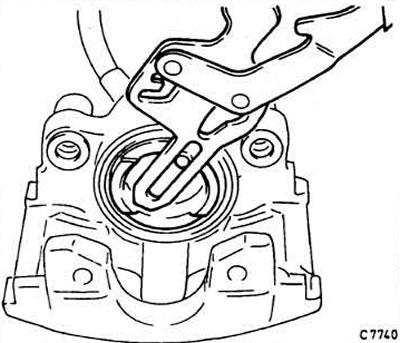
Check the correct position of the piston (the tides must be horizontal). If necessary, adjust the position using the piston rotation collet. Usually no adjustment is required.
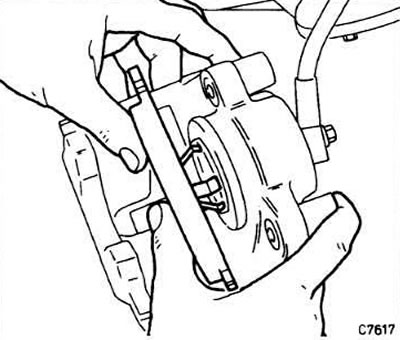
Insert the inner brake shoe with the spring into the piston.
Insert the outer brake shoe. Install the brake caliper body above the brake disc from above into the brake shield guide.
Tilt the caliper body down and press. Lubricate the cleaned dry guide bolt with a special paste (for example, Loctite 262) and tighten to a torque of 30 Nm.
Install the guide bolt caps. Insert the retaining clip into the brake caliper.
Install the wheels. Lower the vehicle and tighten the wheel bolts crosswise to 90 Nm.
Caution! Press the brake pedal hard several times until you feel strong resistance. This will ensure that the pads are seated correctly.
Check the fluid level in the tank, if necessary, add fluid up to the "MAX" mark.
Allow the new pads to work in by braking the car several times with light pressure on the pedal from 80 km/h to 40 km/h. Allow the brakes to cool down between these movements.
Attention! Avoid sudden braking during the first 200 km.
Visitor comments