


Contents: Removal ⬇ Installation ⬇
Removal
Mark the position of the rear wheels relative to the hub so that the balanced wheels take their original position when installed. To mark, it is enough to make a stroke with chalk or paint on the disk and hub.
Raise the rear of the car and remove the rear wheels.
Release the parking brake.
Loosen the brake drum fixing bolt.
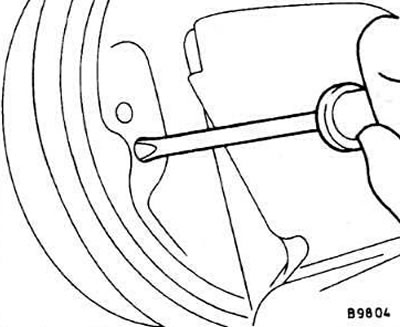
If the drum is worn out, remove the plug from the rear of the brake shield and use a screwdriver to press the parking brake shoe lever until it fits into the brake shoe groove. Remove the drum.
If necessary, disconnect the parking brake cable.
The drum can also be removed by lightly tapping it with a plastic hammer.
Installation
To ensure uniform braking, both drums must have the same dimensions and working surfaces with the same roughness. Therefore, both brake drums must be replaced or reamed at the same time.
Before installation, check the working surface of the drum by hand. The depth of scratches should not exceed 0.4 mm, otherwise bore the drum, and then install brake pads of increased thickness (5.6 mm).
Remove any traces of corrosion (if any) from the drum flange.
Clean the threaded hole of the fixing bolt, using a tap if necessary. Coat the fixing bolt with sealant (for example, Opel 1510177).
Place the drum on the hub so that the hole for the locking bolt aligns with the hole in the hub.
Tighten the fixing bolt to 4 Nm.
Lightly lubricate the hub flange with bearing grease.
Install the wheels, lower the vehicle and tighten the wheel bolts crosswise to 110 Nm.
Attention! Press the brake pedal several times, thereby setting the gap of the parking brake shoes. You need to press it at least 15 times until the sound from the setting lever disappears.
Check the brake fluid level in the reservoir, if necessary, top up the fluid to the "MAX" mark.
Visitor comments