
OpelBook.ru
Cars AvtoVAZ Cars Mitsubishi Cars BMW Cars Mercedes Cars Nissan Cars Toyota Cars Chevrolet
English Русский
Български
Беларускі
Український
Српски
Hrvatski
Română
Polski
Slovenský
Magyar
 |  Sitemap  |  Contacts  |    


Main Astra Corsa Insignia Kadett Omega Vectra Zafira Others Articles
Vectra A (1988-1995, petrol) Vectra A (1988-1995) Vectra B (1995-2002, petrol) Vectra B (1995-2002) Vectra C (2002-2008)
  • Main
  • Vectra
  • Vectra A
  • Chassis
  • Brake system
  • Anti-lock braking system (ABS)

Anti-lock braking system (ABS) (Opel Vectra A)

            0

Some Opel Vectra/Calibra vehicles are equipped with Bosch anti-lock braking systems. It is not possible to install ABS on vehicles not equipped with it.

ABS prevents the wheels from locking when braking. This reduces the braking distance, especially when there is poor traction on the road surface (for example, in the rain or snow). Thanks to this, the car does not lose control even under full braking.

The anti-lock braking system works as follows. The speed of rotation of the wheels is measured by speed sensors, one on each wheel. From the signals from the sensors, the computer calculates an average speed, which roughly corresponds to the speed of the car. By comparing the rotation speed of each individual wheel with this calculated value, the computer recognizes the state of slippage of one or more wheels.

As soon as the wheel becomes prone to locking, that is, the brake fluid pressure in the caliper of this wheel is too high in relation to the force of the wheel's adhesion to the road, the brake system, on a signal from the computer, begins to prevent the pressure in the caliper of this wheel from increasing (the pressure remains constant even when the brake pedal is pressed harder). If the tendency to lock remains, the computer reduces the fluid pressure in the caliper of that wheel, but as soon as the wheel speed increases again, the pressure stops decreasing. When a certain wheel speed is reached, the computer increases the pressure, without exceeding the total pressure value in the brake system at that time.


This process is repeated many times for each wheel. The ABS works until the foot is removed from the brake pedal and also shortly before the car comes to a complete stop (at about 4 km/h).

To ensure normal operation of the ABS on all-wheel drive vehicles, the rear wheel brakes are automatically released by a viscous coupling if necessary.

The emergency shutdown system disables the ABS in case of failure (for example, a broken wire) or at low voltage in the on-board network (below 10.5 V). In this case, the ABS indicator light comes on on the instrument panel. The braking system works as if the car does not have ABS.

When the ABS indicator light comes on while driving, it indicates that the system is disabled.
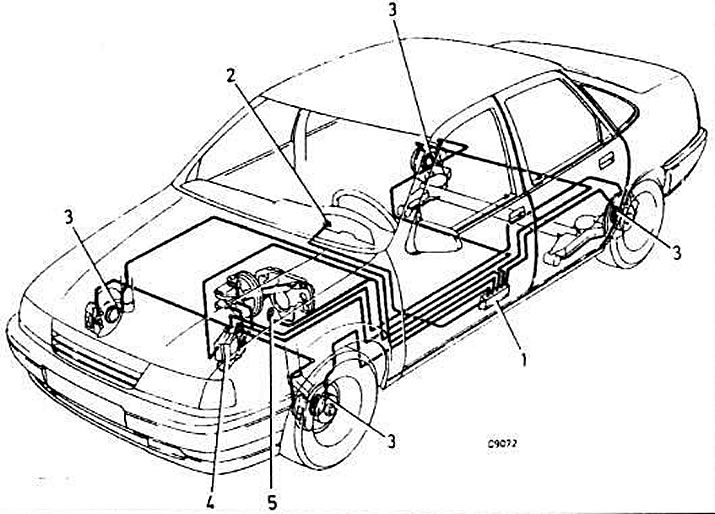
1 - computer

1 - computer
2 - ABS indicator lamp
3 - speed sensor (in all-wheel drive vehicles, the rear sensors are located on the left and right sides of the rear axle gearbox)
4 - hydraulic block
5 - overvoltage protection relay


(Material copied from the portal: OpelBook)


This article is available at russian, bulgarian, belarusian, ukrainian, serbian, croatian, romanian, polish, slovak, hungarian
Checking the article: Zinoviev Kirill

Share information:

Previous articles
Opel Vectra A: Brake system
Next articles

Removal and installation the parking brake cable
Adjusting the parking brake
Removal and installation parking brake pads
Removal and installation the parking brake lever
Checking, removing and installing the brake light switch
Brake force regulators
Checking ABS
Checking the brake fluid level
Checking the thickness of brake pads
External inspection of brake pipes
Replacing brake fluid
Technical characteristics of the brake system


See similar ones from other Opel car manuals:
▶ Anti-lock braking system (ABS) Opel Astra F (1991-1998, petrol)
▶ General information about the anti-lock braking system Opel Corsa C (2000-2006, petrol)
▶ Anti-lock braking system and traction control system Opel Insignia A (2008-2017)
▶ Technical characteristics of the anti-lock braking system Opel Kadett E (1984-1995)
▶ Anti-lock Braking System (ABS) — Precautions Opel Omega A (1986-1993)
Link to this page in different formats

Visitor comments


No comments yet


How much will 34 + 20 =


Vectra C (2002-2008) 
  • General information
  • User manual
  • Vehicle device
  • Maintenance
  • Troubleshooting
  • Power unit
  • Engine repair
  • Cooling system
  • Power and control system
  • Engine electrics
  • Transmission
  • Clutch
  • Car gearbox
  • Drive shafts
  • Chassis
  • Car suspension
  • Steering
  • Brake system
  • Body
  • Exterior
  • Interior
  • Doors, locks and windows
  • Heating and ventilation
  • Electrical equipment
  • Equipment and devices
  • Headlights and lighting
  • Electrical circuits
Vectra B (1995-2002) 
  • General information
  • User manual
  • Weekly checks
  • Maintenance (gasoline)
  • Maintenance (diesel)
  • Troubleshooting
  • Power unit
  • SOHC gasoline engine
  • DOHC petrol engine
  • Diesel engine 1.7 liter
  • Diesel engine 2.0 liters
  • Engine repair
  • Cooling system
  • Fuel system (gasoline)
  • Fuel system (diesel)
  • Charging system
  • Launch system
  • Ignition and preheat
  • Transmission
  • Clutch
  • Mechanical gearbox
  • Automatic gearbox
  • Drive shafts
  • Chassis
  • Brake system
  • Wheel suspension
  • Steering
  • Body
  • Exterior
  • Interior
  • Doors and windows
  • Heating and ventilation
  • Electrical equipment
  • Equipment and devices
  • Electrical circuits
Vectra B (1995-2002, petrol) 
  • General information
  • Maintenance
  • Help with malfunctions
  • Power unit
  • Engine repair
  • Exhaust system
  • Cooling system
  • Fuel system
  • Multec injection system
  • Four point injection
  • Transmission
  • Clutch
  • Gearbox and drive
  • Chassis
  • Wheel suspension
  • Steering
  • Brake system
  • Wheels and tires
  • Body
  • Exterior
  • Interior
  • Electrical equipment
  • Fuses and electronics
  • Power devices
  • Ignition system
  • Lighting and signaling
  • Equipment and devices
  • Heating and ventilation
  • Electrical circuits
Vectra A (1988-1995) 
  • Power unit
  • Engine repair
  • Ignition system
  • Lubrication system
  • Cooling system
  • Injection system
  • Fuel system (carburetor)
  • Fuel system (diesel)
  • Exhaust system
  • Transmission
  • Clutch
  • Car gearbox
  • Chassis
  • Front suspension
  • Rear suspension
  • Steering
  • Brake system
  • Wheels and tires
  • Body
  • Exterior
  • Interior
  • Electrical equipment
  • Electrical circuits
Vectra A (1988-1995, petrol) 
  • General information
  • User manual
  • Maintenance
  • Power unit
  • SOHC engine
  • DOHC engine
  • Cooling and ventilation
  • Fuel system (carburetor)
  • Fuel system (injector)
  • Exhaust converter
  • Transmission
  • Clutch
  • Mechanical gearbox
  • Automatic gearbox
  • Drive shafts
  • Chassis
  • Brake system
  • Car suspension
  • Steering
  • Body
  • Body elements
  • Electrical equipment
  • Power devices
  • Equipment and devices
  • Electrical circuits
OpelBook.ru © 2017–2026 · Mobile version · · Sitemap: EN BG BY UA RS HR RO PL SK HU · Feedback · Site search
Astra F, petrol · Astra G, petrol · Astra G · Astra H · Astra J, petrol · Corsa B · Corsa C, petrol · Corsa C · Insignia A · Kadett D · Kadett E · Omega A · Omega B · Omega B2 · Vectra A, petrol · Vectra A · Vectra B, petrol · Vectra B · Vectra C · Zafira A, petrol · Frontera A, petrol · Frontera B · Ascona C · Vivaro A ·
We want your visit to be comfortable 🤝! We use cookies 🍪 to make that happen.