


Disc brakes
Mark the position of the front or rear wheels relative to their hubs so that the balanced wheels take their original position when installed. To mark, it is enough to make a stroke with chalk or paint on the disk and hub.
Loosen the wheel bolts.
Raise the car.
Remove the wheels.
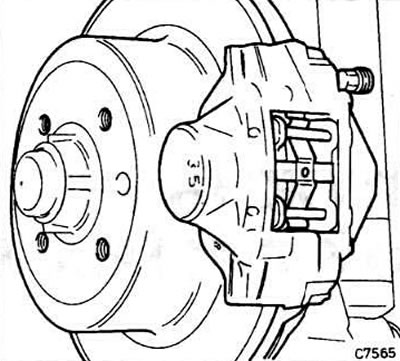
Material copied from this website [OpelBook]
Check the thickness of the overlay by eye (excluding the thickness of the pad). If necessary, use a portable lamp or flashlight, and a small mirror to check the thickness of the inner lining.
If the condition of the lining is unsatisfactory or it cannot be installed, mark and remove the brake pads.
Measure the thickness of the pad and shoe using a caliper.
The wear limit of the front and rear disc brake pads is considered to be the thickness of the pad together with the shoe, equal to 7 mm. If the thickness of at least one pad with the shoe is equal to or less than the specified value, it is necessary to replace all 4 pads on one axle.
Note: From operating experience it is known that 1 mm of wear on the front disc brake lining corresponds to a mileage of at least 1000 km (in the most adverse conditions). During normal use, the linings wear out much more slowly. With a lining thickness of (with a block) 10 mm it will "last" at least 3000 km.
Install the wheels according to the marks.
Lower the vehicle and tighten the wheel bolts crosswise to 110 Nm.
Parking brake
Remove the brake disc.
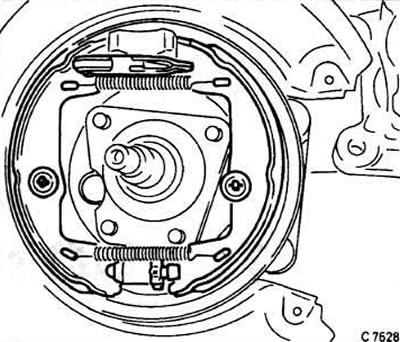
Measure the thickness of the brake pad with a caliper.
Install the brake disc.
Drum brakes
Remove the inspection hole plug to check the thickness of the pad.
Shine a lamp or flashlight into the hole and estimate the thickness of the shoe by eye. If in doubt, remove the brake drum.
Insert the plug.
Visitor comments