


Contents: Inspection. ⬇ Replacement. ⬇
The latest models are discussed in Section 11.
Inspection.
1. It is recommended that, if necessary, the brake shoes be inspected by removing the drums. This will allow a proper inspection of the linings and in addition the wheel cylinders can be inspected for leaks. However, if desired, you can inspect the condition of the rear shoe linings by removing the plug from the inspection hole in the rear brake plate (Figure 9.21).
2. Use a flashlight and mirror to check that the friction material has not worn below the specified minimum. If this is the case, then the shoes need to be replaced.
Replacement.
3. Raise the rear of the car and remove the rear wheels (see Section 3). Block the front wheels by placing something under them. Release the handbrake completely.
4. Remove the drum mounting screw and remove the drum. If the drum sits tightly on the hub, tap it with a plastic hammer. If the drum is scratched due to wear, the cam adjusters may have to be pulled back before the drum can be removed and the shoes removed from the grooves. Before you begin disassembling, sketch the location of the shoes and how the pads are installed in relation to the drive and trailing ends.
5. Disconnect the upper shoe return spring using pliers.
6. Remove the shoe spring rings. These rings are the type that require the ends to be squeezed together to release the ring from the rear brake plate.
7. Separate the shoes until they can be removed from their mounting location below.
8. Unhook the lower shoe return spring and remove the stand located between the shoes (Figure 9.24).
9. Disconnect the end of the handbrake cable from the lever on the brake shoe and remove the shoes. Do not press the brake pedal while the shoes are removed.
10. GM still supplies friction pads to fit the original shoes. This involves drilling out old rivets to remove worn pads and using new rivets supplied with the shoe pads. Riveting should be done from the center outward. The pads are supplied in 5.0mm thickness (0.197 inches) for normal use and 5.6mm thick (0.220 inches) for those cases where the drums have been processed (see also Section 14).
11. Despite all of the above, it is still recommended to use new or factory-machined shoes as spare parts rather than trying to fix them yourself.
12. Before installing new shoes, clean off all dirt and powder from them without inhaling it.
13. Any signs of oil contamination on the rear brake shoes indicate a leak in the hydraulic cylinder (Section 12) or that the hub seal is faulty (Section 10). Fix the leak immediately and replace the shoes.
14. Lightly lubricate the adjusting cams and the upper contact points of the shoes on the rear brake plate with grease that has a high melting point.
15. Lay the shoes out on the work bench, making sure they are positioned correctly in relation to the handbrake lever and the leading and trailing ends of the shoe pad (photo).
(Information taken from the website: OPELBOOK.ru)
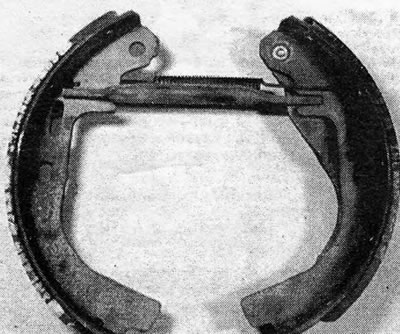
Photo 9.15 Rear brake shoes prepared for installation.
16. Install the lower return spring.
17. Pull the shoes (outward) and install their lower ends in place, and then connect the handbrake cable.
18. Install the strut and upper return spring.
19. Install new spring rings.
20. Install the brake drum.
21. Adjust the shoes as indicated in Section 8.
22. Install the road wheel.
23. Repeat these operations on the opposite brake, as the shoes must be replaced as a set (four shoes). Upon completion, adjust the handbrake if necessary (Section 26).
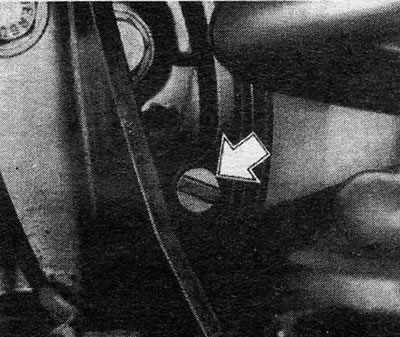
Figure 9.21. Inspection hole plug in the rear plate - indicated by the arrow
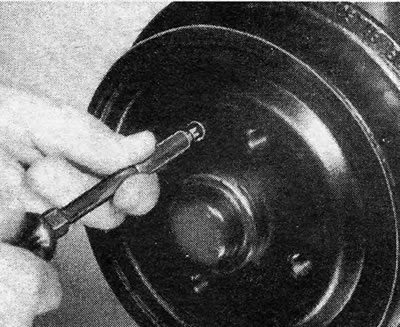
Figure 9.22. Removing the brake drum mounting screw
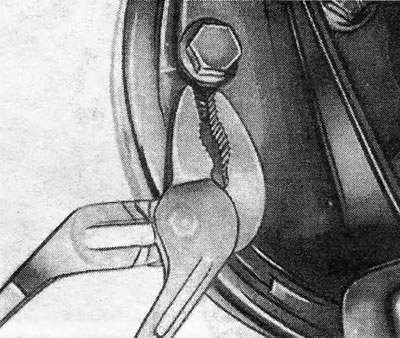
Figure 9.23. Shoe spring compression
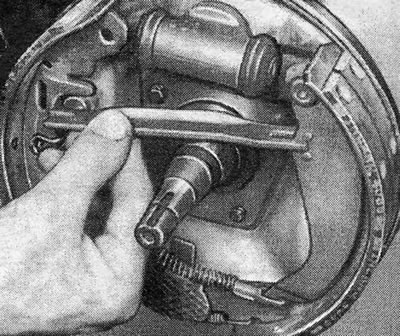
Figure 9.24. Removing the brake shoe stand
Visitor comments