


1. After removing the unit from the machine, clean off all external dirt and remove the reservoir (Section 15, paragraph 7).
2. Insert the rod into the end of the cylinder and press on the piston until it becomes possible to hold it in this position by inserting a smooth pin or rod with a diameter of 3.0 mm (0.118 inches) into the primary opening.
3. Remove the spring ring from the end of the cylinder using pliers or screwdrivers. Throw away the snap ring (Figure 9.37).
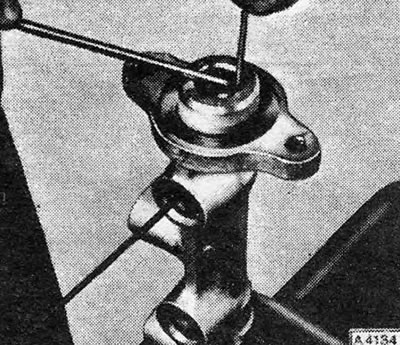
Figure 9.37 - Removing the Master Cylinder Spring Ring (GMF)
4. Remove the primary piston by first removing the temporary retaining pin. Pay attention to how the seals are installed.
5. Remove the secondary piston by tapping the end of the cylinder on a piece of wood. Pay attention to how the seals are installed.
6. Disassemble the primary piston. This can be done by compressing the spring with an aerosol can cap or something similar that has a hole drilled into it. Once the snap ring is exposed, remove it with two screwdrivers and discard it.
7. Inspect the piston and cylinder bore surfaces for scratches or metal-to-metal friction. If this is the case, replace the entire master cylinder.
8. If the components are in good condition, clean them in hydraulic fluid or methylated spirits - and nothing else.
9. Get a repair kit that contains all the necessary spare parts.
Procedures for working with a set of "free" seals.
10. Install the seals on the pistons, using only your fingers to push them into place. It is important that the new seals are installed in exactly the same way as the old ones; they are cone shaped and will only function properly if installed in the correct order.
11. Assemble the primary piston using a new snap ring. The spring ring can be placed into its groove to the end by tapping it with a piece of pipe.
12. Dip the pistons in clean hydraulic fluid and install the secondary piston into the cylinder, then the primary piston.
13. Press and hold the primary piston as directed for disassembly while you install the new snap ring.
14. Install new rubber sealing rings and place the fluid reservoir in its place on the cylinder body.
15. Pour some clean fluid into the reservoir and prepare the master cylinder for operation before installation by pressing the primary piston several times with a rod. Naturally, a large amount of liquid will be ejected from the open ports of the cylinder.
Procedures for working with a set of ready-made assembly.
16. Lubricate the cylinder barrel with brake fluid or brake rubber grease. Clamp the cylinder so that the barrel is in a horizontal position.
17. Remove the plug from the tube and insert the short part of the tube into the cylinder barrel up to the flange on the tube. Using a blunt rod, push the piston out of the tube and into the barrel; hold the pistons in the barrel using a smooth rod or the needle used during disassembly. Remove the rod and tube.
18. Install a new spring ring onto the end of the cylinder. Press down on the primary piston and remove the retaining rod or needle. Make sure the snap ring is in place and that the pistons can move freely.
19. Install new sealing rings and reinstall the reservoir.
20. Prepare the cylinder for operation as described for the ATE type cylinder in the previous Section (paragraph 25).
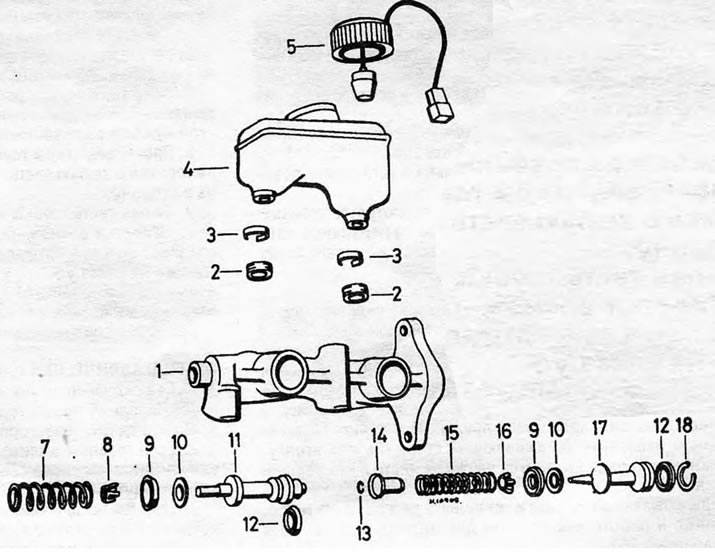
Figure 9.36 - Disassembled GMF type master cylinder 1. Body. 2. Tank sealing rings. 3. Spring rings. 4. Reservoir. 5. Cap with warning switch. 7. Spring. 8. Spring retaining device. 9. Secondary piston seals. 10. Washer. 11. Secondary piston, 12. Primary seals. 13. Spring ring. 14. Spring cuff. 15. Primary piston spring. 16. Spring retaining device. 17. Primary piston. 18. Spring ring.
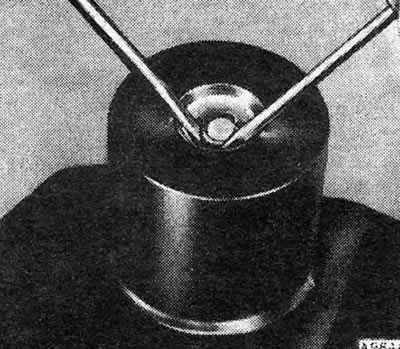
Figure 9.38 - Removing the primary master cylinder piston (GMF) spring ring
Visitor comments