
OpelBook.ru
Cars AvtoVAZ Cars Mitsubishi Cars BMW Cars Mercedes Cars Nissan Cars Toyota Cars Chevrolet
English Русский
Български
Беларускі
Український
Српски
Hrvatski
Română
Polski
Slovenský
Magyar
 |  Sitemap  |  Contacts  |    


Main Astra Corsa Insignia Kadett Omega Vectra Zafira Others Articles
Corsa B (1993-2000) Corsa C (2000-2006, petrol) Corsa C (2000-2006)
  • Main
  • Corsa
  • Corsa B
  • General information
  • Maintenance
  • Replacing brake fluid

Replacing brake fluid (Opel Corsa B)

            0

Brake fluid is hygroscopic, i.e. it can absorb moisture, for example, through the pores of the brake hose and the ventilation hole of the reservoir. As a result, the boiling point of the brake fluid decreases. At high pressure in the hydraulic tract of the brake system, for this reason, vapors can form, which significantly reduces the efficiency of the brake system.

Brake fluid should be replaced every two years, regardless of the mileage. It is advisable to replace it in the spring. If the car is frequently driven in mountainous terrain, the brake fluid should be replaced more often.


Observe safety precautions when handling brake fluid.

1. Pump out the brake fluid from the reservoir, bringing it to a level of approximately 10 mm.

Do not empty the reservoir completely to prevent air from entering the brake system.


2. Fill the reservoir with fresh brake fluid up to the "MAX" mark.

3. Attach a hose to the bleed nipple of the right rear wheel cylinder and place a suitable container underneath to collect the brake fluid.

4. Ask an assistant to press the brake pedal several times. Without releasing the brake pedal, unscrew the bleed nipple. The movement of brake fluid will be visible through the transparent hose. Screw the nipple back in when the pedal hits the floor, and release the brake pedal. Repeat the described process for each bleed nipple as many times as necessary to ensure that there are no bubbles in the brake fluid.

Fresh brake fluid can be identified by its light shade.


Unscrewing the bleed nipple
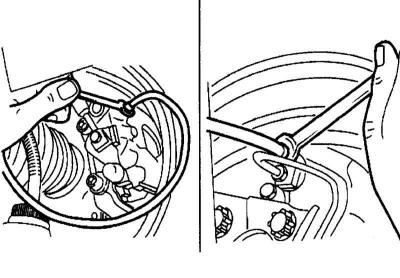


Unscrewing the bleed nipple


5. Screw in the bleeder nipple. Fill the reservoir with brake fluid.

6. Using the method described above, pump out the old brake fluid from the other calipers or wheel cylinders in the following sequence: rear right - rear left - front right - front left.

7. Dispose of old brake fluid in specially designated places.


This article is available at russian, bulgarian, belarusian, ukrainian, serbian, croatian, romanian, polish, slovak, hungarian
Checking the article: Trifonova Emilia

Share information:

Previous articles
Opel Corsa B: Maintenance
Next articles

Checking the clutch pedal adjustment
Replacing spark plugs
Checking and adjusting valve clearances on a diesel engine
Inspection of suspension components
Lubrication of locks, hinges and stops
Checking the composition of exhaust gases
Automatic Transmission Fluid Replacement (ATF)


See similar ones from other Opel car manuals:
▶ Replacing brake fluid Opel Astra J (2009-2015, petrol)
▶ Replacing brake fluid Opel Vectra A (1988-1995, petrol)
▶ Low Brake Fluid Sensor — Checking and Replacing Opel Zafira A (1999-2005, petrol)
▶ Replacing brake fluid Opel Frontera B (1998-2004)
▶ Replacing the rear brake caliper bracket Opel Insignia A (2008-2017)
Link to this page in different formats

Visitor comments


No comments yet


How much will 19 + 16 =


Corsa C (2000-2006) 
  • General information
  • Introduction to guide
  • Troubleshooting
  • Vehicle device
  • User manual
  • Maintenance
  • Power unit
  • Engine repair
  • Cooling system
  • Power and exhaust system
  • Control system
  • Engine electrical equipment
  • Transmission
  • Clutch
  • Mechanical gearbox
  • Automatic gearbox
  • Drive shafts
  • Chassis
  • Brake system
  • Wheel suspension
  • Steering
  • Body
  • Exterior
  • Interior
  • Doors and windows
  • Heating and air conditioning
  • Electrical equipment
  • Equipment and devices
  • Lamps and lighting
  • Electrical circuits
Corsa C (2000-2006, petrol) 
  • User manual
  • Car access
  • Governing bodies
  • Seat control
  • Heating and air conditioning
  • Driving and maintenance
  • Engines 1.0 and 1.2 l
  • Engine repair
  • Cooling and lubrication system
  • Injection system
  • Engines 1.4, 1.6 and 1.8 l
  • Engine repair
  • Cooling and lubrication system
  • Injection system
  • Transmission
  • Clutch
  • Mechanical gearbox
  • Automatic gearbox
  • Drive shafts
  • Chassis
  • Wheels and tires
  • Wheel suspension
  • Steering
  • Brake system
  • Body
  • Exterior
  • Doors and windows
  • Electrical equipment
  • Equipment and devices
  • Lighting system
  • Electrical circuits
Corsa B (1993-2000) 
  • General information
  • Introduction to guide
  • User manual
  • Maintenance
  • Power unit
  • SOHC gasoline engines
  • DOHC gasoline engines
  • Diesel engines
  • Engine repair
  • Cooling system
  • Supply system
  • Injection system (gasoline)
  • Injection system (diesel)
  • Exhaust systems
  • Control system (gasoline)
  • Preheat system (diesel)
  • Charge and launch system
  • Transmission
  • Mechanical gearbox
  • Automatic gearbox
  • Clutch and drive shafts
  • Chassis
  • Brake system
  • Front suspension
  • Rear suspension
  • Steering
  • Body
  • Ventilation and heating
  • Exterior
  • Interior
  • Doors and windows
  • Electrical equipment
  • Equipment and devices
  • Lamps and lighting
  • Electrical circuits
OpelBook.ru © 2017–2026 · Mobile version · · Sitemap: EN BG BY UA RS HR RO PL SK HU · Feedback · Site search
Astra F, petrol · Astra G, petrol · Astra G · Astra H · Astra J, petrol · Corsa B · Corsa C, petrol · Corsa C · Insignia A · Kadett D · Kadett E · Omega A · Omega B · Omega B2 · Vectra A, petrol · Vectra A · Vectra B, petrol · Vectra B · Vectra C · Zafira A, petrol · Frontera A, petrol · Frontera B · Ascona C · Vivaro A ·
We want your visit to be comfortable 🤝! We use cookies 🍪 to make that happen.