


Contents: Examination ⬇ Adjustment ⬇
To compensate for thermal expansion, there must be a certain gap in the valve mechanism.
If the clearance is too small, the valve timing changes, the compression process deteriorates, engine power decreases, and engine operation becomes uneven. In extreme cases, the valves may become deformed or burn to the seats.
If the gap is too large, mechanical noises appear, the valve timing changes, due to the valve opening time being too short and, consequently, poor filling of the cylinders, the engine power decreases, and the engine runs unevenly.
Adjusting valve clearances can only be useful if the valves are well ground, there is no unacceptable play in their guides, and the ends of the valve stems are not clogged.
Valve clearances should be adjusted as part of maintenance, after repairs, or if there is noise in the valve mechanism.
Valve clearances should be checked and adjusted on a cool engine, i.e. when its temperature is equal to the ambient temperature.
Examination
1. Remove the cylinder head cover.
2. Set the piston of the first cylinder to the TDC position (see Chapter Engines).
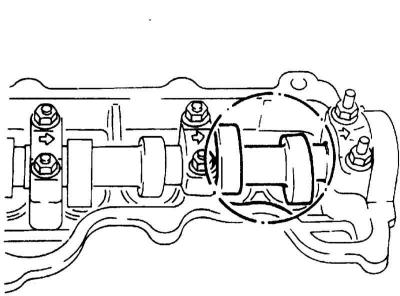
3. When the piston of the first cylinder is at TDC, the position of the camshaft cams looks like the one shown (the cams do not touch the valves of the first cylinder).
Position of the camshaft cams when the piston of the first cylinder is at TDC
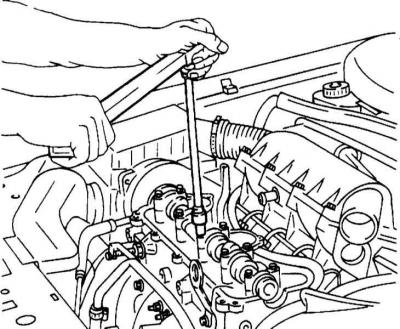
4. Before checking the valve clearances, check that the nuts securing the camshaft support bearing caps are securely tightened. Tighten the nuts with force if necessary 25 Nm.
Checking the tightening force of the nuts securing the support bearing caps
5. Insert a feeler gauge between the camshaft lobe and the adjusting washer and check the clearance according to the requirements of the Specifications in Chapter Vehicle settings and routine maintenance.
6. The feeler gauge should be able to be pulled in, otherwise the valve clearance will need to be adjusted.
7. Mark the crankshaft pulley position opposite the TDC mark. Turn the crankshaft half a turn in the direction of engine rotation. The next piston is now at TDC. According to the firing sequence 1-3-4-2, this is the third cylinder. The cylinder numbers are in order from one to four. Cylinder 1 is at the timing belt pulley. Check the clearances as described above. Then turn the crankshaft another half turn and check the valve clearance of cylinders 4 and 2.
8. If it is necessary to adjust the valve clearance, change the thickness of the feeler gauge until the true clearance value is obtained. Record the obtained value.
9. Install the cylinder head cover with a new gasket and tighten the bolts securing it with force 8 Nm.
Adjustment
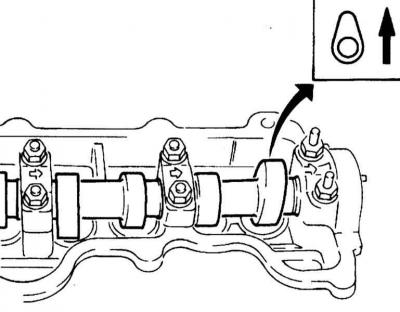
1. Turn the crankshaft so that the top of the camshaft lobe above the valve being adjusted faces upward.
Setting the camshaft to the valve clearance adjustment position
2. Turn the valve tappet so that the tappet groove faces forward.
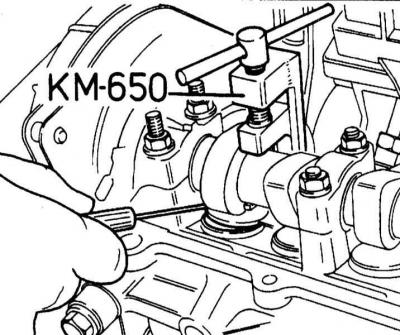
3. The valve clearance is adjusted by selecting adjusting washers. To do this, press the tappet with a special device OPEL-KM-650.
Pressing the pusher with a special tool
4. Remove the adjusting washer from the pusher and use a magnet.
5. Measure the thickness of the installed adjusting shim with a micrometer and record the measurement. The thickness of the shim should be engraved on its underside.
6. Calculate the thickness of the new adjusting washer using the formula N = T (A - S), where N is the thickness of the new adjusting shim, T is the thickness of the removed adjusting shim, A is the measured valve clearance value, and S is the required Specification (in Chapter Vehicle settings and routine maintenance) valve clearance value.
Shims can generally be used repeatedly until wear becomes clearly visible. If the thickness marking on the washer is no longer visible, the washer should no longer be used.
7. Soak the new adjusting washer in engine oil and install it with the marking facing down.
8. Adjust all valve clearances in the manner described above.
9. Finally, check the valve clearances again.
Visitor comments