


Contents: Examination ⬇ Adjustment ⬇
The 1.7L SOHC and 2.0L engines are equipped with hydraulic compensators.
Examination
The importance of proper valve clearances in any internal combustion engine cannot be overstated, due to its impact on engine performance.
The check must be carried out on a cold engine!
1. Set the parking brake, then jack up the front of the vehicle and place it on supports. Remove the right front wheel to provide support for the crankshaft pulley. If equipped, remove the vehicle's crankcase guard.
2. Remove the timing cover (see Removal and installation the timing cover). Remove the injectors (see Chapter Power and exhaust systems).
3. Turn the engine in the normal direction (clockwise when viewed from the right side of the engine) by the crankshaft pulley bolt until the installation mark on the pulley is aligned with the indicator on the oil pump cover.
4. Continue turning the shaft, rotate the crankshaft in the same direction until the cams of the valve drive of the 1st cylinder of the intake camshaft and the valve of the 3rd cylinder of the exhaust shaft turn with their heels towards the tappets (valves are closed). Now you can start performing the check.
5. Draw a diagram (grid) of valve adjustment on a sheet of paper, numbering the cells in accordance with the valve numbering. Fill in the resulting table, entering the nominal values of the clearances of each valve in the cells.
Note that the clearances on the intake and exhaust valves are the same.
6. Having turned the shafts as required (see above), measure the clearances between the heels of the cams and the ends of the tappets with a blade-type feeler gauge. Record the measurement results in the appropriate cells of the table.
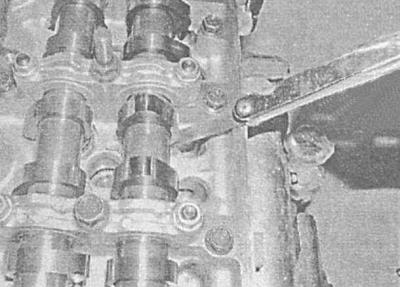
7. To check the clearances of the intake valve of the 3rd cylinder and the exhaust valve of the 4th, turn the crankshaft another half turn (180°). Measure the clearances and record the results.
8. Proceeding in a similar manner, successively turning the crankshaft 180°, measure the clearances of the exhaust valve of the 2nd cylinder and the intake of the 4th cylinder, then the exhaust of the 1st cylinder and the intake of the 2nd. Fill in all the cells.
9. If the measurement results are within the permissible ranges (see Specifications), install the timing cover in place (see Removal and installation the timing cover).
10. Install the injectors (see Chapter Power and exhaust systems).
11. Install the engine guard and wheel, then lower the vehicle to the ground and tighten the wheel bolts to the required torque.
12. If any gaps are set incorrectly, make the appropriate adjustments (see below).
Adjustment
1. Turn the crankshaft so that the cam of the valve to be adjusted is turned with the heel towards the tappet.
Make sure the engine is not at TDC for the valve in question, as replacing the adjusting shim will require compressing the valve spring, which could cause the valve to hit the piston crown.
2. Turn the pusher with the slot in the upper edge forward (exhaust tappets), or back (intake tappets) by engine.
3. If you don't have the KM-6090 special tool at hand, insert a large flat-tip screwdriver between the edge of the tappet and the base of the camshaft. Carefully, using the screwdriver as a lever, push the tappet down until you can remove the adjusting washer. The easiest way to remove the washer is with a magnetized rod.
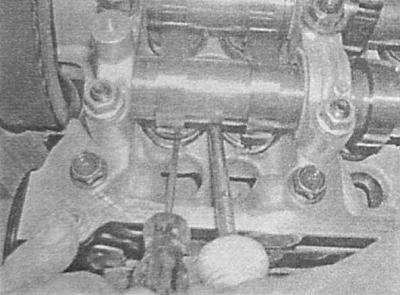
4. Wipe the washer and measure its thickness with a micrometer.
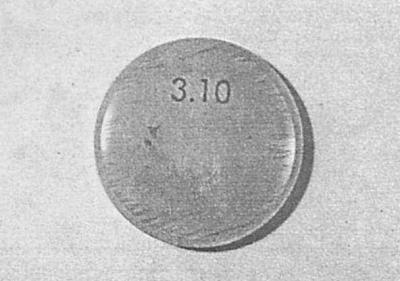
The washers have markings, which, however, may be lost due to wear.
5. Add the valve clearance measurement result to the obtained result. To obtain the required thickness of the new washer, subtract the nominal clearance value from the obtained sum, for example:
6. Valve clearance measurement result A = 0.35 mm
7. Thickness of the removed washer IN = 2.70 mm
8. Amount S = A B = 0.35 2.70 = 3.05 mm
9. Nominal value of clearance WITH = 0.40 mm
10. Thickness of the new washer D = S - C = 3.05 – 0.40 = 2.65 mm
It may be possible to achieve the desired result by simply swapping the washers from one pusher to the other. Record and save for possible future adjustments of the thickness of all washers.
11. Prepare a washer of the required thickness, lubricate it with clean engine oil. Press the pusher and place the washer in it with the marking facing down.
12. Proceed in a similar manner to adjust the clearances of the remaining valves that require adjustment.
13. Turn the crankshaft several times to seat the washers on the tappets, then perform a control check of the clearances before installing the timing cover. Install the cover (see Removal and installation the timing cover).
14. Install the engine guard and wheel, then lower the vehicle to the ground and tighten the wheel bolts to the specified torque.
Visitor comments