


Removal
Engines 1.7L SOHC
Using the special KM-890 device when removing the camshaft from the 1.7 L SOHC engine ensures that the cylinder head gasket is not disturbed. If you do not have the device at hand, you will have to remove the cylinder head (see Removing and installing the cylinder head).
1. Remove the battery.
2. Remove the camshaft gear (see Removal and installation the timing belt tensioner and timing gears (1.7L engines). To prevent the pistons from contacting the valves, turn the crankshaft 90° counterclockwise.
3. Loosen the clamps and remove the air duct connecting the turbocharger to the intercooler. Also remove the sleeve running from the intercooler to the intake manifold.
Both sleeves are also secured in intermediate fasteners (see Chapter Power and Exhaust Systems).
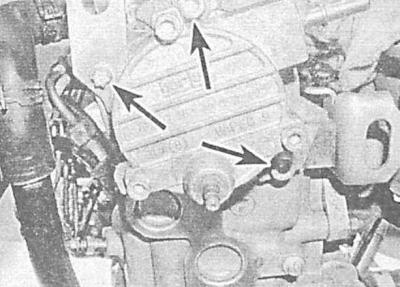
4. Disconnect the brake booster servo tube and vacuum tube (2-3) from the vacuum pump (4).
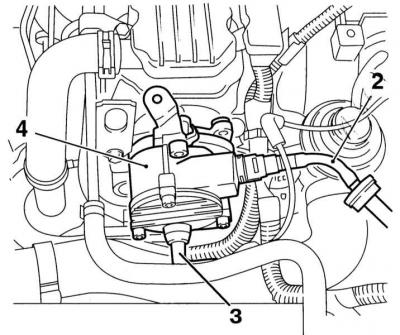
5. Unscrew the mounting bolts and remove the pump together with the turbocharger air duct bracket.
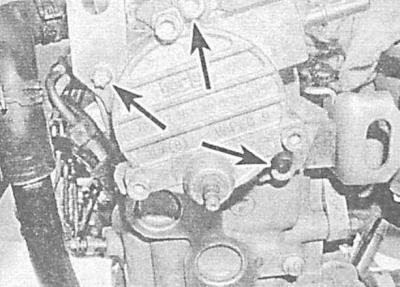
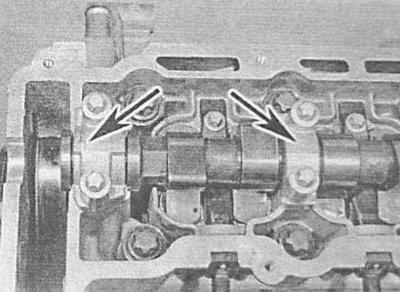
6. Remove the two Allen head cap screws and camshaft thrust plate.
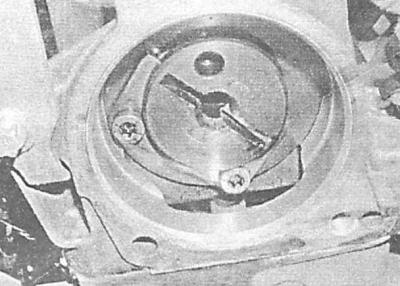
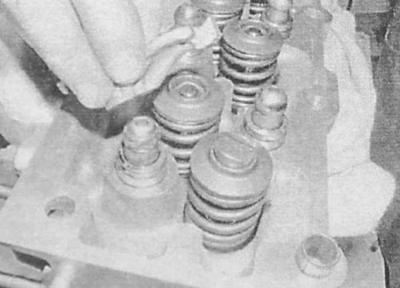
7. If you have the KM-890 device at hand, use it. The device consists of a set of plates with adjustable legs. The plates are attracted to the timing case, pressing the valve drive levers with their legs, after which the camshaft can be freely removed from the drive case. If it is not possible to use the device, you will have to remove the timing case. Since the housing bolts also secure the cylinder head, you will have to remove it as well (see Fig. Removal and installation the cylinder head).
The bolts and gasket are not reusable and must be replaced with new ones during assembly, regardless of their condition.
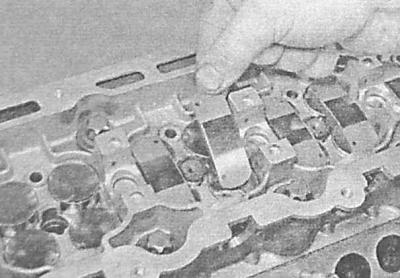
8. After removing the camshaft, prepare 8 transparent polyethylene bags or small plastic cups and mark them according to the valve numbering. Remove the valve drive levers, the shaped washers that fix them, and the hydraulic struts of the compensators. Place the removed components in bags/cups according to the markings.
Engines 1.7L DOHC
1. Remove the timing cover (see Removal and installation the timing cover).
2. Remove the fuel injectors (see Chapter Power and exhaust systems).
3. Remove the camshaft gear (see Removal and installation the timing belt tensioner and timing gears (1.7L engines)).
4. Unscrew the fastening nuts and remove the cover of the 5th camshaft support from the left (from the transmission side) sides.
5. The exhaust camshaft drive gear is equipped with an additional toothed section, which serves to compensate for axial play. The compensating section should be locked to the main shaft gear using a suitable bolt or rod. Insert the bolt/rod into the hole on the inside of the main gear and push it through the compensating section. This locking will allow the compensating spring to be unloaded when removing either camshaft.
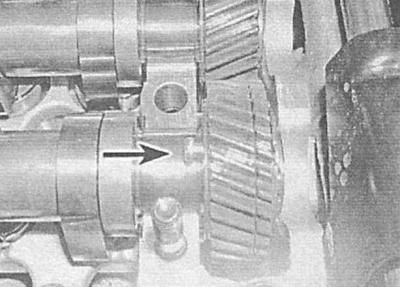
6. Moving in a spiral from the edges to the middle, gradually, one turn at a time, loosen the nuts securing the caps of the remaining supports to relieve the tension from the valve springs gradually and evenly. After all the valve springs are unloaded, the nuts can be unscrewed by hand.
Loosening the nuts in any order can result in the destruction of the camshaft support bearing caps, and in this case the entire cylinder head will have to be replaced, since it is cast and machined together with the support caps, and the caps are not supplied to the market individually.
7. Remove the support covers - try to remember the installation position of the components.
The bearing caps are marked with serial numbers (1 to 5). The arrow markings should point towards the timing belt when installing the caps.
8. Remove the camshafts from the cylinder head.
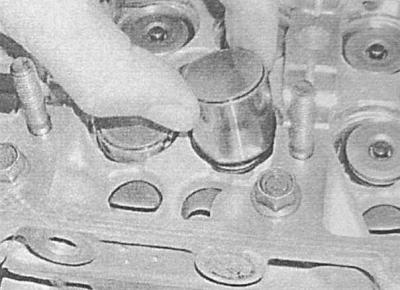
9. Prepare 16 small transparent plastic bags or clean plastic cups and label them according to the valve numbers. Remove the tappets with washers from the head and place them in the appropriate cups.
2.0L Engines
When installing, you will need a new camshaft sprocket mounting bolt and new upper chain guide mounting bolts.
1. Disconnect the negative battery cable and remove the timing cover (see Removal and installation the timing cover).
2. Remove the brake booster servo vacuum pump (see Chapter Brake system).
3. Bring the piston of the 1st cylinder to the TDC position at the end of the compression stroke (see Bringing the piston of the first cylinder to the position of the top dead center of the end of the compression stroke (TDC)) and lock the crankshaft in this position.
4. In order to ensure free access to the fuel injection pump sprocket cover, remove the air cleaner housing and the exhaust system inlet pipe (see Chapter Power and exhaust systems). Also remove the accessory drive belt (see Chapter Routine maintenance). Mark the position of the right engine mount support in relation to the cylinder head bracket. Remove the three bolts securing the support to the cylinder head bracket and the three bolts securing it to the mudguard. Support the right side of the engine with a trolley jack, raising it as high as possible without placing excessive load on other supports and utility lines (hoses, cables, wiring harnesses).
5. Remove the upper chain tensioner (see Removal and installation timing chain tensioners (2.0L engines)).
6. Unscrew the lower mounting bolt of the auxiliary drive belt tension roller stand, loosen the tensioner base axle bolt and remove the latter assembly from the engine.
You should not remove the rack from the tensioner assembly unless absolutely necessary - it will have to be ground in during installation.
7. Unscrew the mounting bolts and remove the fuel injection pump sprocket cover from the timing drive cover.
8. Mark the position on your top chain sprockets. Also mark the position of the camshaft sprocket on the camshaft journal.
9. Unscrew the mounting bolts and remove the upper chain guide from the cylinder head.
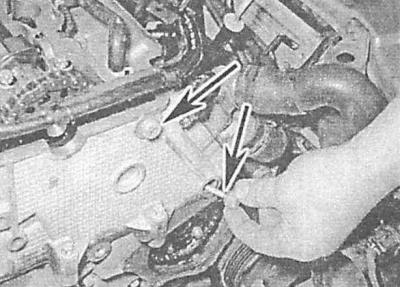
Before loosening the bolts, they should be heated with a heat gun (with a powerful hair dryer) in order to soften the sealant applied to the threads.
10. Hold the camshaft with an open-end wrench and loosen the sprocket mounting bolt. Before loosening the bolt, remove the camshaft locking device. Remember to reinstall the device after the bolt has been loosened.
11. Release the camshaft sprocket from the chain and remove it from the engine.
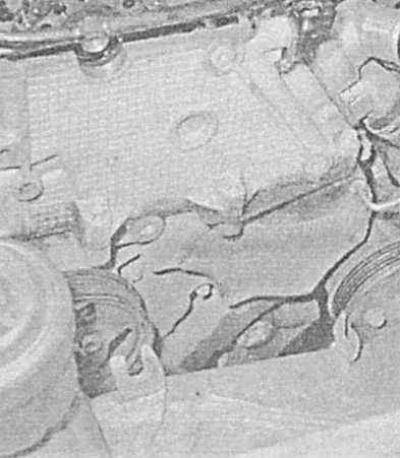
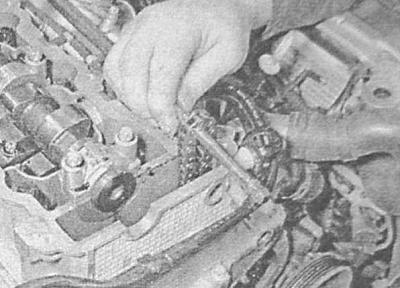
12. Secure the chain with a screwdriver to prevent it from falling into the head - place the screwdriver on the mating surface of the head.
13. Pay attention to the marking of the camshaft support caps. The caps are numbered in order from 1 to 5, with cap No.1 located on the timing chain side. If the marking is difficult to see, apply a new one yourself to avoid confusion during assembly.
14. Moving in a spiral from the edges to the middle, gradually, one turn at a time, loosen the cap mounting bolts - after all the valve springs are unloaded, the bolts can be unscrewed manually. Put the removed bolts together with their caps - try not to lose the guide bushings installed in the 5th support. Remove the camshaft from the cylinder head.
Loosening the nuts in any order can result in the destruction of the camshaft support bearing caps, and in this case the entire cylinder head will have to be replaced, since it is cast and machined together with the support caps, and the caps are not supplied to the market individually.
15. Prepare eight transparent plastic bags or small plastic cups and label them according to the valve numbers. Remove the valve actuator levers and place them in the bags/cups according to the markings.
16. If it is necessary to remove the hydraulic tappets, dismantle the injector adapter tubes (see Chapter Power and exhaust systems). It is best to remove the pushers using a magnetized rod or rubber grip. Place the removed components in bags/cups according to the markings.
Examination
1. Carefully examine the condition of the bearing journals and camshaft cams. If scoring or scratches are detected, replace the shaft. Also check the condition of the working surfaces of the plain bearings in the camshaft housing supports. On 1.7L SOHC engines damaged and worn out supports can be replaced 1.7L DOHC and 2.0L engines the entire cylinder head assembly must be replaced, since it is cast and machined together with the bearing caps, and the caps are not supplied to the market individually.
2. Having placed the camshaft in the prisms, determine the value of its radial runout (by bearing journals) using a plunger-type dial gauge. If the measurement results go beyond the permissible range (see Specifications) the camshaft must be replaced.
3. On 1.7 l engines the camshaft oil seal must also be replaced (see Replacing the camshaft seal (1.7L engines)).
4. On 1.7L SOHC and 2.0L engines assess the degree of wear and the general condition of the working surfaces of the valve drive levers that contact the camshaft cams. If cracks, cavities, grooves, and scoring are detected, the levers should be replaced.
5. On 1.7L SOHC models check the condition of the camshaft thrust plate and replace it if necessary.
If the axial play of the shaft is increased, the plate must also be replaced.
6. Check the condition of the tappets/hydraulic compensators and their mounting seats in the head. If signs of excessive wear of the working surfaces, cracks, scoring and other damage are detected, replace the tappets.
The tappets should also be replaced if the valve mechanism has recently been accompanied by increased noise levels.
Installation
Engines 1.7L SOHC
1. Lubricate all hydraulic tappets, locking washers and valve drive levers with clean engine oil and install them strictly in their original places. Lubricate the rubbing surfaces of the levers with molybdenum-containing grease such as "Molikot A".
2. Install the KM-890 device, carefully insert the camshaft into the timing case, passing its journal through the new seal and secure it with a thrust plate. Tighten the thrust plate mounting bolts with the required force.
3. Make sure that the valve drive levers and their locking washers are installed in their places and are not skewed, then carefully remove the KM-890 device.
4. Install the camshaft gear, tightening its mounting bolt only by hand for now.
5. Turn the camshaft so that the exhaust valve drive cam of the 1st cylinder (closest to the timing belt) turned with the working lug upwards. Turn the crankshaft 90°, bringing it to the TDC position, and install the timing belt (see Removal and installation the timing belt).
6. Insert the vacuum pump shaft into the hole in the left end of the timing case and secure the turbocharger tube bracket with the upper pump mounting bolt. Make sure that the vacuum pump drive shaft is properly engaged with the camshaft journal. Tighten the pump mounting bolts to the required torque.
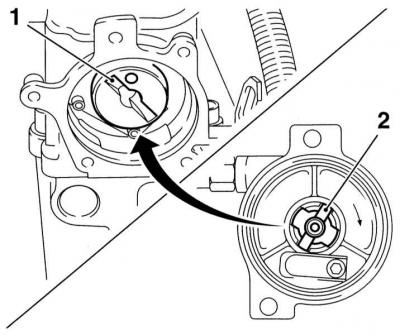
7. Connect the brake booster servo vacuum hose to the vacuum pump.
8. Reinstall the hose that connects the intercooler to the intake manifold, as well as the air duct that runs between the compressor and the intercooler. Install the mounting clips and tighten the bracket mounting bolts securely.
9. Install and connect the battery.
Engines 1.7L DOHC
1. Lubricate the tappets with clean engine oil and install them strictly in their original places, making sure that all washers are installed correctly.
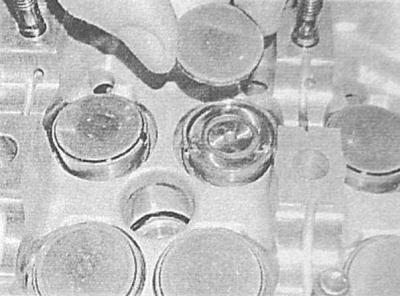
2. To prevent the risk of the valves coming into contact with the piston crowns, turn the crankshaft approximately 60° counterclockwise. Lubricate the tappet washers and camshaft bearings with clean engine oil and place the shafts on the bearings. Make sure that the compensating section of the exhaust camshaft gear is locked with the main gear. Make sure that the mark on the outer surface of the exhaust camshaft gear is located between the two marks on the outer surface of the intake camshaft gear and approximately in line with the cut of the timing case.
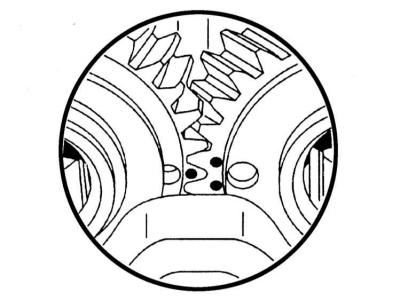
If the exhaust camshaft has been replaced, you will need to purchase the Vauxhall KM-6092 tool to compress the compensator gear spring before installation.
3. Make sure that the mating surfaces of the camshaft bearings and caps are absolutely clean and dry. Lubricate the mating surfaces and the camshaft cams with clean engine oil.
4. Lubricate the mating surfaces of the first support and its cover with a suitable sealant (consult a service station).
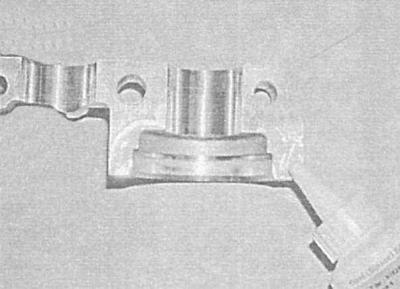
5. Install the bearing caps No.1 through No.4 in their places; the caps are marked and must be installed with arrows pointing in the direction of the timing belt.
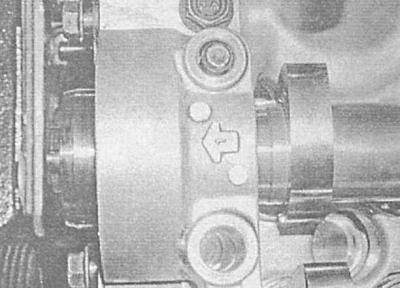
6. Screw on the cover mounting nuts, tightening them only by hand for now.
7. Remove the exhaust camshaft gear section retaining bolt/rod, then install the 5th bearing cover.
8. Working in a strictly defined sequence, gradually, one turn at a time, tighten the nuts securing the caps, smoothly loading the valve springs. Continue tightening in the same sequence until the caps are pressed against the supports, then tighten all the fasteners with the required force.
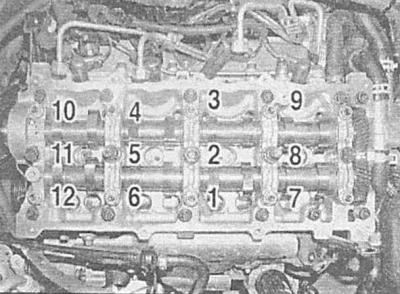
Tightening the nuts in an arbitrary order is fraught with destruction of the camshaft support bearing caps, and in this case the entire cylinder head will have to be replaced, since it is cast and machined together with the support caps, and the caps are not supplied to the market individually.
9. Install the new camshaft oil seal (see Replacing the camshaft seal (1.7L engines)).
10. Install the camshaft sprocket and timing belt (see Removal and installation the timing belt tensioner and timing gears (1.7L engines) and Removal and installation the timing belt).
11. Check the valve clearances and adjust them if necessary (see Checking and adjusting valve clearances (1.7L DOHC engines)), then install the timing cover (see Removal and installation the timing cover).
12. Install the injectors in place (see Chapter Power and exhaust systems).
2.0L Engines
1. If removed, lubricate the tappets with clean engine oil and install them in their original places in the cylinder head. Install the injector adapter pipes (see Chapter Power and exhaust systems).
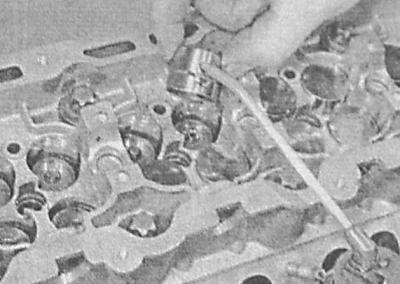
2. Install the valve drive levers in their places (marks on their upper surface to the injector transition tubes).
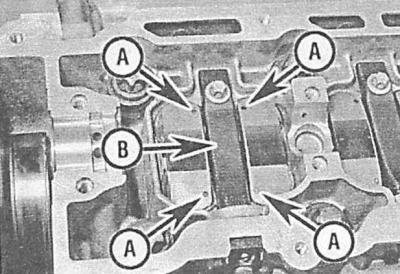
3. Lubricate the cams and bearing journals of the camshaft with clean engine oil and place the shaft in its regular place. Make sure that the crankshaft is still locked in the TDC position and turn the camshaft with the working projections of the cams of the valve drive of the first cylinder upward so that the groove in the end of the camshaft journal is parallel to the upper cut of the head, and the valve timing control hole is in the "12 o'clock" position.
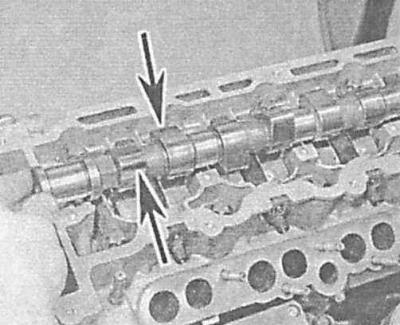
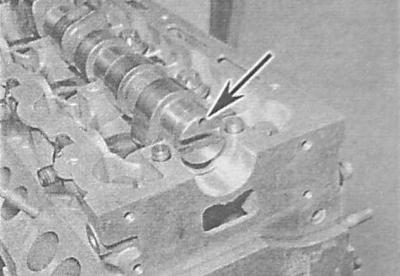
4. Make sure that the mating surfaces of the camshaft bearing supports and their caps are absolutely clean and dry. Lubricate the cams and journals of the camshaft with clean engine oil.
5. Lubricate the mating surfaces with sealant 5th (far left) shaft supports, then install the guide bushings into the cylinder head.
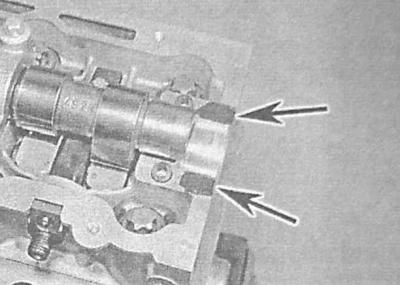
6. Reinstall the camshaft bearing caps. The caps are numbered 1 through 5 and should be legible when viewed from the front of the engine.
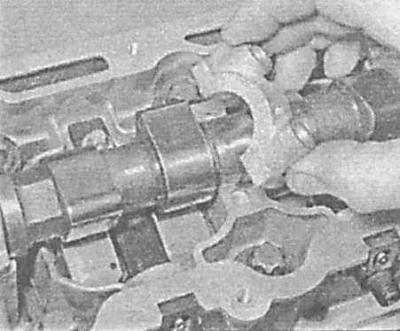
7. Hand tighten the cap bolts, then, moving in a spiral from the center to the edges, gradually tighten the cap bolts one turn at a time, smoothly loading the valve springs. Continue tightening the fasteners until the caps are pressed against the supports, and finally tighten the bolts to the required force.
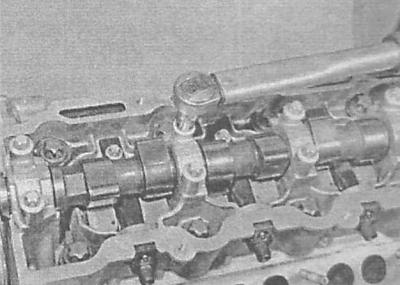
Tightening the nuts in an arbitrary order is fraught with destruction of the camshaft support bearing caps, and in this case the entire cylinder head will have to be replaced, since it is cast and machined together with the support caps, and the caps are not supplied to the market individually.
8. Making sure that the marks made during dismantling are correctly aligned, put the chain on the sprockets of the fuel injection pump and the camshaft. Place the sprocket of the camshaft on the journal of the latter (also make sure that the marks are aligned correctly). Install and tighten the NEW mounting bolt.
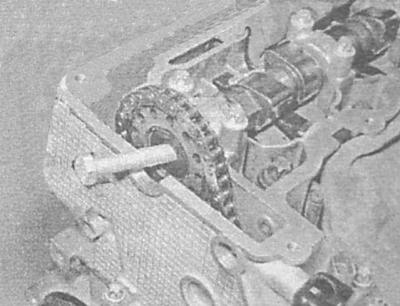
9. Reinstall the upper chain guide (with the mounting protrusion facing up), screw in NEW mounting bolts and tighten them to the required torque.
10. If you have special fixing devices at hand, adjust the valve timing (see Checking and adjusting valve timing (2.0L engines)). After completing the adjustment, remove the devices.
11. If it is not possible to use special devices, align the sprocket and camshaft mounting marks applied during dismantling. Hold the camshaft with an open-end wrench by the flats and tighten the sprocket mounting bolt with the 1st stage force. Make sure that the marks are aligned correctly, tighten the bolt sequentially to the angles of stages 2 and 3 of tightening — use a protractor attachment or apply reference marks with paint or a marker.
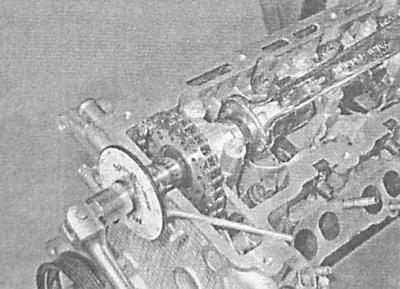
12. Install the upper chain tensioner (see Removal and installation timing chain tensioners (2.0L engines)).
13. Make sure that the mating surfaces of the fuel injection pump and timing belt sprocket covers are absolutely clean and dry. If the covers were fitted with a gasket, do not forget to replace the latter. Screw in the mounting bolts and tighten them to the required torque. If no gasket was provided, fill the cover groove with a sealant cushion approximately 2 mm thick, then press the cover down, screw in the mounting bolts and tighten them to the required torque.
14. Install the accessory drive belt tensioner by tightening the mounting and axle bolts to the required torque. When replacing the tensioner, or after disassembling it, it is necessary to grind the rack - use a socket head, putting it on the hexagonal part of the base. If the rack functions normally, install the accessory drive belt (see Chapter Routine maintenance).
15. Install the right powertrain suspension support assembly onto the cylinder head. Lower the unit, then secure the support to the mudguard, making sure that the mounting marks made during dismantling are correctly aligned. Tighten the mounting bolts to the required torque.
16. Install the timing cover (see Removal and installation the timing cover).
17. Install the exhaust pipe, air cleaner housing and crankshaft position sensor (see Chapter Power and exhaust systems).
18. Install the vacuum pump assembly (see Chapter Brake system).
Visitor comments