


To set the valve timing correctly, you will need special Opel fixing devices, which you can make yourself (see Checking and adjusting the valve timing (2.0L engines). If none of these options are available, have this operation performed by a car service specialist. If the problem has to be solved with improvised means, mark the installation position of the chains on the sprockets before removing the components.
Timing chain routing and sprocket positioning diagram for 2.0L engines
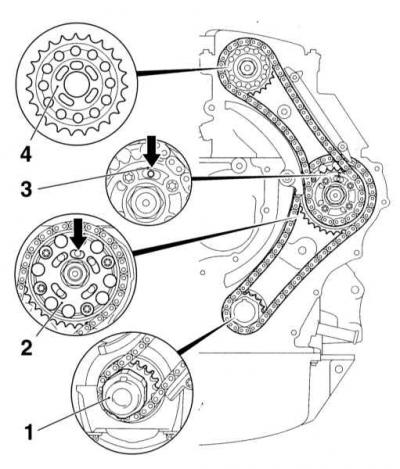
1 - Crankshaft sprocket
2 — Sprocket of the lower chain of the fuel injection pump
3 — Upper chain sprocket of the fuel injection pump
4 — Camshaft sprocket
Removal
Upper chain and sprockets
1. Disconnect the negative battery cable and remove the timing cover (see Removal and installation the timing cover).
2. Set the piston of the first cylinder to the TDC position at the end of the compression stroke (see Bringing the piston of the first cylinder to the position of the top dead center of the end of the compression stroke (TDC). Lock the crankshaft in this position.
3. In order to provide free access to the fuel injection pump sprocket cover, remove the air cleaner housing and the exhaust system inlet pipe (see Chapter Power and exhaust systems). Also remove the accessory drive belt (see Chapter Routine maintenance). Mark the position of the right engine mount support in relation to the cylinder head bracket. Remove the three bolts securing the support to the cylinder head bracket and the three bolts securing it to the mudguard. Support the right side of the engine with a trolley jack, raising it as high as possible without placing excessive load on other supports and utility lines (hoses, cables, wiring harnesses).
4. Timing chain routing diagram for 2.0L engines - see illustration Timing chain routing and sprocket positioning diagram for 2.0L engines.
5. Remove both tensioners (see Removal and installation timing chain tensioners (2.0L engines)).
6. Remove the lower bolt securing the auxiliary drive belt tension roller stand and the bolt securing the base axle. Remove the tensioner assembly from the engine.
Installation will require a new camshaft sprocket mounting bolt and new upper chain guide mounting bolts.
Do not remove the strut from the tensioner assembly unless necessary, otherwise it will have to be ground in during installation.
7. Remove the mounting bolts.
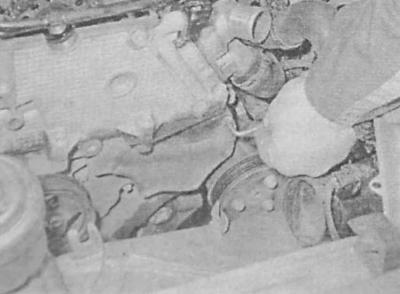
8. Remove the fuel injection pump sprocket cover from the timing chain cover.
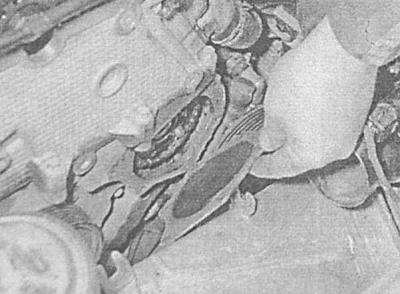
9. Using special tools, lock the sprockets of the fuel injection pump and camshaft (see Removal and installation the timing belt). If you don't have any special tools at hand, mark the installation position of the chain on the sprockets, as well as the position of the sprockets relative to their mounting flanges.
10. Remove the mounting bolts.
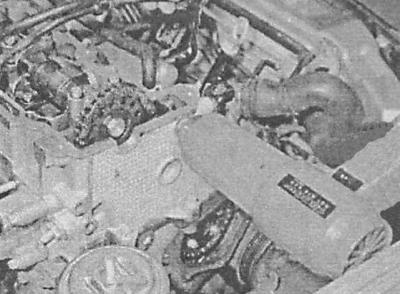
11. Remove the upper chain guide from the top of the cylinder head.
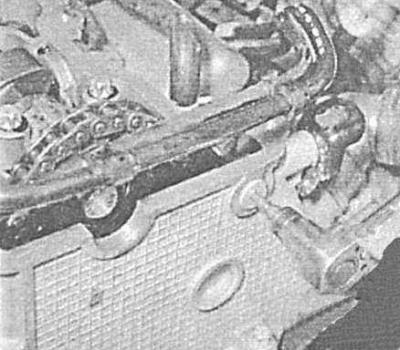
The upper chain guide mounting bolts should be heated with a heat gun before removal (with a powerful hair dryer) in order to soften the thread locking sealant and will make the task much easier.
12. Hold the camshaft with an open-end wrench by the flats and unscrew the bolt securing its sprocket. To make it easier to align the marks during installation, tie the chain to the sprocket.
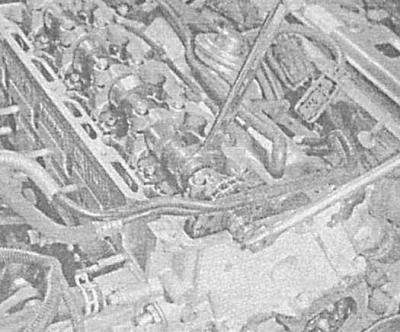
If locking devices were used, remove them before loosening the sprocket bolt, then reinstall them.
13. If installed, remove the injection pump retaining rod, then unscrew the injection pump sprocket mounting bolts to the flange. Remove the injection pump sprocket for the upper chain and the camshaft sprocket. Release the sprocket and remove the upper chain.
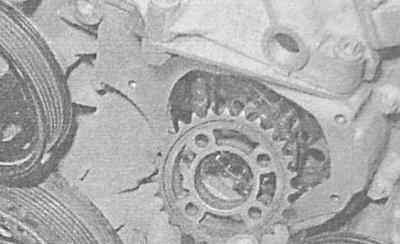
Lower timing chain and sprockets
1. Remove the upper timing chain and sprockets (see above).
2. Remove the timing chain cover (see Removal and installation the timing belt cover).
3. Mark the position of the chain on the sprockets and the sprockets on the flanges.
4. Separate the fuel injection pump sprocket from the flange and remove it together with the engine chain - try to remember the installation position of the components.
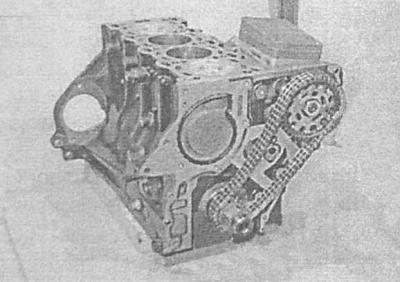
5. Remove the sprocket from the crankshaft journal.
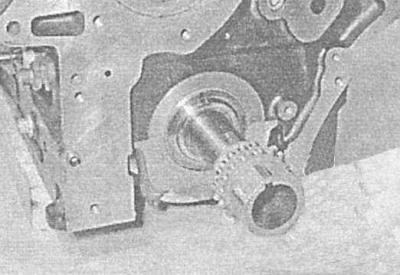
6. Remove from the groove on the journal.
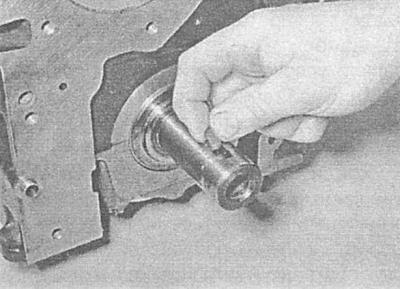
Examination
1. Inspect the sprocket teeth for signs of chipping, wear or other damage. If defects are found in at least one of the sprockets, it must be replaced together with its paired chain. The chain must also be replaced together with the sprockets.
2. Check the condition of the chain cheeks and rollers. The degree of wear is determined by the freedom of its stretching. A new chain should have almost no stretch. A worn chain is subject to replacement. The chain is also subject to replacement during major engine repairs, long-term use and the appearance of excessive noise from the timing drive. Although this is not absolutely necessary, the chain is usually replaced together with the sprockets - an attempt to save on a little sometimes results in subsequent expensive repairs. If you are not sure about the condition of the components, seek advice from car service specialists.
3. Also inspect the chain guides and the shoes of their tensioners. Damaged and worn components are subject to replacement.
Installation
Upper chain and sprockets
1. When installing new components, transfer the timing marks from the old parts to them. Make sure that the crankshaft is in the TDC position of the end of the compression stroke of the piston of the first cylinder and is locked from turning.
2. Place the chain on the camshaft sprocket and install the assembly in its original place.
3. Install the fuel injection pump sprocket and engage it with the chain.
4. Align the mounting marks made during dismantling and secure the sprockets to the flanges of the camshaft and high-pressure fuel pump; if necessary, untie the camshaft sprocket from the chain.
5. Align the timing mark on the fuel injection pump sprocket with the hole in the flange, then screw in the sprocket mounting bolts, tightening them only by hand at this stage.
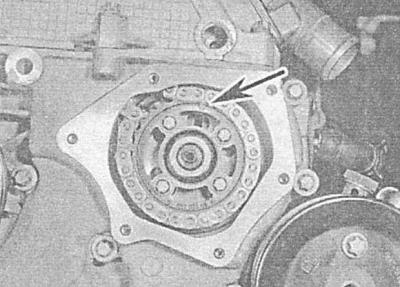
6. Install the NEW camshaft sprocket bolt, tightening it only by hand for now.
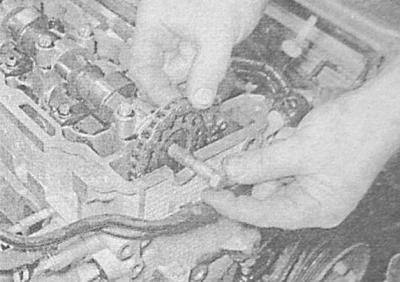
7. Install the lower chain tensioner (see Removal and installation timing chain tensioners (2.0L engines).
8. Install the upper chain guide in place (with the mounting protrusion facing up). Install NEW mounting bolts and tighten them to the specified torque.
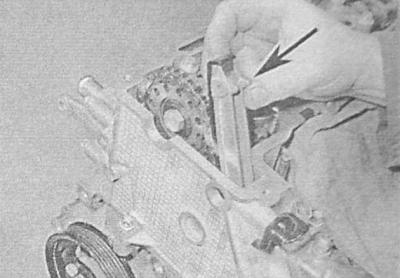
9. If you have special tools, secure the camshaft, fuel injection pump and crankshaft from turning, and also to ensure that the components are positioned correctly. If you do not have tools, make sure that the marks made during dismantling are aligned.
10. When using fixing devices, adjust the valve timing mechanism (see Checking and adjusting valve timing (2.0L engines), then remove the devices.
11. If no special tools were used, align the marks made during component disassembly, then tighten the injection pump sprocket mounting bolts to the required torque. Tighten the camshaft sprocket mounting bolt to the torque for stage 1, holding the camshaft from turning by the flats with an open-end wrench. Make sure that the marks are not offset and tighten the bolt to the corners of stages 2 and 3 — use a protractor attachment, or apply reference marks with paint or a marker.
12. Install the upper chain tensioner (see Removal and installation timing chain tensioners (2.0L engines).
13. Make sure that the mating surfaces of the fuel injection pump sprocket cover and the chain cover are absolutely clean and dry. If the cover was installed with a gasket, do not forget to replace the latter. Tighten the mounting bolts with the required force. If there was no gasket, place a sealant cushion approximately 2 mm thick in the cover groove, then press the cover, screw in the mounting bolts and tighten them with the required force.
14. Install the accessory drive belt tensioner on the engine — make sure that the axle bolts and strut mounting bolts are tightened to the required torque. When replacing a strut, or after forced dismantling of the old one, grind the strut with reciprocating movements, grasping the hexagonal part of the base with a replaceable socket head. After making sure that the strut is functioning correctly, install the drive belt (see Chapter Routine maintenance).
15. Install the right support of the power unit suspension on the cylinder head, then lower the engine and remove the jack. Secure the support to the mudguard, - make sure that the landing marks applied during dismantling are correctly aligned and tighten the mounting bolts with the required force.
16. Install the timing cover (see Removal and installation the timing cover).
17. Install the exhaust pipe, air cleaner housing and crankshaft position sensor (see Chapter Power and exhaust systems). If camshaft locking devices were used, install a vacuum pump on the cylinder head (see Chapter Brake system).
Lower chain and sprockets
1. If new components are being installed, transfer the alignment marks from the old parts to them.
2. Install the crankshaft key, then place the sprocket on the journal, making sure that the key fits into the keyway.
3. Make sure that the fuel injection pump flange is installed correctly (the cutout in the flange must be aligned with the hole in the pump body). The crankshaft must be set to the TDC position of the end of the compression stroke of the piston of the first cylinder and locked.
4. Achieving alignment of the marks applied during dismantling, insert the pump sprocket into engagement with the chain and install the assembly on the engine. Put the chain on the crankshaft sprocket. Make sure that the marks are not knocked down and that the cutout in the pump flange is aligned with the hole in the sprocket.
5. Install the cover (see Removal and installation the timing belt cover). Install the upper timing chain (see above).
Visitor comments