
OpelBook.ru
Cars AvtoVAZ Cars Mitsubishi Cars BMW Cars Mercedes Cars Nissan Cars Toyota Cars Chevrolet
English Русский
Български
Беларускі
Український
Српски
Hrvatski
Română
Polski
Slovenský
Magyar
 |  Sitemap  |  Contacts  |    


Main Astra Corsa Insignia Kadett Omega Vectra Zafira Others Articles
Corsa B (1993-2000) Corsa C (2000-2006, petrol) Corsa C (2000-2006)
  • Main
  • Corsa
  • Corsa B
  • General information
  • Maintenance
  • Checking and adjusting idle speed and maximum speed

Checking and adjusting idle speed and maximum speed (Opel Corsa B)

            0

Contents: Idle speed ⬇ Maximum revolutions ⬇
Models with diesel engine up to 08.1997. (every year).


To adjust the idle speed of a diesel engine, a tachometer operating on the principle of a photocell is required. The photodiode of such a tachometer reacts to light reflected from a white mark. The number of revolutions is read directly from the device.


1. Apply a 1-2 cm wide chalk line to the front flange of the crankshaft pulley or stick a strip of aluminum foil of the same width.

Strip on crankshaft pulley
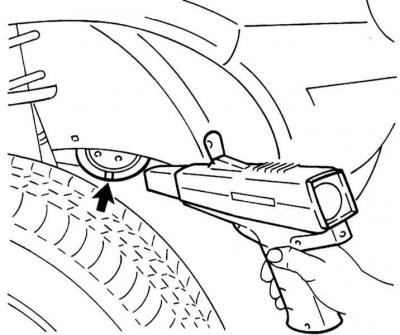
Strip on crankshaft pulley


2. Start the engine and warm it up. After the coolant reaches operating temperature, drive the car for another 5 km to warm the engine oil to a temperature of at least 70 degrees.

3. Turn off all power consumers.

Idle speed


1. Check the speed with a tachometer. It should be in the range 830÷930 rpm.

2. If necessary, loosen the lock nut on the speed control lever on the high-pressure fuel pump and adjust the idle speed with the adjusting screw.

Adjusting the idle speed
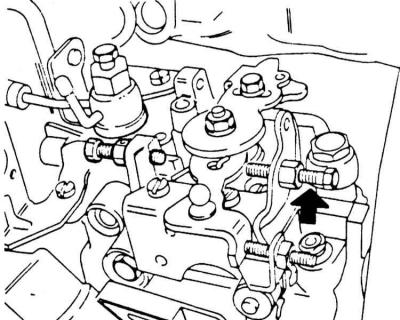
Adjusting the idle speed


3. Fix the adjusting screw.


Maximum revolutions


1. Press the gas pedal all the way down and check the RPM with a tachometer. Compare the obtained values with the requirements Vehicle settings and routine maintenance.

2. If necessary, loosen the lock nut of the maximum speed adjustment lever on the high-pressure fuel pump and adjust the maximum speed with the adjusting screw. First remove the protective cap from the adjusting screw.

Adjusting maximum speed
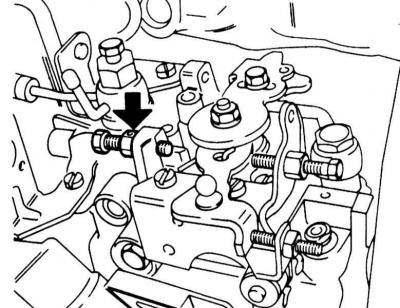
Adjusting maximum speed


At maximum speeds above the requirements of the Specifications, in Chapter Vehicle settings and routine maintenance, engine damage may occur.


3. Secure the adjusting screw and place a new protective cap on it.


This article is available at russian, bulgarian, belarusian, ukrainian, serbian, croatian, romanian, polish, slovak, hungarian
Checking the article: Trifonova Emilia

Share information:

Previous articles
Opel Corsa B: Maintenance
Next articles

Monitoring the condition of the anti-corrosion coating of the car body and underbody
Checking electrical equipment
Checking the brake system
Checking the exhaust system
Checking the condition and replacing the brushes
Checking, servicing and charging
Replacing the filter element
Checking and servicing air conditioning and ventilation
Replacing the fuel filter
Checking the composition of exhaust gases
Lubrication of locks, hinges and stops
Inspection of suspension components


See similar ones from other Opel car manuals:
▶ Checking and adjusting maximum engine speed Opel Astra G (1998-2004)
▶ Checking and adjusting engine idle speed Opel Kadett E (1984-1995)
▶ Checking and adjusting the idle speed — every 10,000 km Opel Omega A (1986-1993)
▶ Checking and adjusting maximum speed Opel Vectra B (1995-2002)
▶ Checking and adjusting engine idle speed and CO levels Opel Frontera A (1991-1998, petrol)
Link to this page in different formats

Visitor comments


No comments yet


How much will 16 + 42 =


Corsa C (2000-2006) 
  • General information
  • Introduction to guide
  • Troubleshooting
  • Vehicle device
  • User manual
  • Maintenance
  • Power unit
  • Engine repair
  • Cooling system
  • Power and exhaust system
  • Control system
  • Engine electrical equipment
  • Transmission
  • Clutch
  • Mechanical gearbox
  • Automatic gearbox
  • Drive shafts
  • Chassis
  • Brake system
  • Wheel suspension
  • Steering
  • Body
  • Exterior
  • Interior
  • Doors and windows
  • Heating and air conditioning
  • Electrical equipment
  • Equipment and devices
  • Lamps and lighting
  • Electrical circuits
Corsa C (2000-2006, petrol) 
  • User manual
  • Car access
  • Governing bodies
  • Seat control
  • Heating and air conditioning
  • Driving and maintenance
  • Engines 1.0 and 1.2 l
  • Engine repair
  • Cooling and lubrication system
  • Injection system
  • Engines 1.4, 1.6 and 1.8 l
  • Engine repair
  • Cooling and lubrication system
  • Injection system
  • Transmission
  • Clutch
  • Mechanical gearbox
  • Automatic gearbox
  • Drive shafts
  • Chassis
  • Wheels and tires
  • Wheel suspension
  • Steering
  • Brake system
  • Body
  • Exterior
  • Doors and windows
  • Electrical equipment
  • Equipment and devices
  • Lighting system
  • Electrical circuits
Corsa B (1993-2000) 
  • General information
  • Introduction to guide
  • User manual
  • Maintenance
  • Power unit
  • SOHC gasoline engines
  • DOHC gasoline engines
  • Diesel engines
  • Engine repair
  • Cooling system
  • Supply system
  • Injection system (gasoline)
  • Injection system (diesel)
  • Exhaust systems
  • Control system (gasoline)
  • Preheat system (diesel)
  • Charge and launch system
  • Transmission
  • Mechanical gearbox
  • Automatic gearbox
  • Clutch and drive shafts
  • Chassis
  • Brake system
  • Front suspension
  • Rear suspension
  • Steering
  • Body
  • Ventilation and heating
  • Exterior
  • Interior
  • Doors and windows
  • Electrical equipment
  • Equipment and devices
  • Lamps and lighting
  • Electrical circuits
OpelBook.ru © 2017–2026 · Mobile version · · Sitemap: EN BG BY UA RS HR RO PL SK HU · Feedback · Site search
Astra F, petrol · Astra G, petrol · Astra G · Astra H · Astra J, petrol · Corsa B · Corsa C, petrol · Corsa C · Insignia A · Kadett D · Kadett E · Omega A · Omega B · Omega B2 · Vectra A, petrol · Vectra A · Vectra B, petrol · Vectra B · Vectra C · Zafira A, petrol · Frontera A, petrol · Frontera B · Ascona C · Vivaro A ·
We want your visit to be comfortable 🤝! We use cookies 🍪 to make that happen.