


Contents: General information ⬇ Z16XEP Engine ⬇ Z18XE Engine ⬇ Engines Z20LE(L/R/H) ⬇ Z17DT(L/H) Engines ⬇ Z19DTH Engine ⬇ Z14XEP Engine ⬇
Caution: Before starting work on removing the timing belt/chain, do not forget to disconnect the cable from the negative terminal of the battery!
General information
The main purpose of the toothed belt/chain is to drive the valve timing mechanism, while it ensures coordinated opening/closing of the valves depending on the current stroke of the working cycle in each of the engine cylinders. In addition, on various engine models, some auxiliary units, such as the high-pressure fuel pump, are driven by means of a toothed belt/chain (diesel models), water pump, and on some engines, an oil pump. Before removing the belt, it is recommended to draw a diagram of its tension. The sequence of operations for removing and installing the timing belt is almost the same for most engines, the differences are determined by the design features of the engines. If some belt replacement operations are not provided in full, as a rule, they do not present any particular difficulties and require only minimal knowledge of plumbing - refer to the description of the belt replacement procedure on the Z16XEP engine.
It is recommended to replace the belt each time it is removed from the engine. If you plan to reuse the belt, mark it with a marker before removing it from the pulleys (in the form of an arrow) to determine the direction of rotation during subsequent installation.
Note: The belt rotates clockwise when viewed from the belt drive side of the engine.
Chain drive (models Z14XEP, Z22YH, Z13DTH) complicates the valve timing adjustment procedure and it differs significantly from the same procedure with a toothed belt. In this case, contact the company's service station or purchase a special tool from official Opel representatives.
During operation, due to weakening of the belt/chain, increase in length or some damage to the belt, it/she may jump one or more teeth on the gear wheels/sprockets of the camshafts, which will lead to a violation of the timing phase coordination, a decrease in engine efficiency, and in some cases to failure of the valves or pistons of the cylinders. Adjustment of the timing phases is carried out with the toothed belt/chain removed by aligning the marks on the pulleys of the camshafts and the engine crankshaft when setting the TDC position for the corresponding piston (see Section 6).
Caution: When turning the camshafts with the timing belt/chain removed, none of the pistons should be in the TDC position - otherwise the valves will rest against the piston, which may damage the valves and/or pistons. It is necessary to turn the engine crankshaft approximately 60° from the TDC position! The crankshaft may not be turned if only a small displacement of the camshafts is required.
Note: After replacing the timing belt, it is recommended to stick a label on the upper timing belt cover indicating the current mileage and replacement date.
Z16XEP Engine
Removal
1. Set the piston of the first cylinder to the TDC position of the compression stroke (see Section 6) - check the valve timing.
2. Remove the multi-rib belt (see Section 7).
3. Remove the right engine boot and disconnect the crankshaft pulley (see Section 5).
4. Remove the multi-rib belt tensioner by loosening the engine block mounting bolt while the tensioner is in the pinned position.
5. Remove the lower timing belt drive cover (see accompanying illustration), unscrewing the mounting bolts.
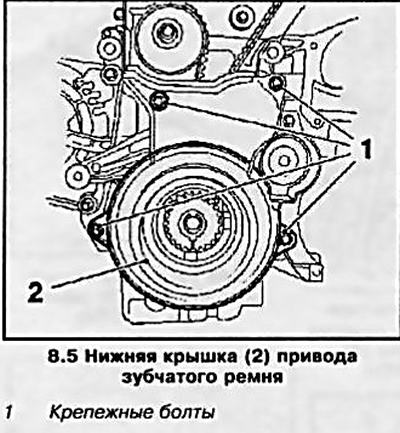
6. Set the TDC position for the piston of the first cylinder of the engine again. Check that all marks match (see illustration 8.6, I and III) and fix the position of the camshafts using special devices (see illustration 8.6, I and II).
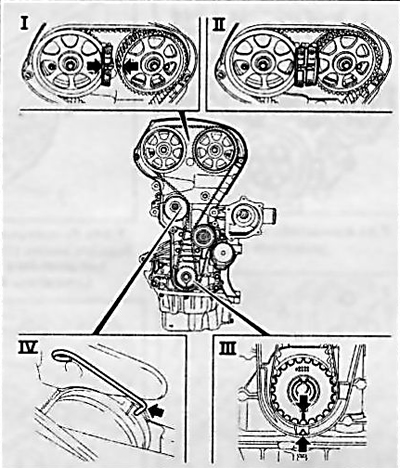
8.6 Removing/installing the timing belt (z16XER engine)
I Checking the alignment of marks on the camshaft wheels (arrows), installing the KM-6340-left device
II Installation of the KM-6340-right device
III Marks for setting TDC on the crankshaft gear (with the pulley removed)
IV Installation with the KM-6333 device (arrow)
Note: If the marks on the gears do not match, there is no need to fix the camshafts.
When removing the timing belt, the tension roller is pressed clockwise with a socket wrench and fixed with the KM-6333 device (see illustration 8.6, IV).
7. If the timing belt is to be reused, do not forget to mark the direction of rotation before removing it. Remove the belt carefully so as not to damage it when threading it through the engine mount. A belt that has characteristic signs of wear, kinks or damage must be replaced without fail.
8. If, when checking the valve timing adjustment, the marks on the timing gear teeth do not match, it is necessary to align the marks after removing the belt by turning the camshafts accordingly and fix the shafts from turning using devices (see illustration 8.6, I and II).
Installation
9. Before installing the timing belt, it is necessary to insert it into a special mounting device, which is included in the delivery set together with the belt (see accompanying illustration). It prevents the belt from bending when threading it through the engine support.
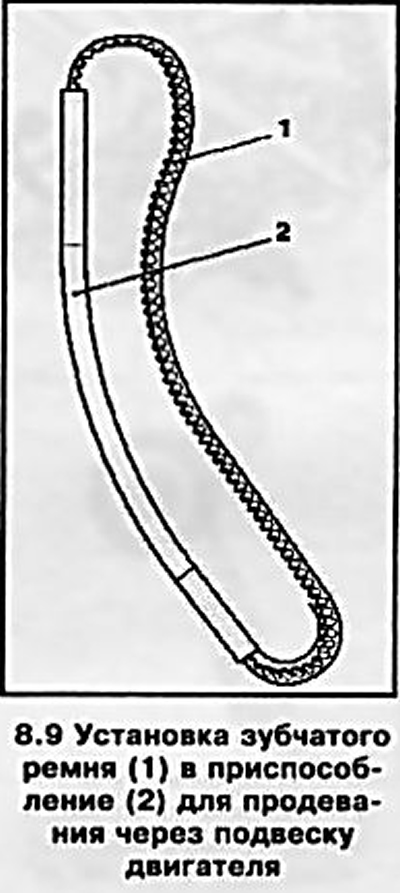
Caution: Overbending may cause the belt to break during operation and cause serious damage to the engine!
10. Remove the fixture and install the timing belt on the pulleys in the following order: exhaust camshaft timing gear, intake camshaft timing gear, tensioner and guide rollers, crankshaft pulley.
11. Remove the retainer from the tension roller - the timing belt tension occurs automatically.
12. Unlock the flywheel if it remains locked after installing the crankshaft pulley (see Section 5), turn the crankshaft 2 revolutions in the direction of engine rotation (clockwise) and set the TDC position for the first cylinder piston again. Check the valve timing - remove and reinstall the toothed belt if necessary.
13. Installation of all other removed components is carried out in the reverse order of removal.
Z18XE Engine
Removal
14. Set the piston of the first cylinder to the TDC position of the end of the compression stroke (see Section 6) - check the valve timing.
15. Remove the multi-rib belt (see Section 7).
16. Remove the right front wheel (see Introduction) and the right engine boot (see Section 5).
17. Remove the multi-rib belt tensioner by removing it from the generator bracket (see accompanying illustration).
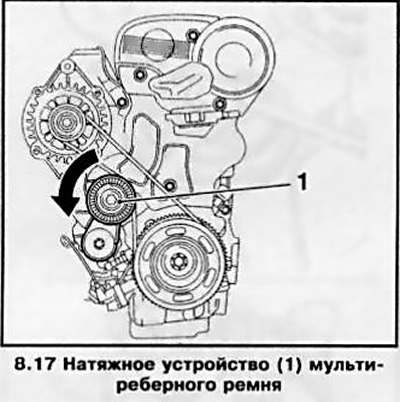
18. Remove the crankshaft pulley (see Section 5).
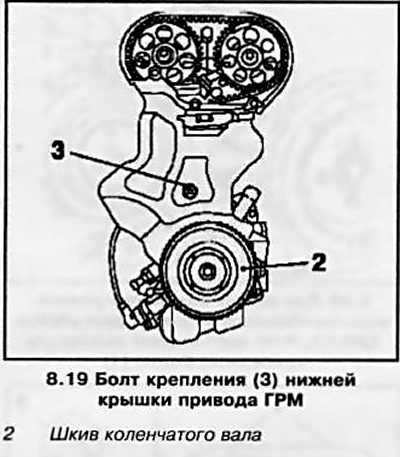
19. Remove the lower timing belt cover (see accompanying illustration), unscrewing 1 mounting bolt.
20. Install the right engine mount removal tools (see Section 5).
21. Screw the crankshaft pulley and timing drive drive gear retaining bolt into place (into the crankshaft).
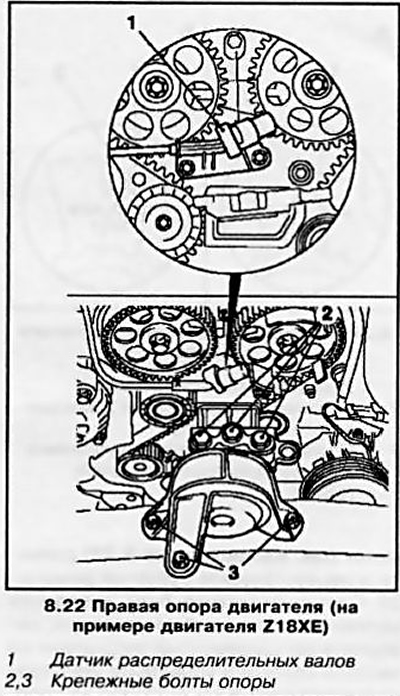
22. Disconnect the camshaft sensor from the cylinder head by unscrewing 2 bolts and remove the right engine mount by unscrewing 6 mounting bolts (see accompanying illustration).
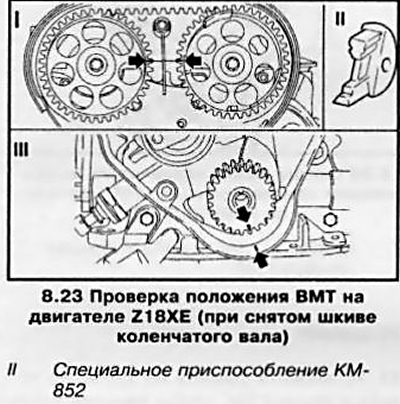
23. Set the TDC position again for the piston of the first cylinder of the engine, check that all marks match (see illustration 8.23, I and III) and fix the position of the camshafts using a special device (see illustration 8.23, II).
Note: If the marks on the gears do not match, there is no need to fix the camshafts.
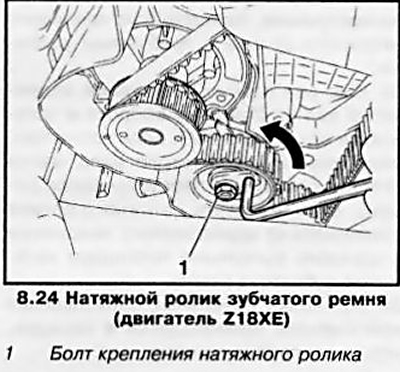
24. Loosen the mounting bolt and turn the timing belt tension roller (see accompanying illustration) for the adjusting eccentric in the direction opposite to the arrow (clockwise) until the tension roller pointer is positioned in front of the left stop, tighten the bolt. If necessary, mark the direction of rotation of the belt and remove it.
25. If, when checking the valve timing adjustment, the marks on the timing gear gear do not match, it is necessary to set the marks to the required position after removing the belt by turning the camshafts and fix them with a special device (see illustration 8.23, II).
Installation
26. Install the belt on the wheels and rollers so that the pull branch (right) is taut, do not forget to check the direction of rotation of the belt.
27. After replacing/removing the belt, it is necessary to adjust its tension. To do this, loosen the fastening bolt and turn the toothed belt tension roller (see illustration 8.24) by the adjusting eccentric in the direction of the arrow so that the tension roller indicator is in front of the right stop, tighten the bolt.
28. Remove the KM-852 device, smoothly turn the crankshaft 2 full turns clockwise and set the piston of the first cylinder to the TDC position. To check the position, reinstall the KM-852 device; if no adjustment is required, remove it. If the marks do not match, (see illustration 8.23) remove and reinstall the timing belt.
29. Slightly loosen the timing belt tension roller mounting bolt, turn the adjusting eccentric clockwise and set the tension roller pointer as shown in the accompanying illustration. Tighten the tension roller mounting bolt to the required torque.
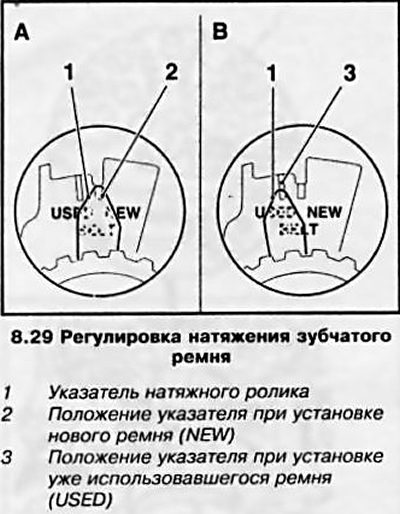
30. Once again, smoothly turn the crankshaft by 2 full revolutions and set the TDC position. If after turning the crankshaft the timing marks do not match, reinstall the belt; if the tension roller indicator deviates from the standard position, repeat the toothed belt tensioning procedure.
31. Installation of the remaining removed components is carried out in the reverse order of removal.
Engines Z20LE(L/R/H)
Removal
32. Set the piston of the first cylinder to the TDC position of the end of the compression stroke (see Section 6) - check the valve timing.
33. Remove the multi-rib belt (see Section 7).
34. Remove the engine boot, press back the multi-rib belt tension roller and secure it with a suitable pin.
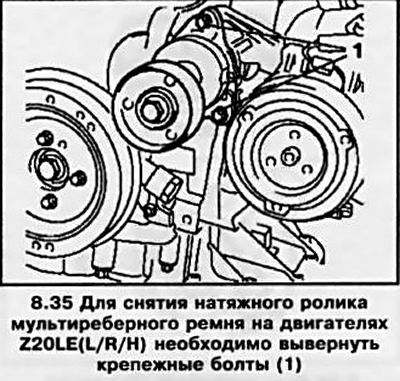
35. Remove 2 mounting bolts (see accompanying illustration) and remove the tension roller.
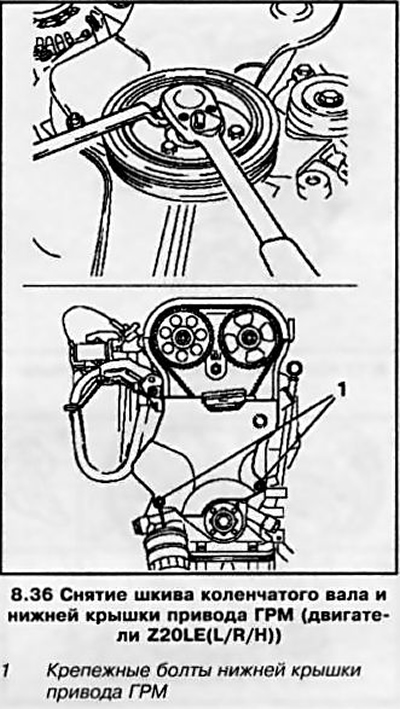
36. Remove the crankshaft pulley by unscrewing the 4 mounting bolts, holding the shaft from turning with a socket wrench (see accompanying illustration). Unscrew the 2 mounting bolts and remove the lower timing belt cover.
37. Install the special tool for removing the right engine mount (see Section 5) and remove the support by unscrewing the 6 mounting bolts (see illustration 8.22).
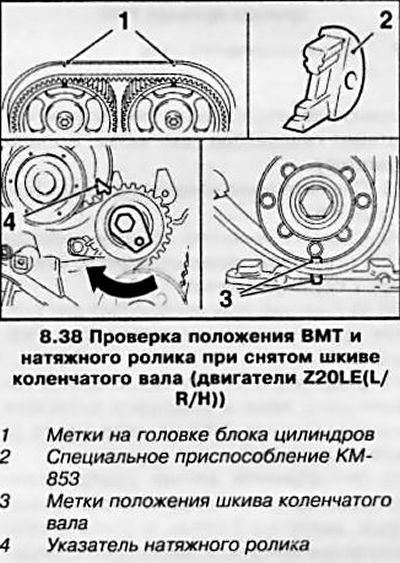
38. Check the TDC position of the camshaft and crankshaft (see accompanying illustration) — all marks must match. Fix the position of the camshaft gears with the KM-853 device.
Note: If the marks on the wheels do not match, there is no need to fix the camshafts.
39. Loosen the toothed belt by loosening the tension roller mounting bolt and turning the adjusting eccentric in the direction of the arrow with an end wrench (see illustration 8.38) so that the tension roller pointer is next to the left stop, tighten the bolt. If necessary, mark the direction of rotation of the belt and remove it.
40. If, when checking the valve timing adjustment, the marks on the timing gear gear do not match, it is necessary to align the marks after removing the belt by turning the camshafts to the required position and fix them with a special device KM-853.
Installation
41. Install the belt on the toothed wheels and rollers so that the pull branch (right) is tensioned, do not forget to check the direction of rotation of the belt.
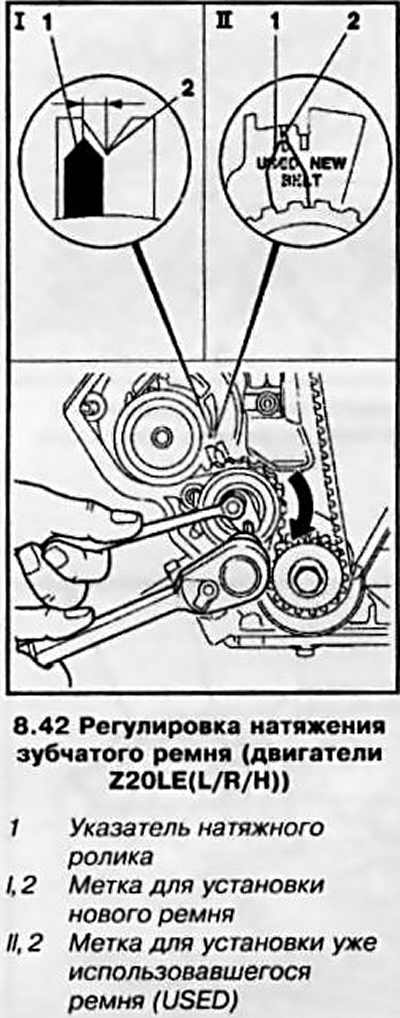
42. After replacing/removing the belt, it is necessary to adjust its tension. The adjustment is performed similarly to the same operation for the Z18XE engine (see paragraphs 27-30)Depending on the configuration, two types of adjustment devices can be installed on engines (see accompanying illustration). In the first version, when installing a new belt, the indicator should be set to the central mark (cutout), and when installing an already used one, 4 mm to the left of this mark. In the second version, both positions have corresponding marks - "NEW" / "USED" ("NEW" / "USED").
43. Installation of the remaining removed components is carried out in the reverse order of removal.
Z17DT(L/H) Engines
Removal
44. Perform the operations described in paragraphs 45-49, Section 6. After removing the air cleaner, remove the multi-rib belt (see Section 7).
45. Remove the engine crankcase guard and install the right engine mount removal tool (see Section 5).
46. Remove the crankshaft pulley by unscrewing the 4 mounting bolts while holding the pulley from turning by the central journal of the crankshaft using a hex key.
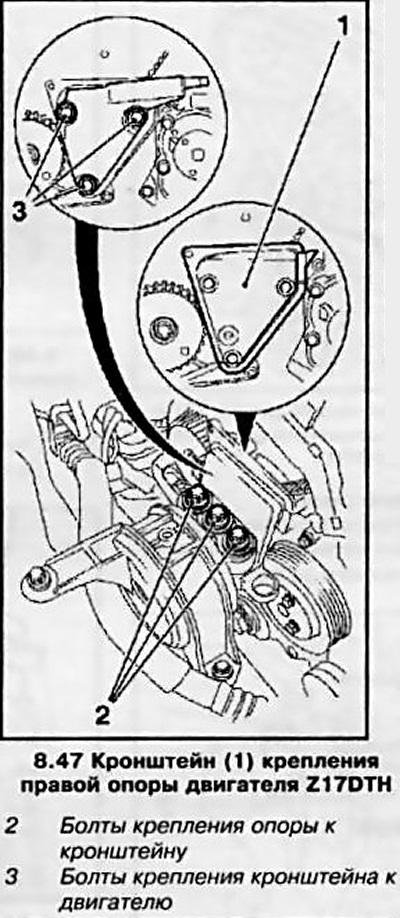
47. Remove the right engine mount by unscrewing the 6 mounting bolts (see accompanying illustration) and remove the right support mounting bracket.
48. Remove the water pump drive pulley of the engine cooling system by unscrewing 3 bolts (see Chapter 3).
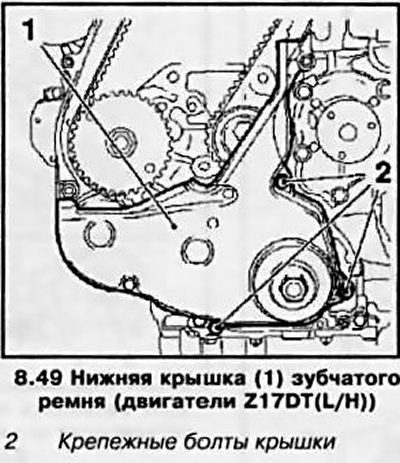
49. Remove the lower timing belt cover (see accompanying illustration).
50. Set the piston of the first cylinder to the TDC position of the end of the compression stroke (see Section 6).
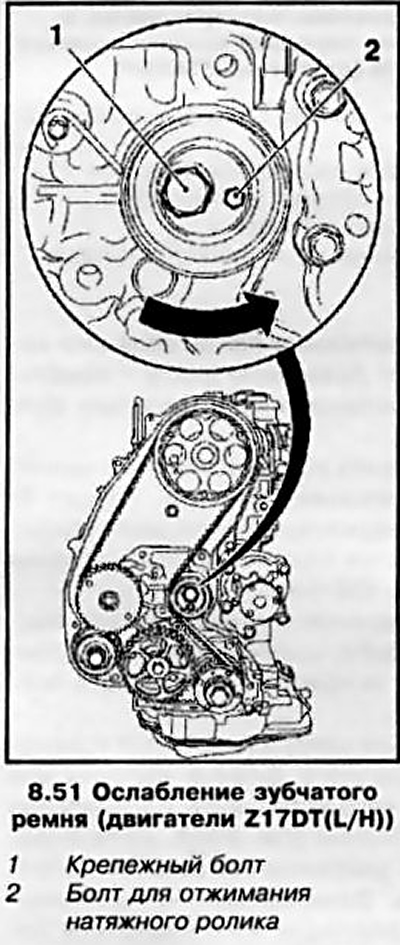
51. Mark the direction of rotation of the timing belt, loosen the tension roller mounting bolt (see accompanying illustration) and using an open-end wrench, press the roller in the direction of the arrow, loosen the belt and tighten the roller mounting bolt in the pressed position. Remove the belt.
Installation
52. Install the toothed belt, observing the direction of rotation, on the drive gears in the order indicated by the arrow (see accompanying illustration). Note: The fuel injection pump and timing drive wheels must be secured with bolts, the marks on the crankshaft mounting flange and the oil pump housing must match.
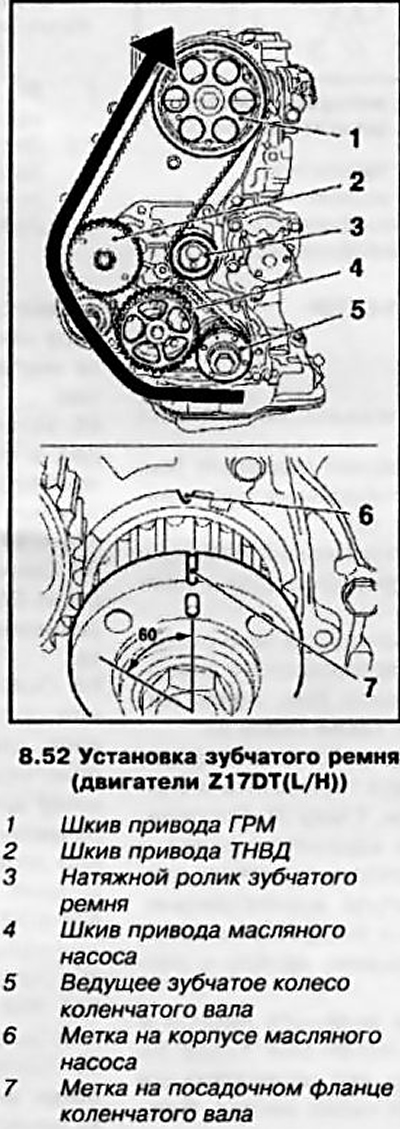
53. Loosen the tension roller mounting bolt and release the roller - the belt will tighten. Unscrew the adjusting bolts of the fuel injection pump and timing belt gears.
54. Turn the crankshaft 60° against the direction of rotation of the shaft (counterclockwise) (see illustration 8.52) and tighten the tension roller mounting bolt to the required torque.
55. Smoothly turn the crankshaft 2 full turns clockwise and set the piston of the first cylinder to the TDC position - the marks on the crankshaft flange and the oil pump housing should match. Screw the adjusting bolts into the fuel injection pump and timing belt drive pulleys - if at least one of the bolts does not screw in (the holes on the pulley and the engine housing did not match), reinstall the timing belt.
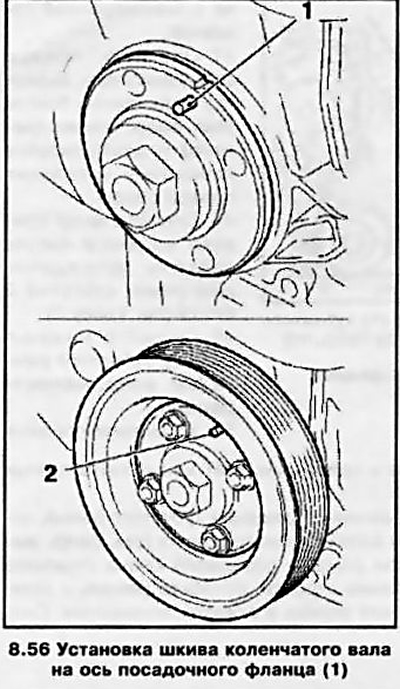
56. Installation of removed and disconnected components is carried out in the reverse order of dismantling. When installing the crankshaft pulley, it is necessary to align the axis of the mounting flange with the hole in the pulley (see accompanying illustration), do not forget to replace the pulley mounting bolts. Tighten all fasteners to the required force (see Specifications). After completing the work, check the coolant level and make the appropriate adjustments if necessary.
Z19DTH Engine
57. When installing the timing belt, place it on the toothed wheels so that its pulling side is taut (see accompanying illustration). In this case, observe the specified direction of rotation of the toothed belt (clockwise).
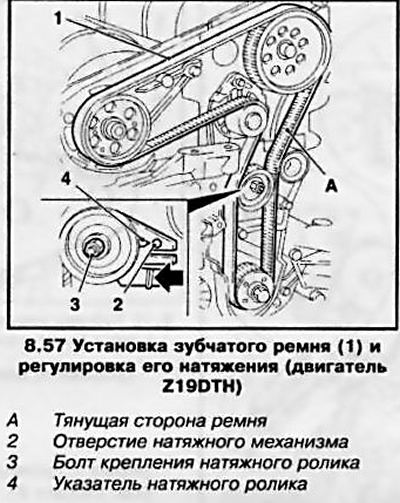
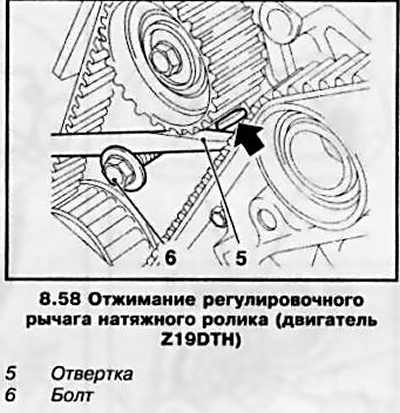
58. The tension of the toothed belt is carried out with the help of an assistant, for which purpose screw in a bolt to use it as a support (see accompanying illustration), and press the adjusting lever with a screwdriver in the direction of the arrow so that the tension roller pointer is opposite the hole. Tighten the mounting bolt.
59. Turn the crankshaft 2 full turns clockwise and set the TDC position for the piston of the first cylinder. Loosen the tension roller mounting bolt and readjust the toothed belt tension. Then tighten the roller mounting bolt with a force of 25 Nm.
Z14XEP Engine
Removal
60. Drain the coolant from the engine cooling system (see Chapter 3) and remove the engine oil pan (see Section 12).
(Article posted on an online resource: «OPELBOOK.ru»)
61. Remove the multi-rib belt and the multi-rib belt tension roller (see Section 7).
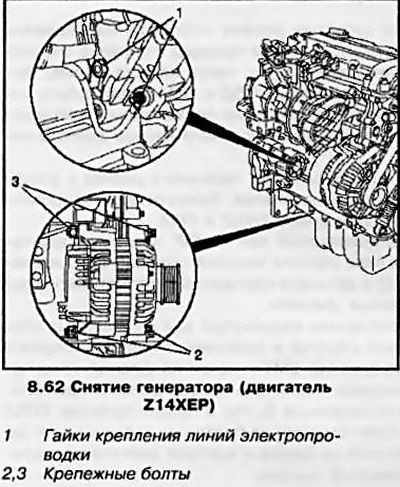
62. Remove the generator by disconnecting the electrical wiring lines and unscrewing the mounting bolts (see accompanying illustration). (See also Chapter 5).
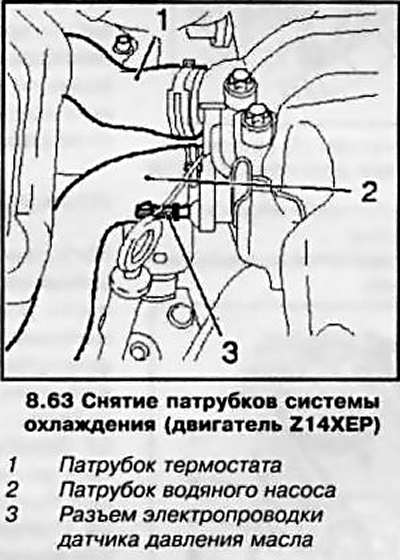
63. Disconnect the cooling system hose from the thermostat housing and remove the thermostat (see Chapter 3). Disconnect the water pump connection and the wiring connector from the oil pressure sensor (see the accompanying illustration.
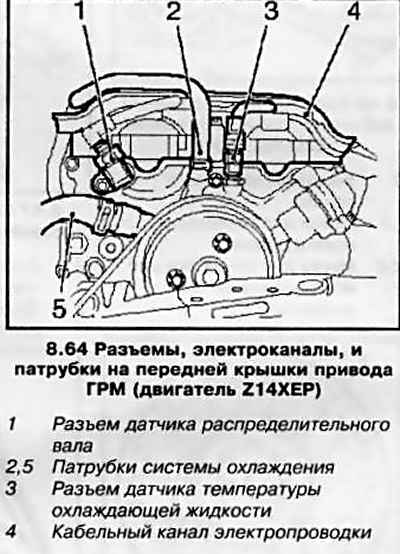
64. Disconnect all connectors, channels and pipes shown in the accompanying illustration.
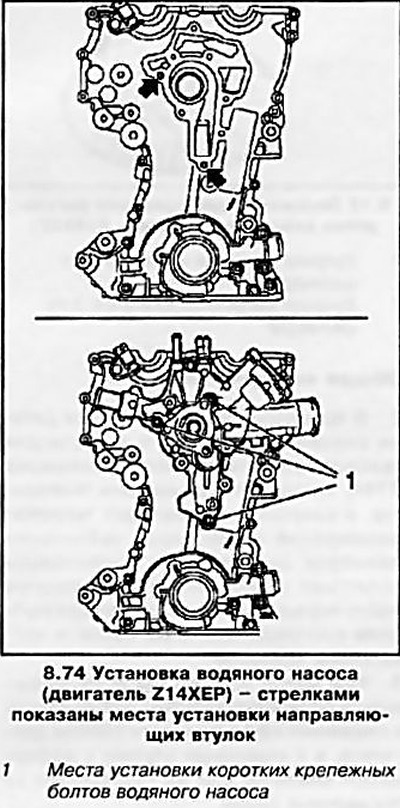
65. Remove the water pump pulley and remove the water pump (see Chapter 3). Make sure that the two guide bushings remain in place.
Note: The water pump mounting bolts are different lengths - mark the installation locations of the three short bolts!
66. Set the piston of the first cylinder to the TDC position (see Section 6) after checking the position of the camshafts, remove the KM-953 and KM-954 devices.
67. Remove the crankshaft pulley by unscrewing 6 bolts, holding the shaft from turning by the head of the central bolt.
68. Loosen the central bolt securing the crankshaft mounting flange, for which purpose install a special device (see accompanying illustration) to keep the shaft from turning.
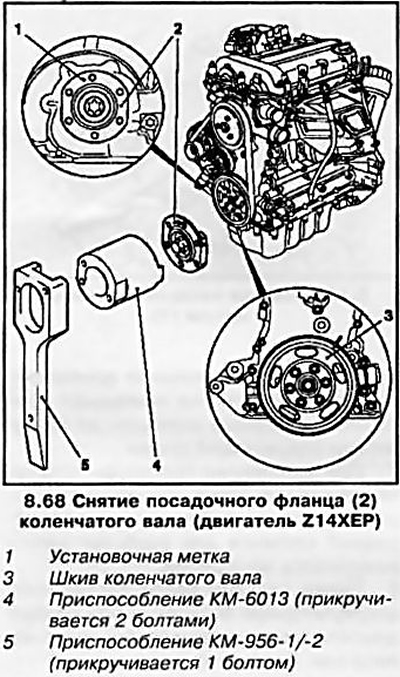
Note: When performing this operation, use the help of an assistant. The KM-952 device must be removed from the mounting hole.
69. Reinstall the KM-952 device, completely unscrew the central bolt and remove the mounting flange.
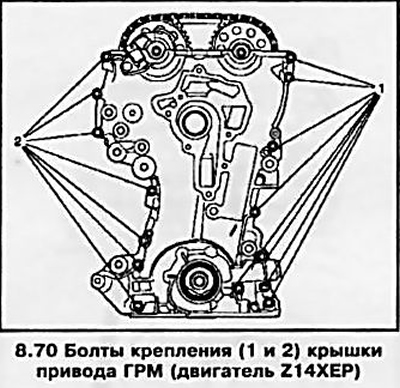
70. Remove 15 mounting bolts (see accompanying illustration) and remove the timing belt cover.
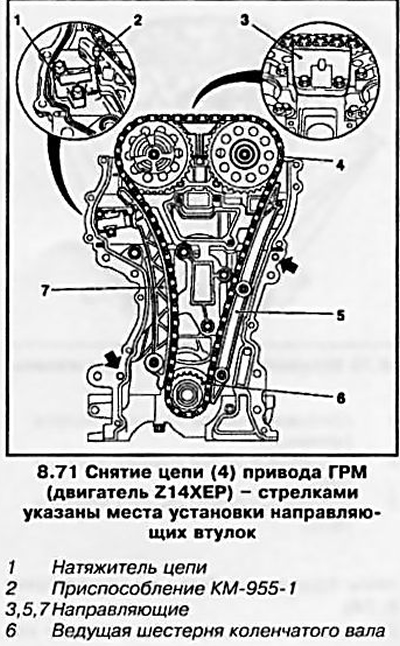
71. Pull back and secure the chain tensioner using the KM-355-1 tool (see accompanying illustration). Remove the guides (alternately - (3), (5), (7)) and remove the chain from the crankshaft drive sprocket. Remove the timing cover gasket. Clean the mating surfaces.
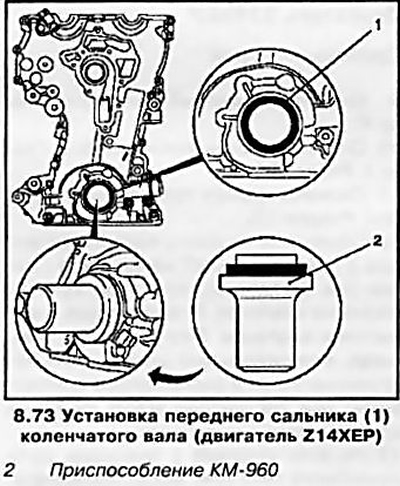
72. Carefully remove the front crankshaft oil seal from the timing cover seat using a suitable tool - do not damage the seating surfaces.
Note: The seal must be replaced every time the timing chain is replaced/removed.
Installation
73. Lubricate the outer surfaces of the new seal with silicone grease (white) and install the seal using the KM-960 tool (see accompanying illustration) into the seat of the timing belt cover.
74. Remove any remaining old gasket from the timing belt cover and install a new water pump gasket on the cleaned surface - make sure the guide bushings are installed correctly (see accompanying illustration). Install the water pump onto the drive cover, securing it with 3 short bolts.
75. Remove the elastomer gaskets (see accompanying illustration) the joints of the cylinder head with the cylinder block and replace them with new ones, having previously lubricated them with silicone sealant (gray color), applying a strip of sealant approximately 2 mm thick. In the absence of elastomeric gaskets, the joints of the mating surfaces can be filled with sealant without installing gaskets.
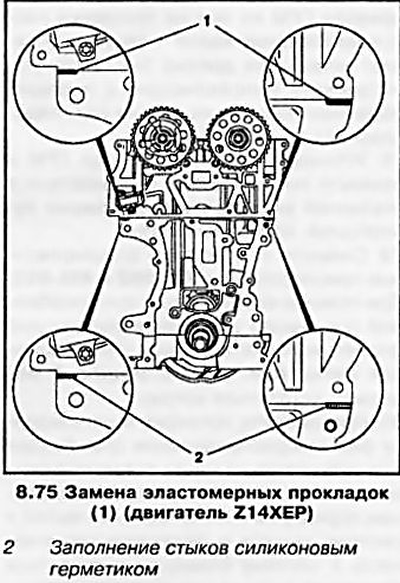
Caution: Installation of the timing belt cover must be completed within 10 minutes after applying the sealant!
76. Install a new timing cover gasket onto the engine - make sure the guide bushings are installed correctly (see illustration 8.74).
77. Install the crankshaft drive sprocket onto the shaft and install the timing chain onto it on the camshaft sprockets - the pull (right) branch of the chain should be taut. Install the guides in the reverse order of their removal (see paragraph 71).
78. Install the timing belt cover and tighten the mounting bolts one by one, in accordance with the numbers shown in the accompanying illustration.
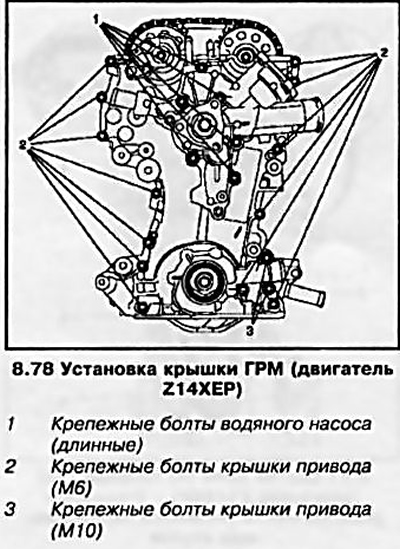
79. Remove the adjusting devices KM-952 and KM-953 from the engine. Using special devices (see above), install the crankshaft mounting flange - installation mark (see illustration 8.68) should be at the top.
80. Check and adjust the valve timing (see Section 6) and install the remaining removed components in the reverse order of their removal. Fill the lubrication system with oil and coolant into the engine cooling system; check the systems for leaks.
Visitor comments