


Contents: Removal and installation the engine…⬇ Installing the tool to remove the…⬇ Removal and installation the…⬇ Removal and installation camshaft…⬇
1. This Section contains some preparatory operations that must be performed when performing various maintenance and engine repairs. As a rule, they are common to all engines described in this Manual. When you first read the book, the materials in this Section can be used - refer to them only when you find a corresponding reference in other sections and chapters.
Removal and installation the engine boot and engine crankcase protection
2. When performing many operations, in order to gain access to the relevant units, it is necessary to remove the right engine boot on petrol models, and the engine crankcase protection on diesel models.
3. First, you need to jack up and place the car on stands or lift it on a lift.
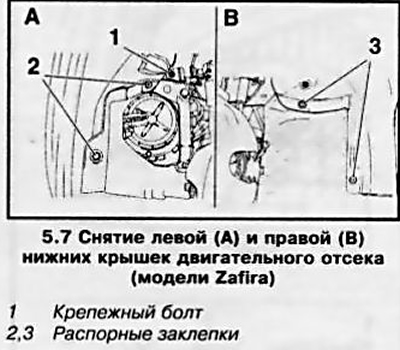
4. To remove the right boot (see accompanying illustration) unscrew 4 bolts and remove 2 rivets.
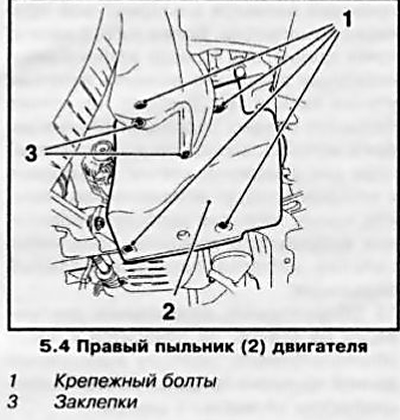
Note: In some cases it may be necessary to remove the right front wheel.
5. The crankcase protection has a service cover designed to provide access to the drain plug on the crankcase for draining engine oil - if necessary, unscrew the 4 bolts and remove the cover.
6. On Astra models, it is necessary to first release the drain hose from the holder on the right side of the engine compartment (see illustration 5.6a). Then, on both sides of the car, unscrew the mounting bolts, remove 2 rivets (see illustration 5.6b) and detach the engine compartment sides from the wheel arches. Remove the 8 mounting bolts (see illustration 5.6c) and remove the crankcase protection.
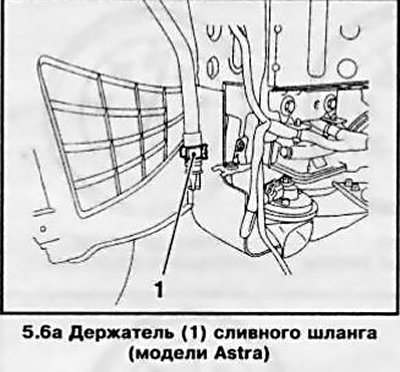
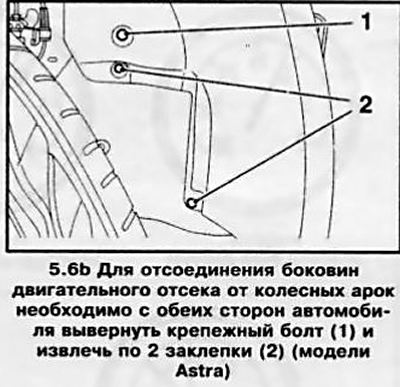
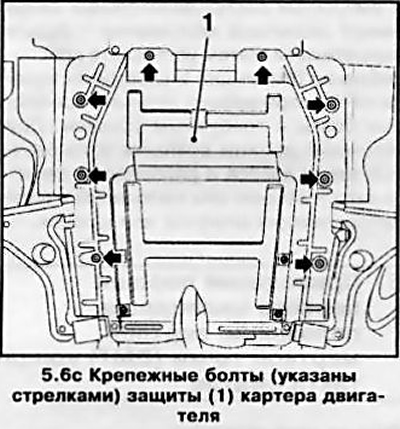
7. On Zafira models, it is necessary to first remove the lower side covers of the engine compartment, for which on the left side, unscrew the fastening bolt and remove 2 rivets, and on the right side, remove only 2 expansion rivets (see accompanying illustration). Further operations are performed in the same way as on Astra models.
8. Installation is carried out in reverse order.
Installing the tool to remove the right/left engine mount
9. The design of the front suspension and the location of the drive units on the engines are made in such a way that the toothed belt/chain, and in some cases the multi-rib belt, are installed as if around the right engine support. When carrying out work with the removal of belts, it is possible to dismantle the right support so as not to remove the engine from the car. Removal of the left pore is required for its replacement, as well as when removing the engine (see Section 19) or transmissions (see Chapters 6 and 7).
10. To carry out the work, you will need a lifting device (hoist) with appropriate devices for lifting the engine or a universal (for all engines described in this Manual) opel kit for holding the engine on the front subframe of the car during the removal/replacement of the support. Using a hoist is less convenient and sometimes even unacceptable. In some cases, a jack can be used to hang the engine, placing a wooden block of suitable size between the jack head and the engine.
11. The procedure for installing/removing the universal fixture is described below.
12. Jack up and place the vehicle on stands or lift it. Remove, if necessary, the right-hand dust cover or engine sump guard (see above).
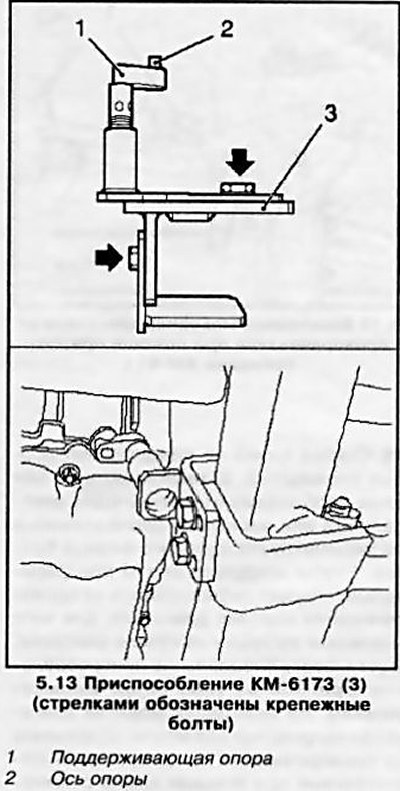
13. Loosen the 4 bolts of the KM-6173 device (see accompanying illustrations) and install the fixture on the front subframe. Unscrew the fixture's support support until it rests against the cylinder block, with the support axis entering the hole in the block. Tighten the bolts.
Text copied from an internet website (OPELBOOK)
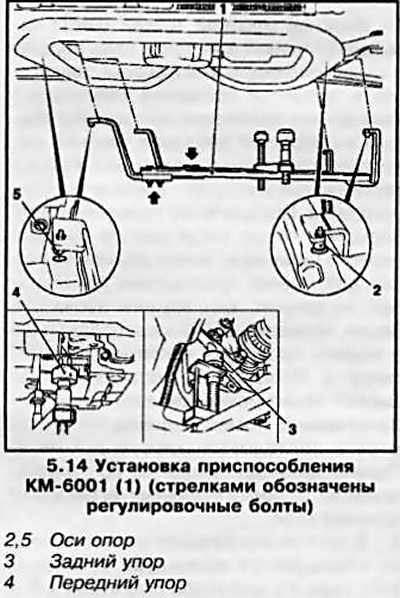
14. Prepare the KM-6001-A device (see accompanying illustration) to install on the corresponding engine model, for which loosen the 3 adjusting bolts and adjust the size of the device. Install the device on the front subframe so that the axes of the device supports fall into the guide holes on the subframe and tighten the 3 adjusting bolts. Adjust the height of the front and rear stops by unscrewing them upward until they rest against the engine block - the device should be tightly fixed on the subframe without play.
15. Dismantling of the devices is carried out in reverse order.
Removal and installation the crankshaft pulley
16. The pulley is mounted directly on the journal or on the crankshaft gear. On most engines, the pulley acts as a torsional vibration damper.
17. Before removing the pulley, the drive belt must be removed from it (see Section 7) and the front engine boot/guard, if they have not been removed before.
Note: In some cases it may be necessary to remove the right front wheel.
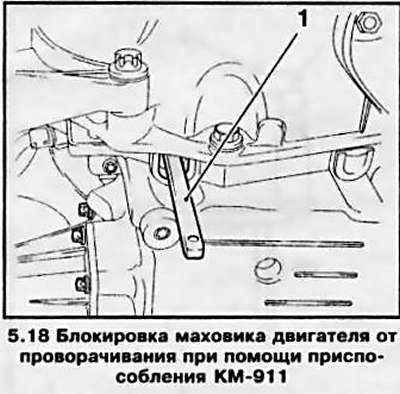
18. Removing the pulley is not particularly difficult. Depending on the model, you need to unscrew one central bolt or several bolts located around the perimeter of the mounting flange. To unscrew the bolts, you should first block the engine flywheel from turning, for which remove the plug on the flywheel dome and install a special device Ore1-KM-91 (see accompanying illustration)On some engine models, the crankshaft can be held from turning by the central hexagon using a socket wrench (in this case, the pulley mounting bolts are located along its perimeter).
19. If the gearbox was previously disconnected from the engine, the flywheel is locked using a special stopper installed on the engine housing (see Illustration 15.2 in this Chapter).
20. To eliminate the malfunction when making a long trip, when it is not possible to jack up the car, etc., in order to block the crankshaft from turning, ask an assistant to engage the highest gear and press the foot brake pedal all the way down (on models with manual transmission).
21. Remember to remove the locking devices if it is necessary to turn the crankshaft after disconnecting the pulley.
22. Before removal, if there are no special marks or mounting pins/keys for installing the pulley in a strictly defined position, it is necessary to remember its position on the mounting flange/tail of the crankshaft - apply marks yourself using a punch or marker.
23. Install the pulley in the reverse order of its removal. Tighten the mounting bolts to the required torque (see Specifications). Only new bolts should be used during installation.
Removal and installation camshaft gears
Removal
24. This subsection describes the procedure for removing the camshaft gears for engines with a timing belt drive - first you need to remove the timing belt (see Section 8).
25. Install the KM-6347 and KM-956-1 devices on the camshaft gear (see accompanying illustration) so that the grooves of the KM-6347 device engage with the wheel and, turning the device clockwise, tighten the 2 mounting bolts.
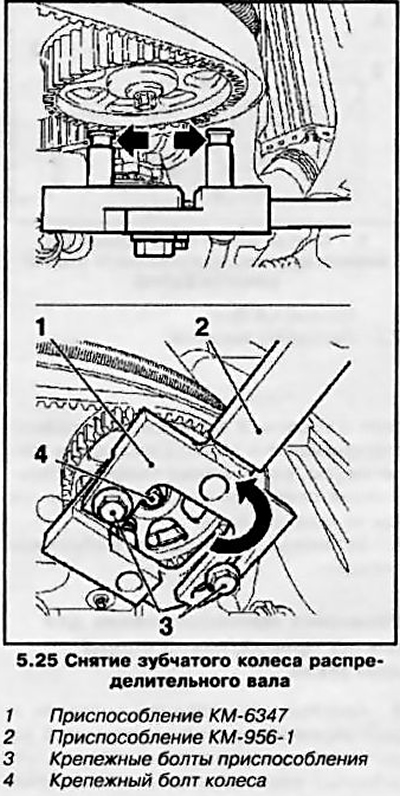
Note: The exhaust camshaft wheel is usually removed first.
26. Use an assistant to hold the wheel from turning with the installed device, unscrew the wheel mounting bolt and remove the wheel. Remove the device from the pulley.
27. Repeat the procedure to remove the second one (on the corresponding models) gear wheel.
Installation
28. Install the wheels one by one into their places - tighten the wheel mounting bolts by hand.
Note: On some models the intake and exhaust camshaft gears have different designs - please pay attention.
Then install the device (see above) and, holding the wheels from turning, tighten the mounting bolts to the required force. When installing, the installation marks of the wheel and camshaft must match - they are usually made in the form of guide pins or keys.
Visitor comments