


Contents: General information ⬇ Z16XEP Engine ⬇ Z18XE Engine ⬇ Engines Z20LE(L/R/H) ⬇ Z14XEP Engine ⬇ Engine Z22YH ⬇ Engine Z19DT(H) ⬇ Engine Z17DT(L/H) ⬇ Z13DTH Engine ⬇
General information
1. Top dead center (TDC) is the highest point of the piston stroke in its cylinder. In 4-stroke engines, during the rotation of the crankshaft, this position is reached by each of the pistons twice during one working cycle: once at the end of the compression stroke and the second time at the end of the exhaust stroke. Determining the TDC position of the piston at the end of the compression stroke (usually the first cylinder) is important for many subsequent jobs, such as replacing the timing belt, checking the valve timing, and replacing the cylinder head gasket. Sometimes the TDC of the compression stroke is also called the ignition timing.
Note: Cylinder numbers are counted in sequence from 1 to 4. The first cylinder is located on the accessory/timing drive side.
2. This section describes in the most complete way the procedure for setting the TDC of the first cylinder of the 1.6 l Z16XEP engine. For other engines, only the features of setting the TDC are given. When performing the work, some special tools and devices from Opel will be required, make sure in advance that all the necessary accessories are available and at hand.
3. To bring the piston of the first cylinder to TDC, it is necessary to turn the crankshaft evenly and slowly so that the TDC marks coincide. Depending on the conditions, turning the engine crankshaft can be done in the following ways:
- Raise and place the front of the car on stands. Engage 5th gear - when one of the raised wheels turns, the engine crankshaft will turn (models with manual transmission). Use an assistant to turn the wheel when making adjustments.
- If you don't have any jacking devices at hand, choose a flat, fairly large area and engage 5th gear. When moving the car by pushing, the crankshaft will also turn (models with manual transmission).
- In stationary conditions, the crankshaft is turned using a ratchet wrench and a change of head, which is installed on the central bolt of the crankshaft pulley, while the neutral gear must be engaged and the parking brake must be cocked. The crankshaft should be turned clockwise (if you look from the timing drive side).
Caution: Do not turn the engine by the camshaft gear mounting bolt - this will put too much tension on the timing belt/chain!
Z16XEP Engine
4. Remove the air cleaner (see Chapter 4).
5. Remove the upper timing belt/drive cover (see accompanying illustration), for which loosen the 2 mounting bolts, detach the drive cover from the casing and then slightly pull it upwards by the lug (arrow).
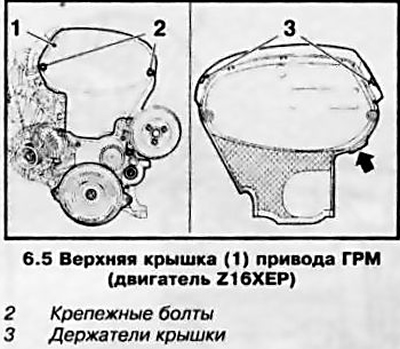
6. Remove the right engine boot (see Section 5).
7. Turn the crankshaft pulley in the direction of engine rotation (clockwise) so that the marks on the pulley and casing match (see accompanying illustration 6.7a) — in this case, marks on the gear wheels of the camshafts (see contrast illustration 6.7b) should be opposite each other. Now the piston of the first cylinder is at TDC of the compression stroke.
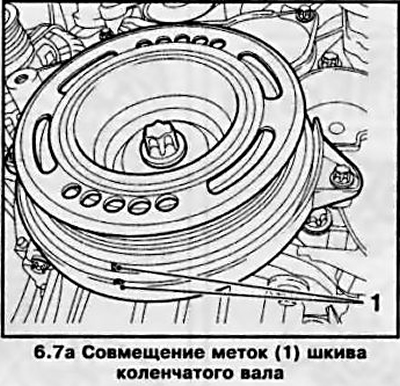
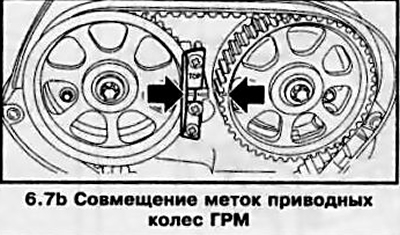
Note: If the marks are on the outside of the timing gear, turn the crankshaft one more revolution.
If the timing pulley marks do not match, it is necessary to adjust the timing phases, for which remove the toothed belt (see Section 8) — it is recommended to contact the Opel company service station.
8. After completing the check, reinstall the removed components. Installation is performed in the reverse order. Before installing the upper timing belt cover, check its integrity and thoroughly wipe it from the outside and inside.
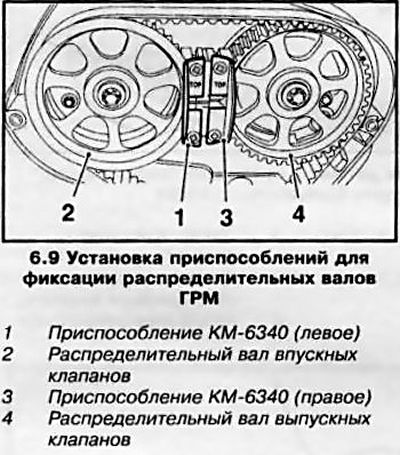
9. If, in addition to checking the valve timing, setting TDC is required for other work on the engine, it is necessary to first disconnect the negative battery cable and, after removing the upper toothed belt cover, remove the multi-rib drive belt (see Section 7), and fix the camshaft gears with special devices (see accompanying illustration).
Z18XE Engine
10. Remove the top engine cover (see Section 2).
11. Remove the air cleaner (see Chapter 4).
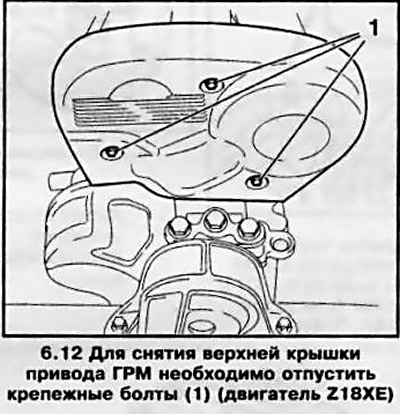
12. Remove the upper timing belt cover (see accompanying illustration), for which you need to loosen the 3 mounting bolts.
13. Turn the crankshaft pulley in the direction of engine rotation (clockwise) so that the marks on the pulley and engine block match (see accompanying illustration) — the marks on the camshaft gears must also match. Now the piston of the first cylinder is at TDC of the compression stroke. At the Opel service station, the KM-852 device is installed between the camshaft gears for more accurate determination of the TDC position.
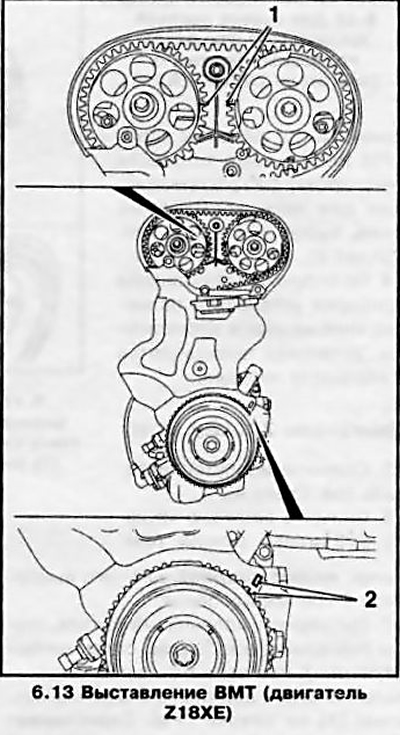
Note: If the camshaft marks are on the outside of the gears, turn the crankshaft one more revolution.
If the timing marks do not match, it is necessary to adjust the timing phases, for which it is necessary to remove the timing belt (see Section 8).
14. After completing the check, reinstall the removed components. Installation is performed in the reverse order.
Engines Z20LE(L/R/H)
15. Remove the air cleaner (see Chapter 4).
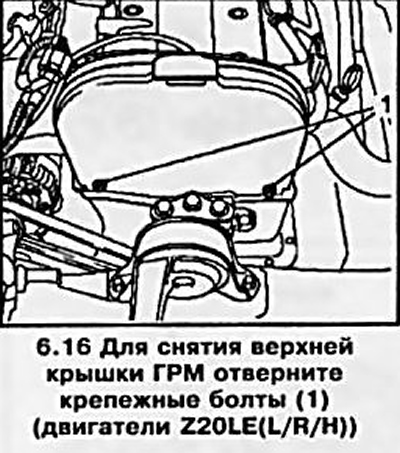
16. Remove the upper timing belt cover (see accompanying illustration), for which unscrew the 2 mounting bolts.
17. Turn the crankshaft so that the marks (2) align (see accompanying illustration), while the marks on the camshafts must coincide with the marks (1) on the timing belt cover.
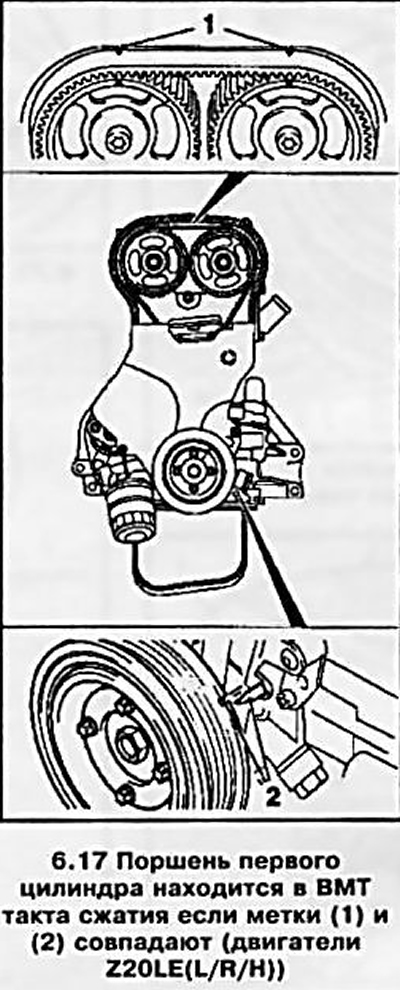
Note: If the camshaft marks are on the outside of the gears, turn the crankshaft one more revolution.
If the camshaft marks do not match, the valve timing is adjusted, for which it is necessary to remove the toothed belt (see Section 8).
18. After completing the check, reinstall all removed components.
Z14XEP Engine
19. Checking and adjusting the valve timing is a very labor-intensive operation and can only be performed using special tools from Opel KM-952, KM-953 and KM-954.
Examination
20. Remove the air cleaner (see Chapter 4).
21. Remove the ignition module (see Chapter 1, Section 22)
22. Disconnect the sensors and supply wiring (see accompanying illustration) from the cylinder head cover.
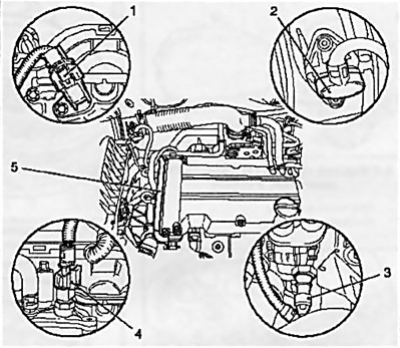
6.22 Disconnecting the sensors from the cylinder head cover (z14XEP engine)
1 Camshaft sensor
2 Air flow control sensor
3 Engine oil pressure sensor
4 Coolant temperature sensor
5 Electrical wiring box
23. Disconnect 2 crankcase ventilation hoses.
24. Unscrew the 13 mounting bolts and remove the cylinder head cover, remove the remains of the old cover gasket and clean the mating surfaces.
25. Remove the right engine boot (see Section 5).
26. Unscrew the bolt closing the crankshaft adjustment hole (see accompanying illustration) and lower the car.
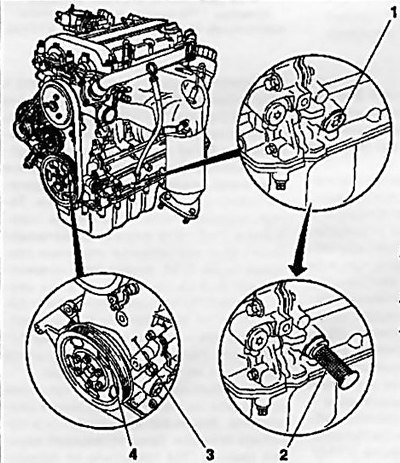
6.26 Setting TDC on the Z14XEP engine
1 Crankshaft adjusting hole bolt
2 Installed device KM-952
3 Mark on the timing belt cover
4 Mark on the crankshaft pulley
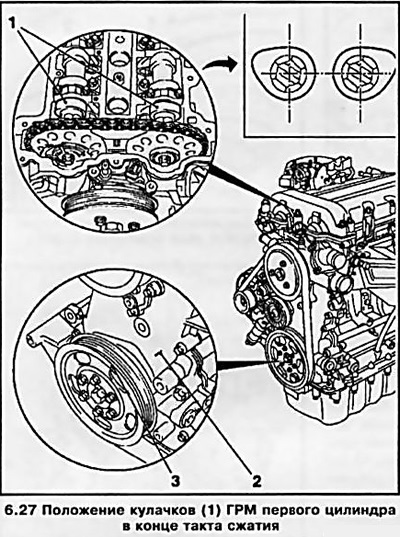
27. Install the KM-952 device into the hole (see illustration 6.26), and slowly and smoothly turn the crankshaft until the device engages with the shaft (will fix the shaft) — the marks on the crankshaft pulley and on the timing belt cover must match, with the timing belt cams above the first cylinder (see accompanying illustration) should be facing in opposite directions from the center of the engine - if this position is not observed, turn the crankshaft another revolution.
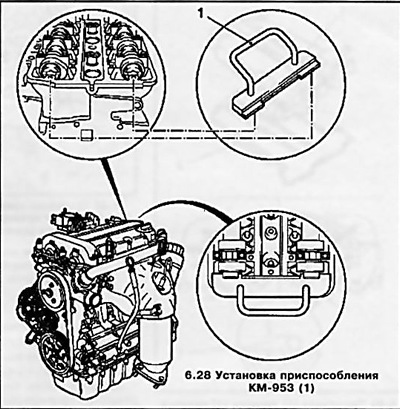
28. Install into the camshaft grooves (from the flywheel side) special device KM-953 (see accompanying illustration) — the projections of the device must enter the grooves to the greatest possible depth. If it is not possible to install the device, it is necessary to adjust the valve timing (see below).
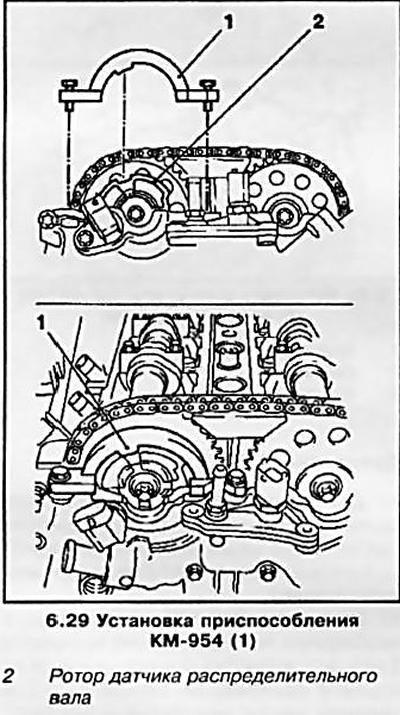
29. Install the special device KM-954 (see accompanying illustration) so that the projection of the device fits into the recess of the camshaft sensor rotor. If the projection and recess do not match, adjust the valve timing (see below).
Adjustment
30. Unlike models with a timing belt drive, the valve timing on this engine can be adjusted without removing the drive cover and the chain itself.
31. After completing the check, remove the KM-953 and 954 devices from the engine.
Caution: Never use control devices to hold the engine shafts from turning!
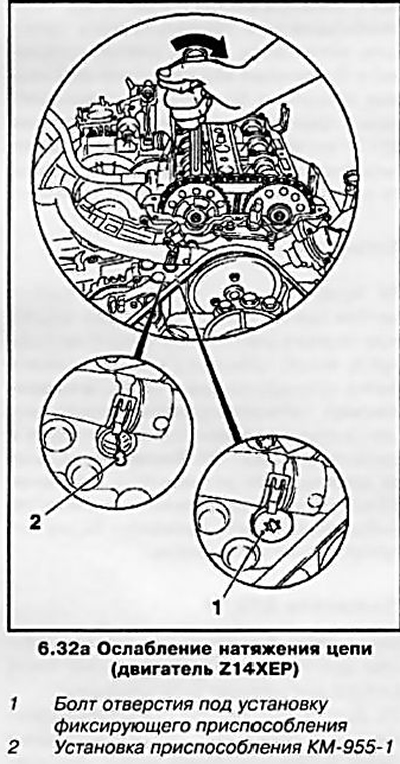
32. Unscrew the bolt, freeing the hole for installing the KM-955-1 device (see illustration 6.32a). Using an open-end wrench, press the intake camshaft in the direction indicated by the arrow and secure the chain tensioner with the KM-955-1 device, thereby loosening the chain tension.
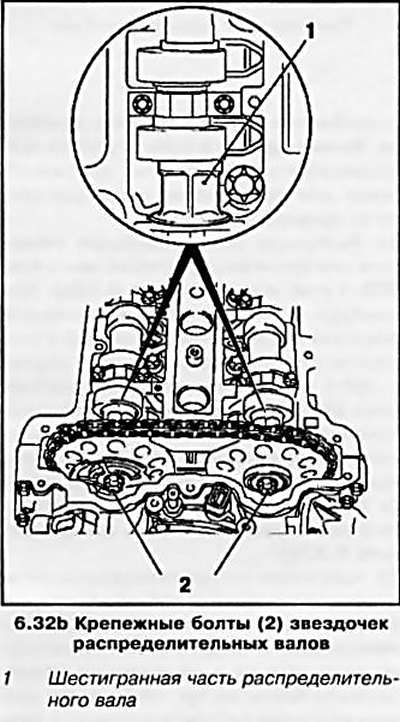
Caution: When pressing/turning the camshafts, the key must be installed only on the hexagon-shaped part of the shaft (see illustration 6.32b)!
33. While holding the camshafts from turning, loosen the sprocket mounting bolts on both shafts (see illustration 6.32b), and then unscrew them one by one and replace them with new ones. Tighten the bolts, notes, so that the intake camshaft sensor rotor (see illustration 6.29) could be turned manually.
34. Install the KM-953 device by turning the camshafts with an open-end wrench, and remove the KM-955-1 device.
35. Install the KM-954 device so that the protrusion of the device coincides with the recess of the rotor (see illustration 6.29) — if necessary, tighten the rotor manually.
36. Screw the KM-955-1 tool mounting hole bolt back into place and tighten to the required torque. Tighten the camshaft sprocket mounting bolts to 10 Nm or less, then remove all adjusting tools.
37. Tighten the sprocket mounting bolts to 50 Nm and another 60° - use an assistant if necessary, then smoothly turn the engine crankshaft 2 full turns and use the tools to check the TDC position - if the tools are not installed (see above), re-adjust the valve timing.
Installation
38. Install all removed components in the reverse order of removal. Use a new cylinder head cover gasket when reassembling (see accompanying illustration), apply sealant (gray color) on the joints of the cylinder head and the timing belt cover.
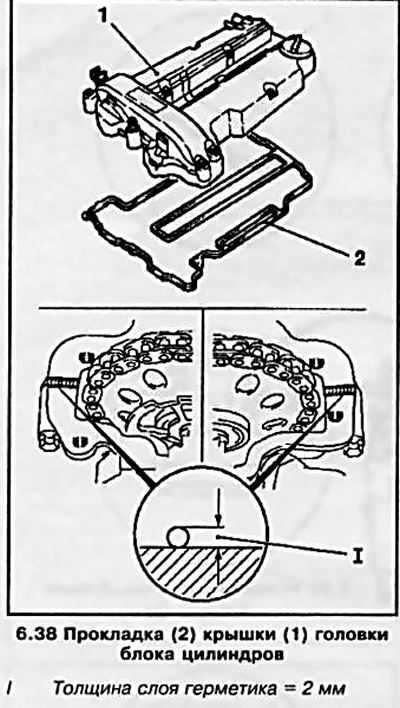
Attention: The lid must be installed within 10 minutes after applying the sealant!
Don't forget to replace the adjusting hole bolt gasket.
Engine Z22YH
Attention: Unlike others, this engine determines the TDC of the compression stroke for the piston of the 4th cylinder!
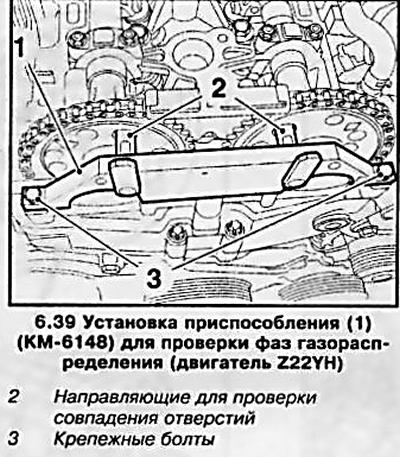
39. To check the valve timing after carrying out the preparatory work and turning the crankshaft pulley until the marks are aligned, it is necessary to install a special device KM-6148 using the mounting bolts (see accompanying illustration) — the guides must enter the special holes on the toothed pulleys of the camshafts. If this does not happen, it is necessary to make the appropriate adjustment.
Engine Z19DT(H)
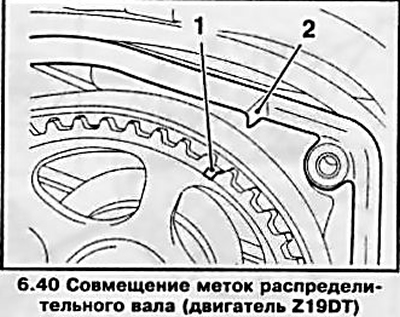
40. Z19DT engine - it is necessary to turn the crankshaft until the marks on the camshaft pulley and on the timing belt cover are aligned (see accompanying illustration).
41. Z19DTH engine - to check it is necessary to first unscrew the 2 threaded plugs at the front and rear of the camshaft housing and screw in special adjusting mandrels Opel-EN-46789 instead (from the intake valve side) and EN-46789-100 (from the exhaust valve side). Turn the crankshaft so that the adjusting mandrels are fixed in the camshafts.
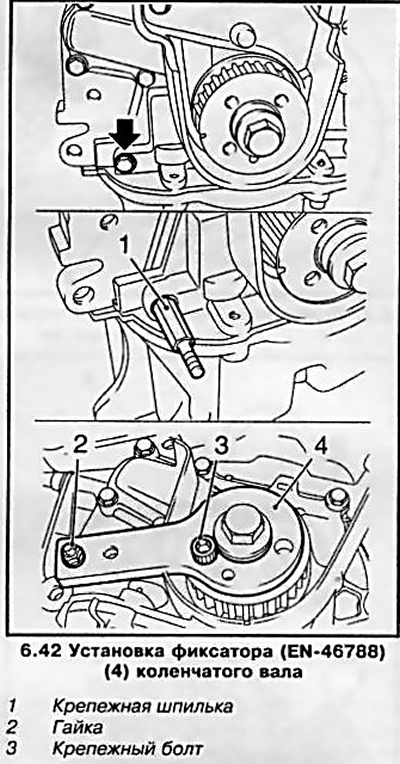
42. Install the crankshaft lock EN-46788 (see accompanying illustration), for which unscrew the bolt (arrow) of the oil pump and install a special mounting stud instead. Install the retainer on the crankshaft gear and secure it to the gear with a bolt and nut on the mounting stud.
43. If, with the tool installed, the TDC marks on the camshaft pulley and the camshaft housing match, then the timing is adjusted correctly. Otherwise, remove the toothed belt and make the appropriate adjustment - it is recommended that this operation be entrusted to service station specialists.
44. After completing the check, reinstall the removed components. Do not forget to reinstall the engine cover (see Section 2).
Engine Z17DT(L/H)
45. Remove the engine cover (see Section 2).
46. Remove the air cleaner (see Chapter 4).
47. Remove the bolt securing the electrical wiring box from the upper front timing belt cover (see accompanying illustration), disconnect the wiring harness and vacuum tube.
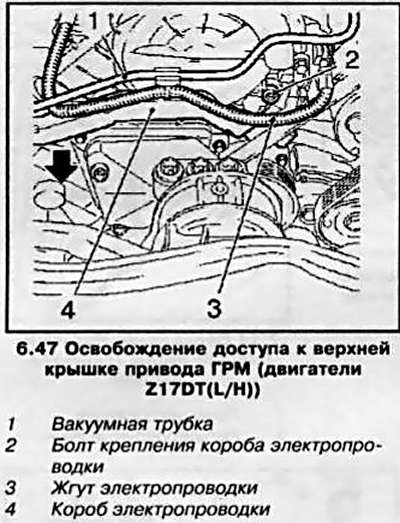
48. Disconnect the vacuum tube (see accompanying illustration) from the timing belt cover (3 holders), unscrew the 8 mounting bolts and remove the top cover of the drive.
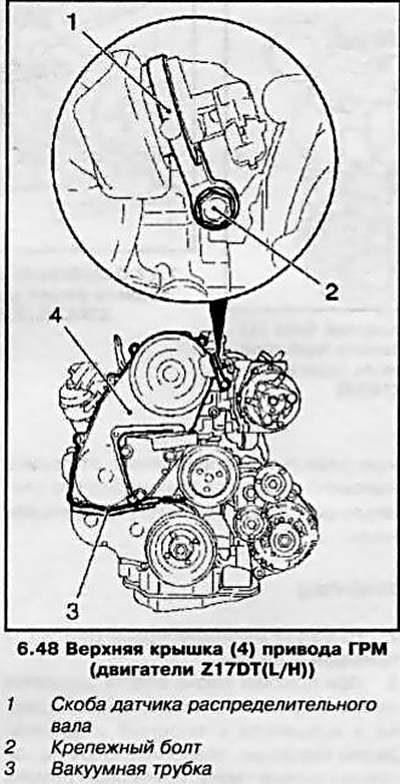
Note: Bolts of different lengths are used to secure the top timing belt cover - remember the installation position of the bolts!
49. Remove the camshaft sensor bracket (see illustration 6.48).
50. Turn the crankshaft until the holes on the camshaft and fuel injection pump gears are aligned with the holes on the engine body and screw in the mounting bolts (see accompanying illustration) M6 into the corresponding hole of the camshaft wheel and M8 into the fuel injection pump drive wheel.
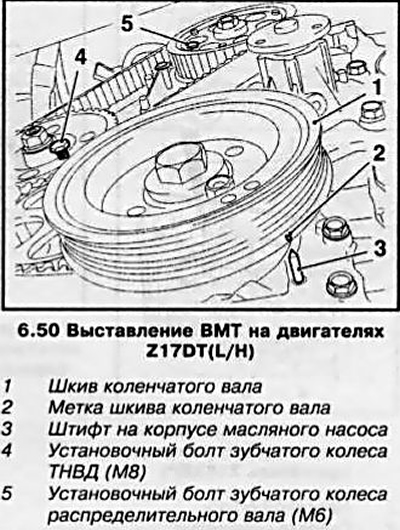
51. Remove the engine crankcase guard (see Section 5) and check the alignment of the marks - with the mounting bolts screwed in, the mark on the crankshaft pulley should coincide with the pin on the oil pump cover.
Note: With the crankshaft pulley removed, the mark on the drive gear must align with the lug on the oil pump cover.
If the marks do not match, it is necessary to adjust the timing phases (see Section 8) - remove the timing belt first.
52. After completing the check, reinstall all removed components.
Z13DTH Engine
53. Unscrew 2 plugs from the camshaft housing (see accompanying illustration). Clean the threads and screw the locking pins into the holes (Opel-EN-46781) — after installation, the chamfers on the outer side of the studs should be horizontal. If necessary, mark the studs.
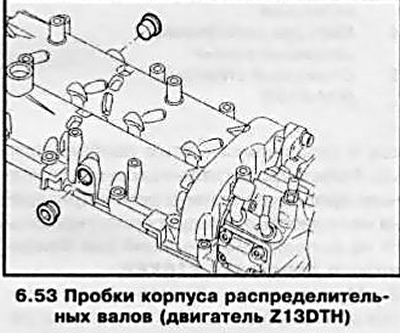
54. Turn the crankshaft clockwise until the spring-loaded locking pins are engaged.
Caution: When turning the crankshaft, the assistant must ensure that the locking pins do not turn!
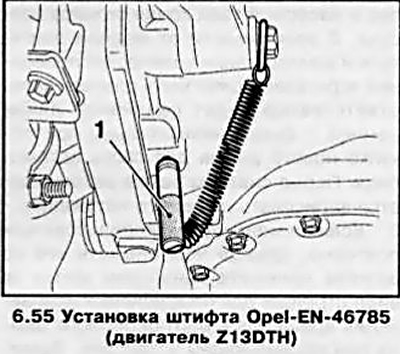
55. Insert the Opel-EN-46785 pin into the special hole on the manual transmission (see accompanying illustration), slightly rotating the crankshaft back and forth so that the pin enters the hole in the flywheel. If the pin does not fit into the flywheel, it is necessary to adjust the valve timing.
Visitor comments