


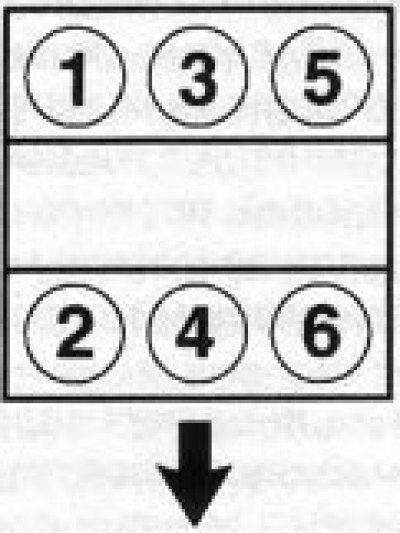
6.1 Numbering of cylinders of a 6-cylinder engine; the arrow indicates the direction of movement of the vehicle
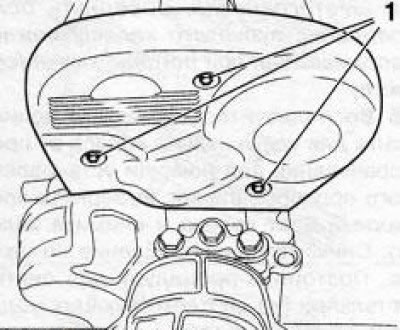
To remove the upper timing belt cover, loosen the mounting bolts (1) (engines Z16XE/Z18XE)
Note: Cylinder numbers are counted in sequence from 1 to 4. The first cylinder is on the accessory/timing drive side. On 6-cylinder engines, the numbering starts from the near left (if you look at the engine from the timing drive side) cylinder (see illustration).
2. Checking and adjusting the valve timing is a very labor-intensive operation and can only be performed using a special Opel tool. Make sure in advance that all necessary accessories are available and at hand. This tool is usually only available at a service station. In addition, on most engines, this operation requires labor-intensive preparatory work - it is recommended to entrust this procedure to Opel service station specialists.
Note: The following is a detailed description of the procedure for only some engines. For other engines, the procedure for performing preparatory work is described in Section 8.
3. To bring the piston of the first cylinder to TDC, it is necessary to turn the crankshaft evenly and slowly so that the TDC marks coincide. Depending on the conditions, turning the engine crankshaft can be done in the following ways:
Raise one of the front wheels and place the car on a stand. Engage 5th gear - when turning the raised wheel, the engine crankshaft will turn (models with manual transmission). Use an assistant to turn the wheel when making adjustments.
If you don't have any jacking devices at hand, choose a flat, fairly large area and engage 5th gear. When moving the car by pushing, the crankshaft will also turn (models with manual transmission).
In stationary conditions, the crankshaft is turned using a ratchet wrench and a change of head, which is installed on the central bolt of the crankshaft pulley, while the neutral gear must be engaged and the parking brake must be cocked. The crankshaft should be turned clockwise (if you look from the timing drive side).
Warning. Do not turn the engine by the camshaft gear bolt - the timing belt/ timing chain is tightened too much!
4. Before starting work on setting TDC, disconnect the wire from the negative terminal of the battery.
Engines Z16XE/Z18XE
5. Remove the top engine cover.
6. Remove the 3 mounting bolts (see accompanying illustration), separate the upper timing belt cover from the rear timing belt cover and remove it.
7. Turn the crankshaft pulley in the direction of engine rotation (clockwise) so that the marks on the pulley and engine block match (see illustration) - the marks on the camshaft gears must also match. Now the piston of the first cylinder is at TDC of the compression stroke.
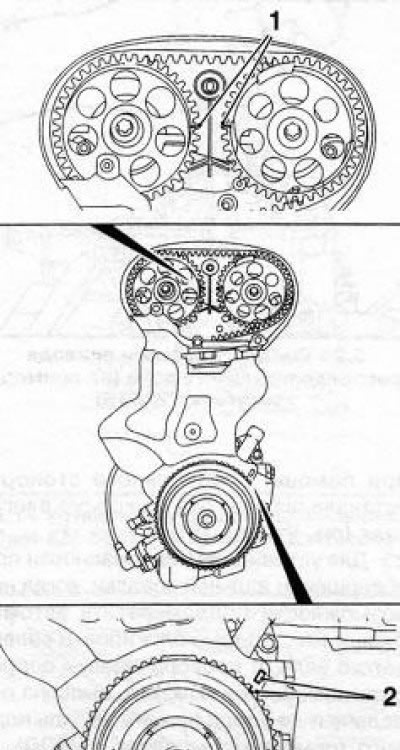
6.7 Setting TDC (engines Z16XE/Z18XE) - marks (2) of the crankshaft pulley and marks (1) of the camshaft gears must match
Note: If the camshaft marks are on the outside of the gears, turn the crankshaft one more revolution.
If the timing marks do not match, it is necessary to adjust the timing phases, for which it is necessary to remove the timing belt
8. After completing the check, reinstall the removed components. Installation is performed in the reverse order. Before installing the upper timing belt cover, check its integrity and thoroughly wipe it from the outside and inside.
Engines Z22SE/Z22YH
Attention! Unlike others, these engines determine the TDC of the compression stroke for the piston of the 4th cylinder!
Note: Checking and adjusting the valve timing can only be done using a special device Opel-KM-6148.
9. Remove the engine cover.
10. Remove the air cleaner and relieve pressure in the fuel supply system.
11. Release from the holders, loosen the fastening and remove the fuel line. To prevent dirt from entering the fuel system, close the free ends of the fuel line under the suitable plugs.
12. Disconnect the engine crankcase ventilation hose. Close the free end of the hose and the landing socket with suitable plugs.
13. Remove the ignition module.
14. Disconnect the cooling system hose, loosen the fastening nut (2) (see illustration) and remove the coolant pipe. Disconnect the 2 lambda probe wiring connectors and the exhaust gas recirculation (EGR) valve connector. Remove the 5 bolts and 2 mounting nuts, remove the studs and remove the ground bus. Remove the wiring harness holder.
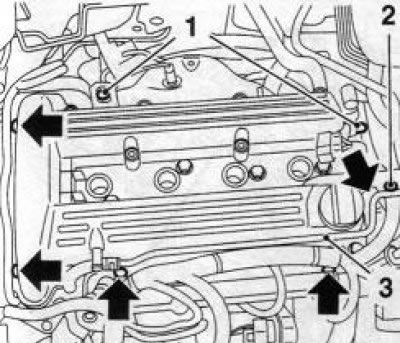
6.14 Preparing the cylinder head cover for removal: 1, 2. Fastening nuts; 3. Cooling system pipe
15. Remove the 14 mounting bolts and remove the cylinder head cover.
16. Place the vehicle on stands or lift it.
17. Remove the multi-rib belt cover.
18. Set the TDC of the compression stroke for the piston of the 4th cylinder by slowly and evenly turning the crankshaft in the direction of engine rotation until the marks on the crankshaft pulley and on the timing belt cover coincide, while the cams cm. see illustration) of the camshafts above the 4th cylinder should point upwards.
[Source is on the website: www.OpelBook.ru]
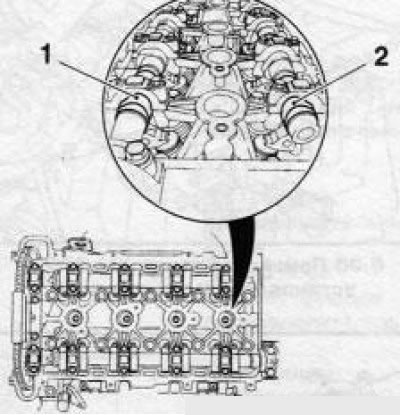
16.18 When setting the TDC of the compression stroke for the piston of the 4th cylinder, the cams (1 and 2) of the camshafts should be directed upwards
Note: If the cams point downwards when the marks are aligned, turn the crankshaft another revolution.
Lower the car onto its wheels.
19. To check the valve timing, it is necessary to install a special device KM-6148 using mounting bolts (see illustration) - the guides must enter the special holes on the toothed pulleys of the camshafts. If this does not happen, it is necessary to make the appropriate adjustment.
20. Installation of all removed components is carried out in the reverse order of removal. Before installing the cylinder head cover, clean all mating surfaces and threaded holes, install the cylinder head cover with five new gaskets.
Z19DT(H) Engines
Attention! The steering wheel angle sensor setting is reset after each battery disconnection and after completing the work it is necessary to re-set the sensor!
21. Remove the front right wheel.
22. Remove the lower engine compartment cover.
23. Loosen the crankshaft pulley mounting bolts.
24. Remove the multi-rib belt.
25. Unscrew the crankshaft pulley mounting bolts and remove the pulley.
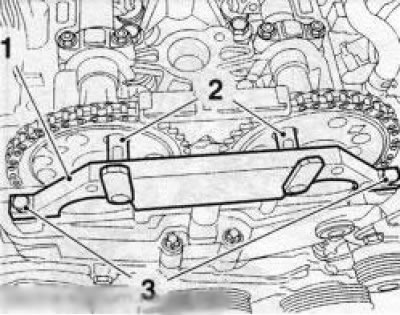
Installing the device (1) (KM-6148) for checking the valve timing (z22YH engine): 2. Guides for checking the alignment of holes; 3. Mounting bolts
26. Remove the air cleaner.
27. Remove the right engine mount.
28. Remove the 6 mounting bolts and the upper timing belt cover. Disconnect the wiring from the crankshaft angle sensor. On the Z19DTH engine additionally, remove the mounting bolt and the engine oil dipstick guide tube and disconnect the crankcase ventilation (PCV) line.
29. Z19DT Engine - it is necessary to turn the crankshaft until the marks on the camshaft pulley and on the timing belt casing are aligned (see illustration).
Caution! Do not tighten the engine by the camshaft, otherwise the timing belt will be too tight!
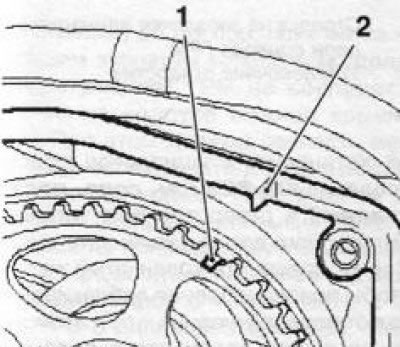
6.29 Alignment of the camshaft mothers (1 and 2) (z19DT engine)
30. Z19DTH Engine - to check, it is necessary to first unscrew the 2 threaded plugs at the front and back of the camshaft housing and screw in special Opel adjustment mandrels instead of themEN46789 (from the intake valve side) and EN-46789-100 (from the exhaust valve side) (see illustration). Turn the crankshaft so that the adjusting mandrels are fixed in the camshafts.
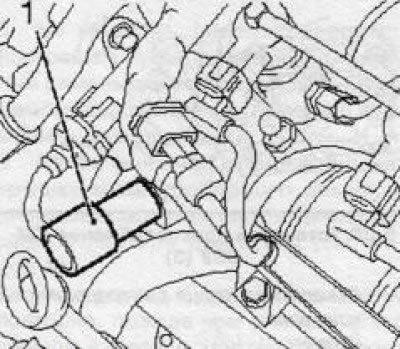
6.30 Fitting the EN46789 (1) tool to the Z19DTH engine
31. Install the tensioner lock EN-46788 (see illustration), for which unscrew the bolt (arrow) of the oil pump and install a special mounting stud instead. Install the retainer on the crankshaft gear and secure it to the gear with a bolt and nut on the mounting stud.
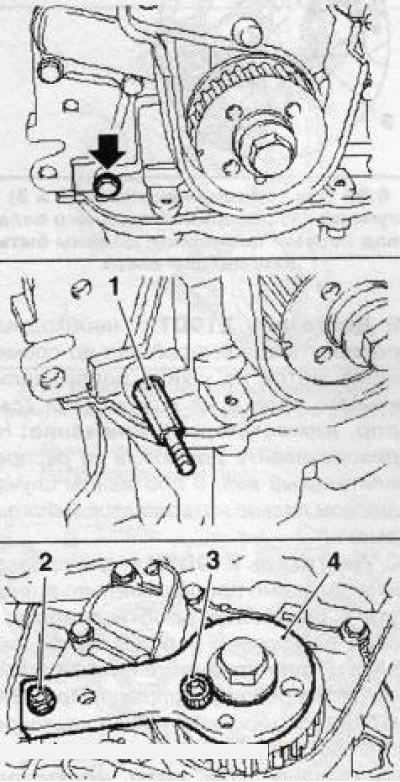
6.31 Installing the crankshaft lock (4) (EN-46788): 1. Mounting pin; 2. Nut; 3. Mounting bolt
32. If, with the tool installed, the TDC marks on the camshaft pulley and the camshaft housing match, the timing is adjusted correctly. Otherwise, remove the timing belt and make the appropriate adjustment.
33. After completing the check, reinstall the removed components. Do not forget to reinstall the engine cover
Engines Y22DTR/Y20DTH
Note: The timing chain does not require maintenance or adjustment for almost the entire period of operation. A description of the preparatory work for checking the valve timing adjustment is given in Section 8.
34. To check the valve timing adjustment, the cylinder head cover and the high-pressure fuel pump (HPFP) drive sprocket cover must first be removed.
35. Slowly and smoothly rotate the crankshaft in the direction of engine rotation (clockwise) until the mark on the crankshaft pulley slightly reaches the mark on the timing belt cover (si. accompanying illustration). The camshaft lobes above the first cylinder must be pointing upwards, otherwise turn the crankshaft one more full revolution.
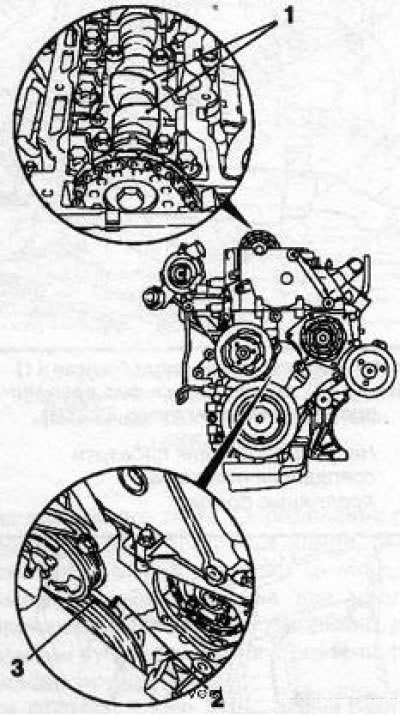
6.35 When aligning marks (2 and 3), the camshaft cams (1) above the first cylinder should be pointing upwards
36. Install the special device KM-929 (see illustration) into the hole for installing the crankshaft pulse sensor. Slightly turn the crankshaft so that the device blocks the shaft from turning - the marks on the crankshaft pulley and on the timing belt cover should match.
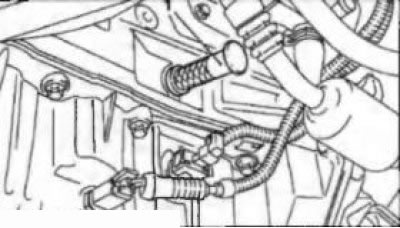
6.36 KM-929 device in the installed position
37. Check the position of the single chain drive sprocket on the high pressure fuel pump; the arrow on the sprocket should match the gap on the flange and the mounting hole of the fuel pump (see illustration). Install the Device KM-927 into the mounting hole.
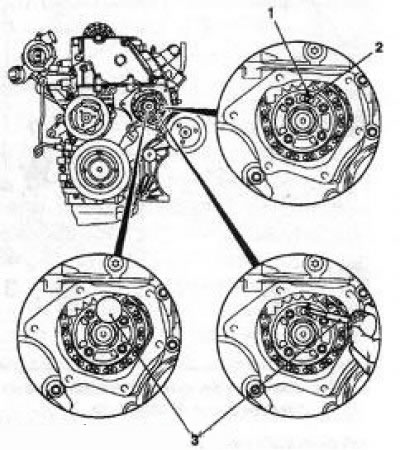
6.37 Installation of the KM927 device (3): 1. Arrow on the sprocket of a single timing chain drive; 2. Mounting hole
38. Install the fixture KM932 from the opposite side of the camshaft so that the pin of the device enters the hole on the end of the camshaft (see accompanying illustration).
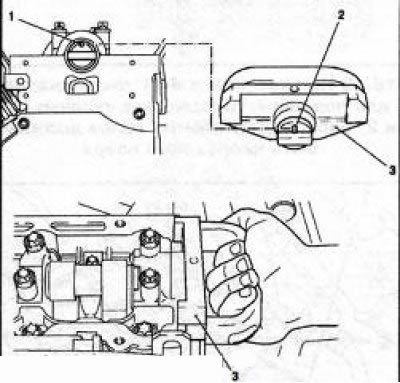
6.38 Installation of the KM932 device (3): 1. Hole in the end of the camshaft; 2. Pin
40. If during installation of the devices any marks do not match or it is not possible to install the devices in the holes intended for them, it is necessary to adjust the timing belt.
Y30DT and Z32SE engines
41. Engine Z32SE: To check the correct installation of the valve timing, it is necessary to remove the front timing cover. This operation is described in Section 8, where a description of the procedure for setting TDC is also given.
42. Y30DT Engine: Setting the TDC is done with the upper timing belt cover removed (see Section 8). Smoothly rotate the crankshaft in the direction of engine rotation (clockwise) until the mark on the next gear (see illustration) The timing belt does not match the mark on the lower timing belt cover housing. In this case, the marks on the crankshaft pulley and on the lower timing belt cover housing must match, and the marks on the camshaft bosses must match the marks on the camshaft drive gears - on the shaft of 2-4-6 cylinders with the mark "LH", and on the shaft of 1-3-5 cylinders with the mark "RH".
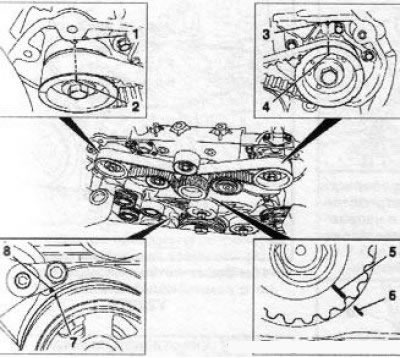
6.42 Marks for setting TDC of compression stroke for cylinder 1 (y30DT engine): 1, 3. On the camshaft covers; 2, 4. On the gear wheels of the camshaft drive; 5. On the drive gear; 6, 8. On the bottom cover; 7. On the crankshaft pulley
Note: You may need a viewing mirror to check the marks. If at least one pair of marks does not match, you must remove the toothed belt and adjust the timing drive.
Visitor comments