


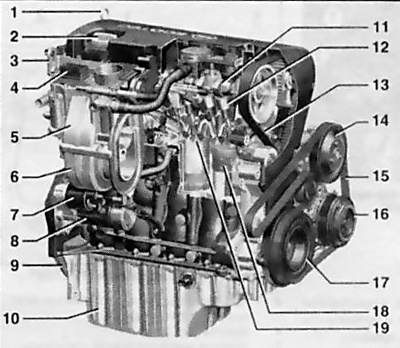
1.1a Petrol engine 1.6 l (77 kW/105 hp)
1 Engine oil level gauge
2 Oil filler cap
3 Rigging eye
4 Electronic Engine Control Module (ECM)
5 Upper part of the intake manifold
6 Lower part of the intake manifold
7 Starter solenoid relay
8 Starter
9 Flywheel
10 Oil pan
11 Intake valve camshaft
12 Hydraulic valve lifter
13 Toothed belt
14 Water pump pulley
15 Multi-rib auxiliary drive belt
16 Air conditioning compressor pulley
17 Crankshaft pulley
18 Piston
19 Inlet valve
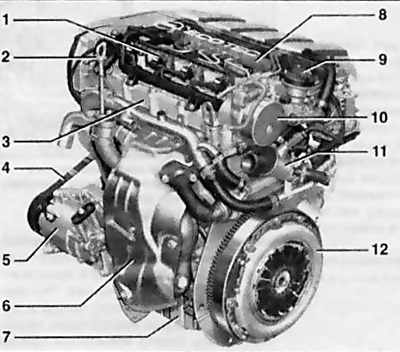
1.1b Diesel engine 1.9 l (110 kW/150 hp)
1 Nozzle
2 Engine oil level gauge
3 Cylinder head
4 Multi-rib belt
5 Compressor of the A/C system
6 Exhaust manifold protection
7 Oil pan
8 Return pipeline
9 Oil filler cap
10 Vacuum pump
11 Thermostat housing
12 Clutch basket
2. Opel continues to improve the design of engines. New models are equipped with 4-cylinder in-line 16-valve engines equipped with two overhead camshafts (DOHC), with an improved mixture formation process and increased efficiency of the working cycle. The only exception is the diesel engine Z19DT/J, which has one camshaft and 2 valves per cylinder. The engine is installed transversely in the front of the car. The drive is carried out to the front wheels by means of a transmission assembly mounted on the left side of the engine.
3. Due to space limitations and the paucity of sources of information, this Guide examines in more detail only the modifications of engines of earlier (2004) production and those most widely represented on the Russian market. For other engines, only some of their most important features are offered to the attention of readers.
4. To check the technical condition of the engine, perform work on diagnosing the engine systems and mechanisms, its maintenance and repair, a fairly large range of special devices and instruments with a set of adapters is required, as well as certain experience in working with such tools, so the authors of this Manual strongly recommend contacting specialized service stations of official representatives of Opel for maintenance and repair. In addition, the format of this publication does not allow for a full description in detail of all operations for disassembling/assembling engines installed on the models described in this Manual. Therefore, the following sections provide a list and procedure for performing only the main operations most often performed during maintenance and current repairs. Some operations are quite simple and are constantly repeated during work - in some cases, their description is omitted.
Note: Due to the constant modification of the vehicle design, including engines, some deviations from the procedures described below are possible. In this case, elementary ingenuity is required to dismantle/install parts or units - carefully inspect them and determine which additional elements need to be disconnected beforehand or what prevents their dismantling. It is unlikely that new options will be fundamentally different from those described.
List of repair works performed without removing the engine from the car (Maintenance and current repairs)
5. The following repairs can be performed without removing the engine from the vehicle:
- a) Compression check;
- b) Removing and installing the timing cover;
- c) Removing and installing the timing belt cover;
- d) Removal and installation of timing drive components (belt/chain, gears/sprockets);
- e) Removal and installation of camshafts and tappets;
- f) Adjustment of valve clearances (diesel engines 1.7 l DOHC and 1.9n SOHC, petrol - 1.6 l)
- g) Removing and installing the cylinder head;
- h) Removing and installing the oil pan;
- i) Removal, repair and installation of the oil pump;
- j) Removing and installing the oil cooler (with appropriate equipment);
- k) Replacement of crankshaft and camshaft seals;
- l) Checking the condition and replacing the powertrain suspension supports;
- m) Removal, condition check and installation of the flywheel/drive disk.
6. Before starting work, thoroughly clean the engine compartment and the outer surfaces of the power unit using one of a wide range of special solvents. This treatment will prevent dirt from getting inside the engine.
7. If necessary, depending on the nature of the work to be done, the hood can be removed to provide free access to the components to be serviced (see Chapter 11) - to avoid accidental damage to the paintwork, cover the car fenders with special covers or just old blankets.
Visitor comments