


General information
1. The vehicles in question use an alternator. When installing additional electrical equipment, check that the generator capacity is sufficient to supply new consumers with electricity.
2. The generator is driven by a multi-ribbed belt from the engine crankshaft.
3. The generator is an electric machine with electromagnetic excitation. To convert alternating current into direct current, a rectifier is built into the generator. Output voltage is adjusted by a built-in regulator.
4. When the generator is operating, the electric current flowing through the excitation winding creates a magnetic flux around the rotor poles. When the rotor rotates, its magnetic poles periodically change under each stator tooth, as a result of which the magnetic flux passing through the teeth continuously changes in magnitude and voltage. This variable magnetic flux creates an electromotive force (EMF) in the stator winding.
5. At high rotor speed, when the generator output voltage begins to exceed 13.6-14.5 V, the voltage regulator is locked, and the current does not pass through the excitation winding. When the voltage decreases, the regulator is unlocked again, allowing the current to pass freely through the excitation winding. The higher the rotor speed, the longer the regulator remains locked and, accordingly, the more the voltage at the generator output decreases. The process of locking and unlocking the regulator occurs at a high frequency, so the output oscillations remain practically unnoticeable and the generator voltage can be considered constant, maintained at a level of 13.6-14.5 V.
6. The charging system does not require periodic maintenance, however, the condition of the alternator drive belt, battery and its wiring should be checked and replaced on a regular basis in accordance with the maintenance schedule (see Chapter 1).
7. The serviceability of the charging system is monitored using the corresponding lamp on the instrument cluster (see Chapter "Controls and operating techniques", Section 16).
Safety precautions when servicing the generator:
- Do not disconnect the battery or voltage regulator while the engine is running;
- Do not short the generator excitation terminal or the cable attached to it to ground;
- Do not confuse the order of connecting the voltage regulator wiring;
- When charging the battery without removing it from the vehicle, make sure that both cables are disconnected from it;
- Remember that turning on a voltage regulator shorted to ground will cause it to fail immediately;
- Never remove the alternator while the battery is connected;
- Never use voltage meters or test lamps connected to household power (110/220 V) when testing on-board electrical equipment;
- When checking the condition of the diodes, do not apply a voltage higher than 12 V to them and do not use meggers that also have a high output voltage - a breakdown of the diodes will lead to a short circuit. Remember that when checking the insulation of the wiring with a megger, it is necessary to disconnect all the wiring from the generator;
- Before carrying out any electric welding work on the vehicle, do not forget to disconnect the electrical wiring from the generator and battery;
- Any checks of the circuits and components of the on-board electrical wiring should be carried out with the engine not running and the battery disconnected;
- Remember that reversing the polarity of any connections carries the risk of irreversible failure of the rectifier and generator voltage regulator.
Checking the generator voltage
8. If the battery does not charge or charges insufficiently while the vehicle is moving, the generator voltage must be checked.
9. Connect a voltmeter between the positive and negative terminals of the battery and start the engine. The voltage at start-up should drop to approximately 8 volts (at an ambient temperature of +20°C).
10. Increase the engine speed to 3000 rpm - if the generator and regulator are working properly, the voltage at the terminals should be from 13 to 14.5 V.
11. To check the voltage stability, turn on the high beam and repeat the measurements at 3000/min. The measured voltage should not increase by more than 0.4 V from the previously measured values.
12. If the readings go beyond the nominal value, the generator and regulator must be checked in a specialized workshop.
Removal and installation
Z14XEP Engine
13. Remove the multi-rib belt (see Chapter 2).
14. Loosen the 2 mounting nuts and disconnect the generator supply wiring.
15. Unscrew the bolt (see accompanying illustration) fastenings of the multi-rib belt tensioner and press the tensioner (see arrow) to gain access to the lower generator mounting bolt.
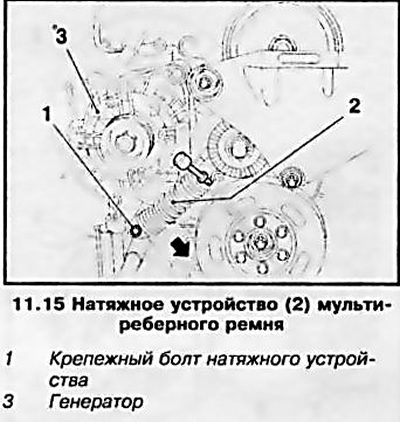
16. Loosen the upper and lower generator mounting bolt nuts, remove the bolts and remove the generator.
17. Installation is carried out in the reverse order of removal.
Z16XEP Engine
18. Remove the multi-rib belt (see Chapter 2).
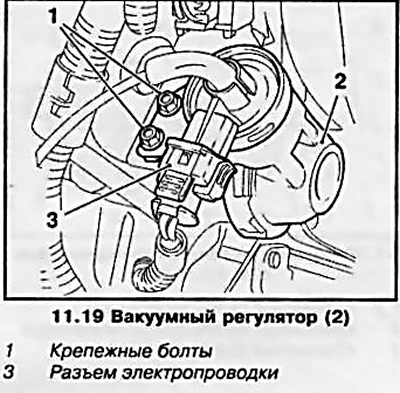
19. Disconnect the electrical wiring connector and the rod from the vacuum regulator (see accompanying illustration), unscrew 2. mounting bolts and remove the regulator.
20. Raise the car on the lift, loosen the 2 fastening nuts (see accompanying illustration) and disconnect the generator supply wiring.
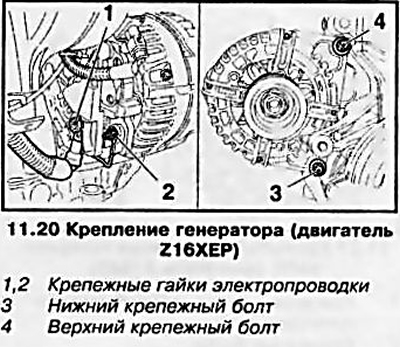
21. Remove the lower generator mounting bolt, lower the vehicle, remove the upper bolt and remove the generator.
22. Installation is carried out in the reverse order of removal.
Z18XE Engine
23. Remove the multi-rib belt (see Chapter 2).
24. Disconnect the electrical wiring connector (see accompanying illustration) from the camshaft sensor, unscrew the upper generator mounting bolt, loosen the lower mounting bolt and move the generator back.
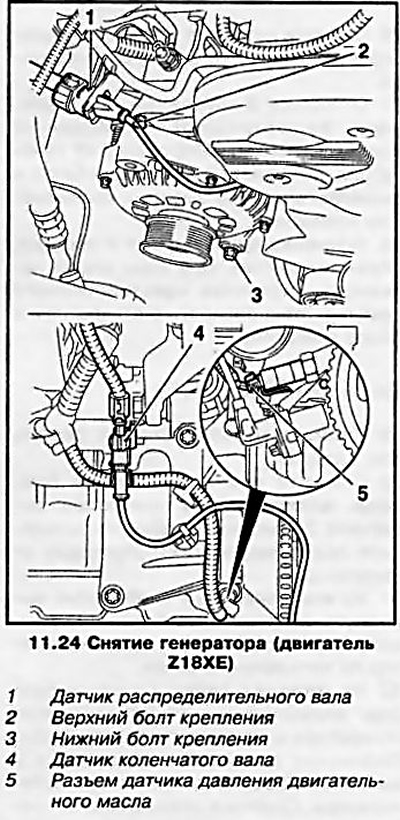
25. Disconnect the electrical wiring connector (see illustration 11.24) from the crankshaft sensor, disconnect the engine oil pressure sensor connector and release the cable from the fasteners.
26. Remove the multi-rib belt tensioner from the generator support.
27. Loosen the 2 mounting nuts (see accompanying illustration) and disconnect the supply wiring from the generator, unscrew the 3 mounting bolts and remove the generator together with the mounting bracket.
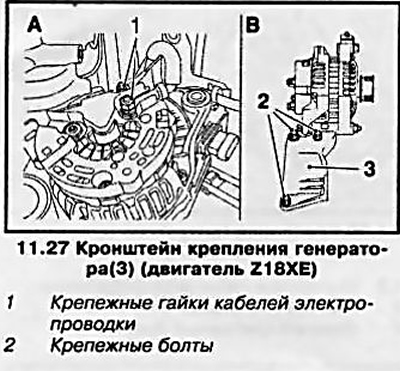
28. Installation is performed in the reverse order of removal. In this case, the bushing of the multi-rib belt tensioner must coincide with the hole in the generator support.
Engine Z20LE(L/R/H)
29. Remove the multi-rib belt (see Chapter 2).
30. Remove the mounting brackets (see accompanying illustration) generator, unscrew the 2 fastening nuts and disconnect the supply wiring from the generator.
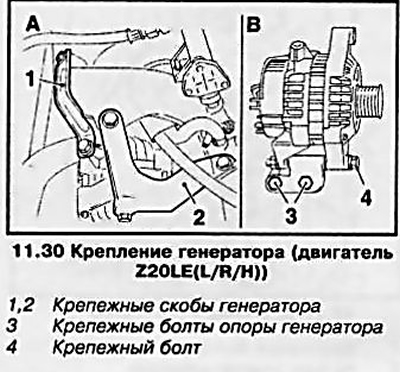
31. On Astra models, it is necessary to unscrew 2 mounting bolts (3) (see accompanying illustration) and remove the generator in an upward direction.
32. On Zafira models: Loosen the bolt (see illustration 11.30) generator mounts and move the generator back. Raise the car on the lift and unscrew the 2 generator support mounting bolts. Lower the car, disconnect the fuel line from the generator support and remove the generator.
33. Installation is carried out in reverse order.
Engine Z22YH (Zafira)
34. Remove the multi-rib belt (see Chapter 2).
Note: The belt is removed from below.
35. Disconnect the generator wiring connector, remove the 2 lower generator mounting bolts, lower the vehicle and remove the 2 upper mounting bolts.
36. Push the cooling system hose to the side and remove the generator upwards.
37. Installation is carried out in reverse order.
38. Remove the multi-rib belt (see Chapter 2).
39. Loosen the 3 mounting nuts and disconnect the electrical wiring from the generator.
40. Remove the upper and lower mounting bolts and remove the generator.
41. Installation is carried out in reverse order.
Engine Z17DT(L/H)
42. Remove the multi-rib belt (see Chapter 2).
43. Remove the horn (see Chapter 12).
44. Disconnect the vacuum lines (see accompanying illustration) brake booster and magnetic valve from the vacuum pump, disconnect from the pump.
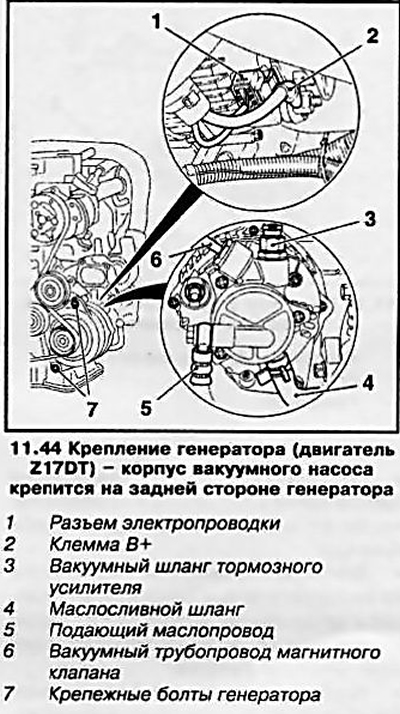
45. Place a suitable container under the vacuum pump. Remove the hollow bolt (see illustration 11.44) and disconnect the oil feed line from the vacuum pump, then loosen the clamp and disconnect the oil drain hose.
46. Loosen the fastening nut (see illustration 11.44), disconnect the terminal (B+), and then the electrical wiring connector (D+) from the generator. Unscrew the 2 mounting bolts and remove the generator.
47. Installation is performed in the reverse order of removal. Before connecting the supply oil line, do not forget to replace the sealing ring.
Engine Z19DT(L/H)
48. Remove the multi-rib belt (see Chapter 2).
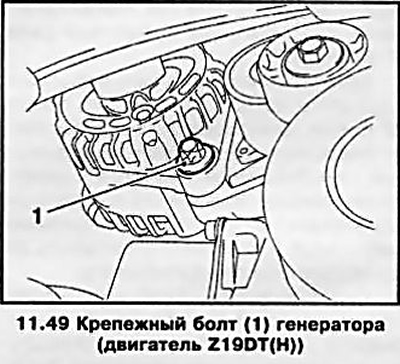
49. Remove the bolt (see accompanying illustration) generator mounts and lower the vehicle.
50. Remove the fuel filter housing from the mounting clamp and remove the latter (see Chapter 4, Section 10).
51. Release the wiring harnesses (see accompanying illustration) engine control system and air flow meter from the mounting clamps, and disconnect the meter wiring connector.
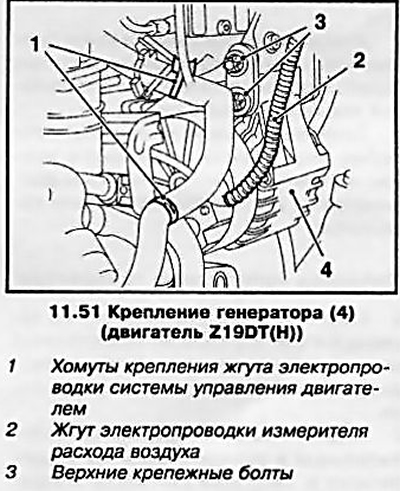
52. Remove the 3 mounting nuts and disconnect the electrical wiring from the generator, then remove the 2 upper bolts (see illustration 11.51) bracket mounts and remove the generator.
53. Installation is carried out in the reverse order of removal. The upper mounting bolts must be tightened after the multi-rib belt is installed.
Visitor comments