


Note: General information on battery maintenance and charging is provided in Chapter 1, Section 11 Manuals.
Disconnecting the battery
1. When carrying out repair work, it is always recommended to disconnect the battery. In principle, if the battery needs to be disconnected without removing it from the car, it is enough to disconnect only the wire from the negative terminal, but in order to avoid any unforeseen accidents, it is recommended to disconnect both wires and cover the battery with a protective cover (with appropriate equipment).
Caution: Always disconnect the negative wire first and connect it last!
2. The car has several systems that require constant power supply. Disconnecting the battery inevitably leads to erasing the information about the optimal settings stored in the engine management system memory, disabling the clock, destroying the security code entered in the radio, etc. Before disconnecting the battery, carefully read the recommendations below:
- a) On models equipped with a single lock, do not forget to remove the key from the ignition and put it in your pocket - when the battery is connected, all doors will automatically lock;
- b) Disconnecting the battery will erase all the acquired settings from the ECM memory (except for basic settings). These parameters include: idle speed, maximum speed, and self-diagnostic system fault codes. If necessary, read the diagnostic data before disconnecting the battery (see section 3). After connection, all lost settings will be restored automatically, but the control system will need some time for this, during which the engine may operate unstably in various modes;
- c) If the battery is disconnected while the anti-theft alarm is on, the system will remain in the same mode after the battery is connected. The audible alarm may sound when the battery terminals are connected;
- d) On models equipped with a trip computer, disconnecting the battery will also erase all user data entered during operation of the computer;
- e) The infotainment system installed in the vehicle is equipped with a security code. Before disconnecting the battery, make sure you have the correct combination to activate the equipment. The security code is provided in the infotainment system operating manual and must be kept outside the vehicle. If the combination is lost, contact an authorized Opel service station for assistance.
Note: On models produced since 2005, the security code is recognized by the electronic system without the owner's intervention and does not need to be entered when connecting the battery.
3. You can avoid unpleasant consequences of disconnecting the battery by using an external power source - detailed rules for using such devices are given in the operating instructions. As a rule, such power sources are connected to the cigarette lighter socket, after which the standard battery can be safely disconnected. The current generated by the source should be sufficient to power the control module memory, prevent the radio from blocking and maintain the functionality of the clock.
Warning: Some of these devices can supply the system with current sufficient for normal operation of other energy consumers. Before servicing electrical components, make sure that the corresponding consumer is completely de-energized!
4. After connecting the battery, it is necessary to coordinate the electric drives of the window lifters and the upper hatch (with appropriate equipment) (See Chapter "Controls and operating techniques").
Purchasing a new battery
5 When purchasing, you must select a new battery with the same nominal voltage - 12 V, and capacity (measured in ampere-hours (Ah)) as the battery being replaced.
6. Depending on the generator installed on the engine, the engine starting system and the number of electrical consumers, the vehicle may be equipped with a battery with a capacity of 36 Ah/44 Ah/55 Ah/60 Ah/66 Ah/70 Ah. The battery capacity corresponding to a specific vehicle is specified in the technical documentation supplied with it upon sale. If during operation it is necessary to change the number of electrical consumers, for example when installing new equipment, consult an Opel service station, where they will provide detailed advice on the possibility of such changes, help select, install and carry out the appropriate adjustments to the engine electrical equipment. Otherwise, if a battery with a lower capacity than required is used, this will lead to constant overcharging of the battery, evaporation of the electrolyte and gradual destruction of the battery plates, as a result of which the battery life will be sharply reduced. In addition, the output capacity may be insufficient to start the engine, especially during cold starts in winter. Purchasing a battery with a capacity larger than the nominal capacity does not provide a gain in terms of its service life, because Constant undercharging will lead to sulphation of the plates. Using a battery with an excessively high starting current is fraught with burning out the starter windings.
7. Modern technologies make it possible to produce batteries that reliably ensure the functioning of all systems with minimal maintenance work (see Chapter 1, Section 11). If the operating rules are observed, the battery will last for 3-4 years. However, it should be borne in mind that engine control on modern cars, including the models discussed in this Manual, is performed using electronic systems. The number of electronic equipment has also increased to ensure the convenience and comfort of the driver and passengers. All electronic equipment is very demanding on the constancy and magnitude of voltage in the electrical network. Therefore, if there is a need for frequent charging of the battery, its starting properties have deteriorated, etc., do not delay purchasing a new battery - this will save on much more expensive repairs of electronic systems.
Removal and installation
Note: Please read the above instructions carefully before disconnecting the battery.
8. Turn off all electrical consumers and wait approximately 1 minute to remove internal electrical voltage on electronic circuits.
9. The battery is located in the left front corner of the engine compartment and on some models may be housed in a protective cover.
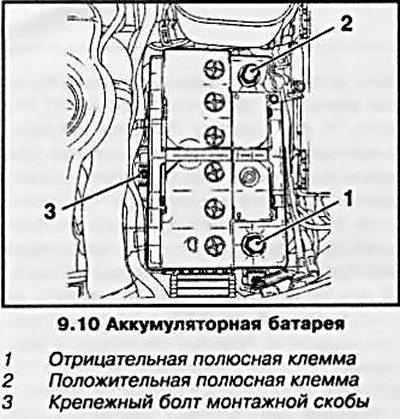
10. If equipped, open the protective cover, loosen the terminal lug nut and disconnect the wire from the negative terminal (see accompanying illustration).
11. If so equipped, lift the protective cover and disconnect the positive cable.
12. Remove the mounting bolt, remove the mounting bracket and remove the battery from the engine compartment (see illustration 9.10).
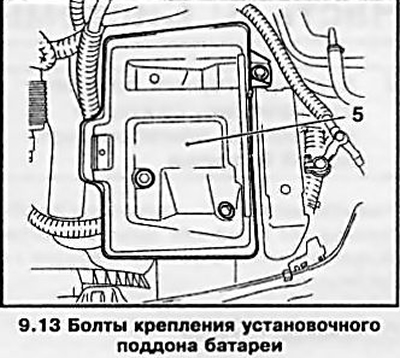
13. If necessary, unscrew the mounting bolts and remove the battery mounting tray (see accompanying illustration) - do not forget to release the electrical wiring, connectors and hoses that are attached to the pan from all intermediate fasteners.
14. Installation is carried out in the reverse order of dismantling the components. Before connecting the battery, it is necessary to clean its surfaces and terminals from traces of oxidation and dirt (see Chapter 1). After connecting the wires, lubricate the terminal blocks with technical petroleum jelly.
Caution: The negative wire must be connected last! Do not mix up the battery terminals when connecting the wires - this can cause serious damage to the generator and other electrical equipment!
Make sure the battery is securely fastened.
15. After connecting the battery, it is necessary to coordinate the electric drives of the window lifters and the upper hatch (with appropriate equipment) (See Chapter "Controls and operating techniques").
Visitor comments