
OpelBook.ru
Cars AvtoVAZ Cars Mitsubishi Cars BMW Cars Mercedes Cars Nissan Cars Toyota Cars Chevrolet
English Русский
Български
Беларускі
Український
Српски
Hrvatski
Română
Polski
Slovenský
Magyar
 |  Sitemap  |  Contacts  |    


Main Astra Corsa Insignia Kadett Omega Vectra Zafira Others Articles
Vectra A (1988-1995, petrol) Vectra A (1988-1995) Vectra B (1995-2002, petrol) Vectra B (1995-2002) Vectra C (2002-2008)
  • Main
  • Vectra
  • Vectra A
  • Chassis
  • Car suspension
  • Front suspension strut — removal, overhaul and installation

Front suspension strut — removal, overhaul and installation (Opel Vectra A)

            0

Contents: Removal ⬇ Bulkhead ⬇ Installation ⬇
Note: A ball joint puller and spring compressor are required to overhaul the strut. The tie rod end ball joint self-locking nut, drive shaft retaining ring and hub nut must be replaced during installation.


Removal


1. Where applicable, remove the hubcaps, then loosen the front wheel bolts. Apply the handbrake, then jack up and support the front of the vehicle on axle stands. Remove the appropriate front wheel.

2. Where applicable, remove the ABS sensor from the steering knuckle as described in Section 9 and disconnect its electrical wiring from the rack.

3. Remove the brake caliper from the steering knuckle as described in Section 9.

Move the caliper to the side and tie it to the body using a piece of wire or rope so that you don't have to disconnect the brake hose.

4. Loosen and remove the self-locking nut of the ball joint connecting the steering rod end to the suspension strut.

5. Remove the ball joint using a special puller.

6. Disconnect the outer end of the drive shaft from the steering knuckle as described in Section 8. Support the drive shaft by tying it to the body with wire or rope. Do not allow the drive shaft to hang under its own weight.

7. Working in the engine compartment, unscrew the upper strut mount nut. To unscrew the nut, you need to hold the piston rod of the suspension strut stationary with a slotted wrench (see illustration). Support the stand as it may fall out after removing the nut.
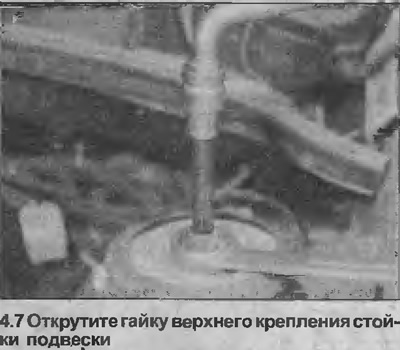
7. Working in the engine compartment, unscrew the upper strut mount nut. To unscrew the nut, you…


8. Remove the strut/steering knuckle assembly (see illustration).
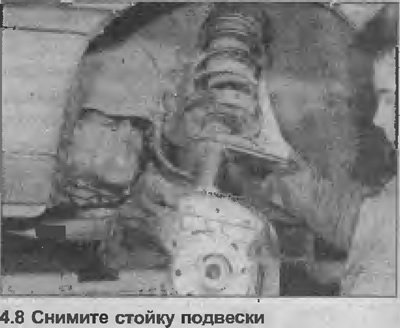


8. Remove the strut/steering knuckle assembly (see illustration).


9. If the rack does not require overhaul, proceed to step 30.

Bulkhead


10. Remove the hub, wheel bearing and brake disc shield as described in Chapter 2.

11. Place the suspension strut on a workbench or in a vice, install the spring compressor and compress the spring to relieve pressure on its upper support. Make sure the compressor is securely installed on the spring.

12. Hold the strut piston rod with a slotted wrench and unscrew the rod nut.

13. Remove the rubber part of the upper strut mount and the bearing (see illustrations).
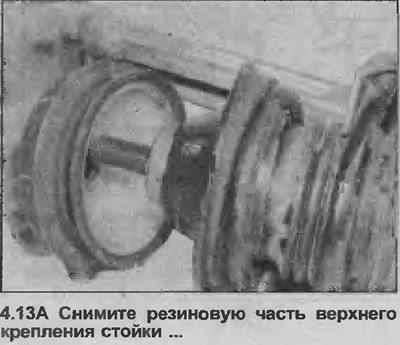
13. Remove the rubber part of the upper strut mount and the bearing (see illustrations).
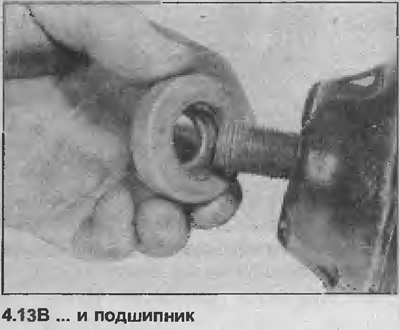

13. Remove the rubber part of the upper strut mount and the bearing (see illustrations).


14. Remove the upper spring seat and the shock absorber ring, then carefully release the puller and remove the spring (see illustration). Remember the correct orientation of the spring.
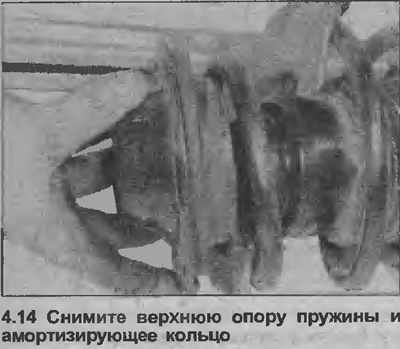


14. Remove the upper spring seat and the shock absorber ring, then carefully release the puller and…


15. Remove the protective cover and the rubber cushion installed inside it from the rack (see illustration).
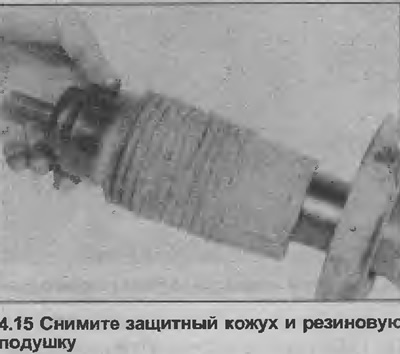
15. Remove the protective cover and the rubber cushion installed inside it from the rack (see…


16. To remove the shock absorber cylinder, you need to unscrew the ring nut from the upper end of the telescopic strut. The nut is extremely tight. It is recommended to turn the strut over and clamp the nut in a vice, and then, inserting the bolt into the steering rod bracket, rotate the strut with a long rod.

17. Remove the shock absorber cylinder (see illustrations).
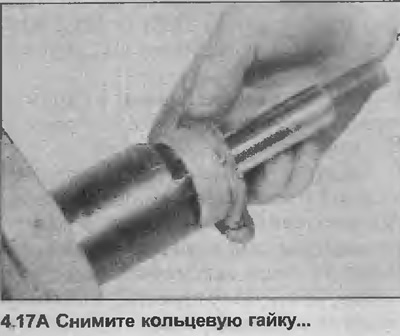
17. Remove the shock absorber cylinder (see illustrations).
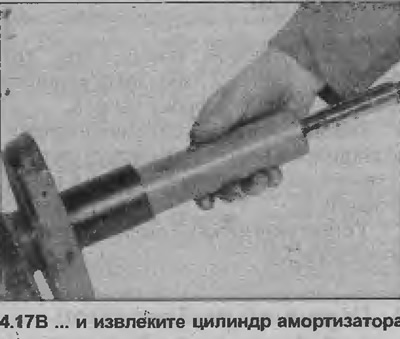

17. Remove the shock absorber cylinder (see illustrations).


18. To check the operation of the shock absorber, clamp its lower end in a vice, then move the piston several times to its full stroke. If the shock absorber piston moves jerkily (not smoothly) or there is a lack of resistance, replace the shock absorber.


19. Inspect all components for signs of wear or damage and replace if necessary. Pay particular attention to the rubber cushion and bearing.

20. Begin assembly by inserting the shock absorber cylinder into the strut, then install the ring nut.

21. Clamp the rack in a vice and tighten the ring nut to the specified tightening torque Specifications.

22. Install and compress the suspension spring, making sure that the end of the spring rests against the protrusion on its lower support (see illustration).
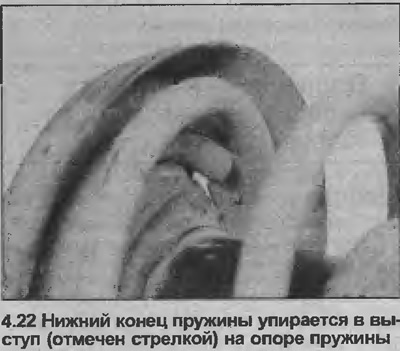
22. Install and compress the suspension spring, making sure that the end of the spring rests…


23. Install the rubber cushion and protective cover.

24. Install the upper spring seat and shock absorber ring so that the mark on the shock absorber ring aligns with the hole in the spring seat (see illustration). The hole in the spring support must be rotated relative to the end of the spring by 90°.
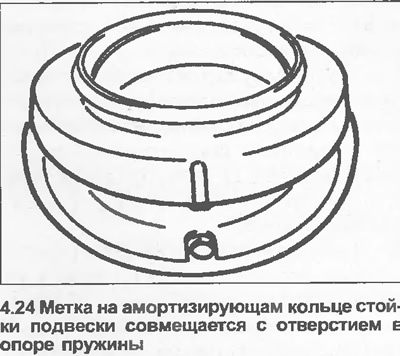
24. Install the upper spring seat and shock absorber ring so that the mark on the shock absorber…


25. Apply a small amount of grease to the bearing, then install it with the side where part of the bearing track is visible facing up.


26. Install the rubber part of the upper rack mount.

27. Hold the strut piston rod stationary and tighten the rod nut with the specified tightening force Specifications.

28. Carefully release and remove the spring compressor, making sure the spring supports are seated correctly. Make sure the lower end of the spring still rests against the lug on the support.

29. Install the stand as follows.

Installation


30. Install the upper end of the rack into the mount, then screw on the fastening nut and tighten it to the specified tightening torque Specifications by the method used in paragraph 27.

31. Connect the outer end of the drive shaft to the steering knuckle as described in Section 8.

32. Insert the ball joint of the tie rod end into the suspension strut and tighten the new self-locking nut to the specified tightening torque Specifications.

33. Install the brake caliper on the steering knuckle as described in Section 9.

34. Where applicable, install the ABS sensor to the steering knuckle as described in Section 9 and secure its wiring to the rack.

35. Install the wheel and lower the vehicle to the ground. Tighten the wheel bolts completely and, where applicable, install the hubcap.

36. Check and, if necessary, adjust the front wheel alignment angles as described in Chapter 45.


This article is available at russian, bulgarian, belarusian, ukrainian, serbian, croatian, romanian, polish, slovak, hungarian
Checking the article: Chernov Alexander

Share information:

Previous articles
Opel Vectra A: Car suspension
Next articles

Engine subframe — removal and installation
Front Wheel Bearing — Replacement
General description of the suspension
Suspension specifications
Lower control arm front suspension — removal and installation
Front Lower Arm Bushings — Replacement
Ball joint of the lower arm of the front suspension — removal and installation
Front Anti-Roll Bar — Removal and Installation
Front Anti-Roll Bar Bushings — Replacement
Rear Wheel Bearing (SOHC Models) — Adjustment


See similar ones from other Opel car manuals:
▶ Front suspension strut — removal and installation Opel Astra F (1991-1998, petrol)
▶ Removal and installation the GMA front suspension strut… Opel Insignia A (2008-2017)
▶ Front suspension strut — removal and installation Opel Omega A (1986-1993)
▶ Front suspension strut — removal and installation Opel Zafira A (1999-2005, petrol)
▶ Front Suspension Strut — Inspection Opel Ascona C (1981-1988)
Link to this page in different formats

Visitor comments


No comments yet


How much will 28 + 15 =


Vectra C (2002-2008) 
  • General information
  • User manual
  • Vehicle device
  • Maintenance
  • Troubleshooting
  • Power unit
  • Engine repair
  • Cooling system
  • Power and control system
  • Engine electrics
  • Transmission
  • Clutch
  • Car gearbox
  • Drive shafts
  • Chassis
  • Car suspension
  • Steering
  • Brake system
  • Body
  • Exterior
  • Interior
  • Doors, locks and windows
  • Heating and ventilation
  • Electrical equipment
  • Equipment and devices
  • Headlights and lighting
  • Electrical circuits
Vectra B (1995-2002) 
  • General information
  • User manual
  • Weekly checks
  • Maintenance (gasoline)
  • Maintenance (diesel)
  • Troubleshooting
  • Power unit
  • SOHC gasoline engine
  • DOHC petrol engine
  • Diesel engine 1.7 liter
  • Diesel engine 2.0 liters
  • Engine repair
  • Cooling system
  • Fuel system (gasoline)
  • Fuel system (diesel)
  • Charging system
  • Launch system
  • Ignition and preheat
  • Transmission
  • Clutch
  • Mechanical gearbox
  • Automatic gearbox
  • Drive shafts
  • Chassis
  • Brake system
  • Wheel suspension
  • Steering
  • Body
  • Exterior
  • Interior
  • Doors and windows
  • Heating and ventilation
  • Electrical equipment
  • Equipment and devices
  • Electrical circuits
Vectra B (1995-2002, petrol) 
  • General information
  • Maintenance
  • Help with malfunctions
  • Power unit
  • Engine repair
  • Exhaust system
  • Cooling system
  • Fuel system
  • Multec injection system
  • Four point injection
  • Transmission
  • Clutch
  • Gearbox and drive
  • Chassis
  • Wheel suspension
  • Steering
  • Brake system
  • Wheels and tires
  • Body
  • Exterior
  • Interior
  • Electrical equipment
  • Fuses and electronics
  • Power devices
  • Ignition system
  • Lighting and signaling
  • Equipment and devices
  • Heating and ventilation
  • Electrical circuits
Vectra A (1988-1995) 
  • Power unit
  • Engine repair
  • Ignition system
  • Lubrication system
  • Cooling system
  • Injection system
  • Fuel system (carburetor)
  • Fuel system (diesel)
  • Exhaust system
  • Transmission
  • Clutch
  • Car gearbox
  • Chassis
  • Front suspension
  • Rear suspension
  • Steering
  • Brake system
  • Wheels and tires
  • Body
  • Exterior
  • Interior
  • Electrical equipment
  • Electrical circuits
Vectra A (1988-1995, petrol) 
  • General information
  • User manual
  • Maintenance
  • Power unit
  • SOHC engine
  • DOHC engine
  • Cooling and ventilation
  • Fuel system (carburetor)
  • Fuel system (injector)
  • Exhaust converter
  • Transmission
  • Clutch
  • Mechanical gearbox
  • Automatic gearbox
  • Drive shafts
  • Chassis
  • Brake system
  • Car suspension
  • Steering
  • Body
  • Body elements
  • Electrical equipment
  • Power devices
  • Equipment and devices
  • Electrical circuits
OpelBook.ru © 2017–2026 · Mobile version · · Sitemap: EN BG BY UA RS HR RO PL SK HU · Feedback · Site search
Astra F, petrol · Astra G, petrol · Astra G · Astra H · Astra J, petrol · Corsa B · Corsa C, petrol · Corsa C · Insignia A · Kadett D · Kadett E · Omega A · Omega B · Omega B2 · Vectra A, petrol · Vectra A · Vectra B, petrol · Vectra B · Vectra C · Zafira A, petrol · Frontera A, petrol · Frontera B · Ascona C · Vivaro A ·
We want your visit to be comfortable 🤝! We use cookies 🍪 to make that happen.