


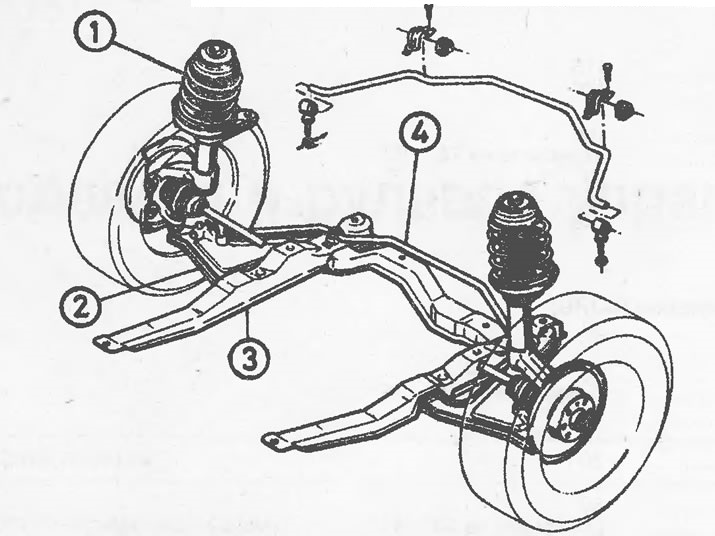
1.1 Front Suspension Component Locations - All Models
1 MacPherson strut
2 Lower arm
3 Sub-engine frame
4 Anti-roll bar
2. The lower arms are fixed to the front engine subframe (horizontal) and back (vertical) bushings.
This suspension design increases the vehicle's stability during braking and prevents skidding, even when one side of the vehicle is braking on a slippery surface and the other on a dry and hard surface.
3. The steering knuckles, located between the lower ends of the MacPherson struts and the lower control arms, carry the double-row ball bearings for the wheels and brake caliper assemblies.
4. Rear suspension on models with a single overhead camshaft (SOHC) (dependent type) consists of a torsion beam and longitudinal arms with spindle springs and telescopic shock absorbers. The front ends of the longitudinal suspension arms are fixed to the bottom with horizontal bushings, and the rear ends are connected to the shock absorbers. The upper ends of the shock absorbers are attached to the bottom with bolts. The spindle springs act independently of the shock absorbers. Some models are equipped with an anti-roll bar, which is installed between the torsion beam and the rear ends of the longitudinal suspension arms (see illustration).
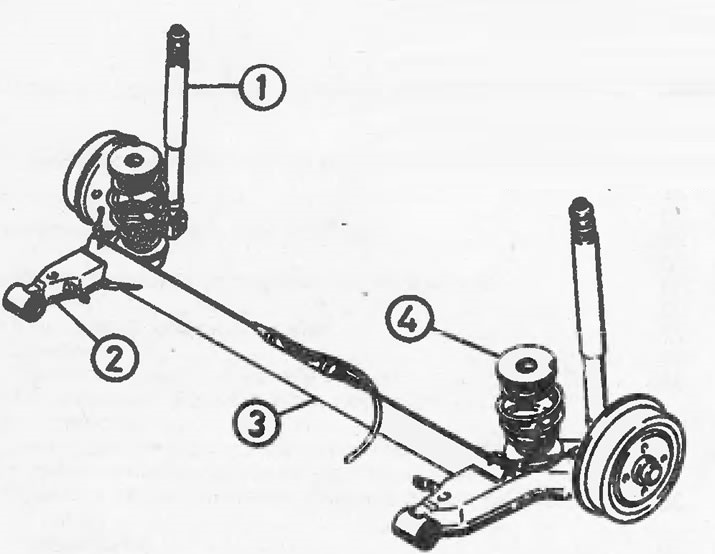
1.4 Arrangement of rear suspension components-Single overhead camshaft (SOHC)models (model shown with rear drum brakes)
1 Shock absorber
2 Suspension trailing arm
3 Torsion beam
4 Spindle spring
5. The manual rear suspension stiffness adjustment system is installed. Some models are equipped as standard, while others can be supplied upon request by the owner. The suspension stiffness is adjusted by changing the air pressure in the pneumatic shock absorbers. A special adjustment valve is located in the luggage compartment.
6. Rear suspension on models with two overhead camshafts (DOHC) (independent type) consists of diagonal arms with fusiform springs, telescopic shock absorbers and an anti-roll bar. The front end of each diagonal arm is secured to the suspension cross member by two horizontal bushings, and their rear ends are connected to the shock absorbers. The upper ends of the shock absorbers are bolted to the underbody. The springs are installed and operate independently of the shock absorbers. The anti-roll bar is located on the suspension cross member and is connected to the diagonal arms by vertical connecting levers. The ends of the Suspension cross member are bolted directly to the underbody of the vehicle (see illustration).
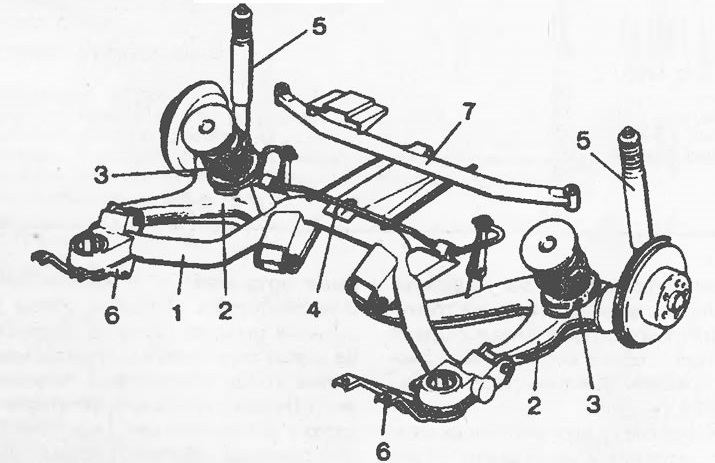
1.6 Rear suspension component arrangement-model with two overhead camshafts (DOHC)
1 Crossbar
2 Diagonal lever
3 Coil springs
4 Anti-roll bar
5 Shock absorber
6 Crossbar mounting bracket
7 Rear crossmember beam
7. Rack-and-pinion steering mechanism. Rotation is transmitted to the front wheels via steering rods, the inner ends of which are connected to the rack, and the outer ends to the suspension struts via ball joints.
8. The steering column consists of a housing having a deformable section and a shaft, the lower end of which is attached to an elastic coupling.
(Material provided by this website www.opelbook.ru)
9. Power steering is standard on some models, and can be supplied to other models upon request. The power steering is hydraulic, with pressure generated by a pump driven by a belt from the crankshaft. On the 1.8 and 2.0 L models, the fluid-carrying tubes run under the radiator to maintain the brake fluid temperature within the required limits.
Visitor comments