


Control and measuring instruments
The arrangement of the gauges in the instrument cluster is shown in Figure 16.1.
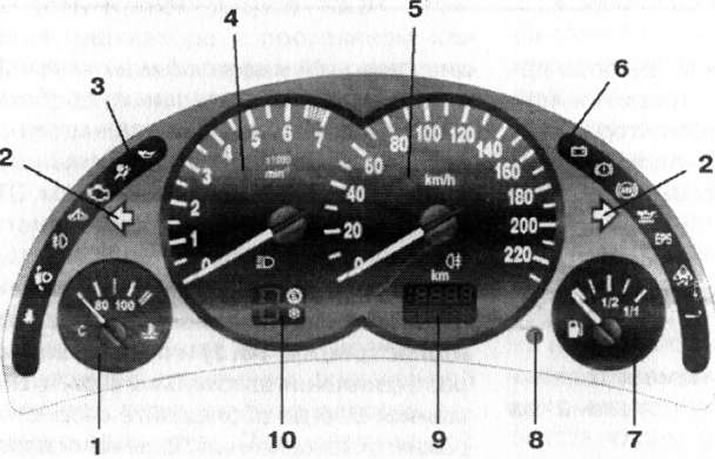
16.1 Layout of meters, control lamps and indicators in combination: 1. Coolant temperature gauge; 2. Direction indicator/hazard warning lights; 3. Left indicator/control lamp window; 4. Tachometer; 5. Speedometer; 6. Right indicator/control lamp window; 7. Fuel gauge; 8. Button for resetting the current mileage counter/setting the time/displaying the service indication; 9. Odometer/resettable trip meter/hour/service indicator display; 10. Display of the selected transmission mode (AT/Easytronic)
Note: Depending on the year of manufacture of the vehicle and its configuration, the appearance of the instrument cluster as a whole and individual instruments may differ from those shown in the accompanying illustrations.
Speedometer
The speedometer is located in the central part of the instrument cluster on the right (see illustration 16.1) and shows the vehicle speed in km/h.
Attention: Always observe the speed limit established by the Road Traffic Regulations (RTR), follow the speed limit signs!
The lower part of the speedometer field has a display for the odometer/resettable trip meter/hour/service indication (see below).
Tachometer
The tachometer is located in the central part of the instrument cluster on the left (see illustration 16.1) and shows the engine crankshaft speed in thousands of revolutions per minute (the arrow reading should be multiplied by 1000)To avoid engine failure, do not exceed the maximum permissible crankshaft speed (the tachometer needle should never enter the red zone of the scale).
Caution: If the tachometer needle approaches the red sector of the scale, you should immediately shift to a higher gear!
Fuel gauge
The fuel gauge dial is mounted in the instrument cluster to the right of the speedometer (see illustration 16.1) and serves for visual monitoring of the remaining fuel supply in the tank.
The device shows the APPROXIMATE fuel level in the tank. The error of the fuel gauge readings is minimal when the car is in a strictly horizontal position. When the car is moving on winding or hilly roads, the error of the device increases. When the ignition is turned off, the gauge needle moves to the zero mark of the scale.
The minimum fuel reserve indicator light go in the lower left sector of the gauge dial (see illustration 16.2) activated when there is a small amount of fuel left in the tank (the meter's arrow drops to the leftmost sector of the scale), and warns about the beginning of using the fuel reserve. Activation of the control lamp in flashing mode warns about the inadmissibility of further reduction of the amount of fuel in the tank - at the first opportunity fill up the tank.
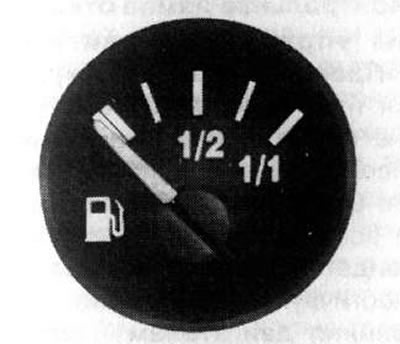
16.2. Fuel gauge dial
Warning: It is strictly forbidden to drive until the tank is empty - this can lead to failure of the catalytic converter of exhaust gases (see Section 28)!
When the fuel level on diesel models is completely exhausted, it is necessary to remove air from the fuel system (see Chapter 1).
Coolant temperature gauge
The fuel gauge dial is mounted in the instrument cluster to the left of the tachometer (see illustration 16.1) and serves for visual monitoring of the engine operating temperature. The meter only functions when there is sufficient coolant in the engine cooling system.
The meter readings may vary within the operating temperature range, depending on the ambient air temperature and the vehicle's driving mode. With normal operation of all systems, the coolant temperature should not exceed the range of 80-100°C (with a warm engine) (see illustration 16.3). When operating, the cooling system creates increased pressure, which allows the vehicle to continue operating for some time when the coolant temperature exceeds 100°C. Reduce the engine load as soon as possible, stop the vehicle on the side of the road if necessary, check the coolant level and reduce the temperature. If appropriate measures are not taken in case of overheating, further movement of the vehicle may lead to serious damage to the power unit.
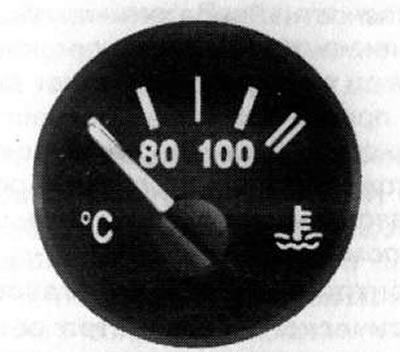
16.3. Coolant temperature gauge dial
Odometer/Resettable Tripmeter/Clock/Service Display
The display is mounted in the lower part of the speedometer dial (see illustration 16.1). The odometer and resettable trip counter display fields are located one above the other: the odometer at the bottom, the trip counter at the top.
The odometer records the total mileage of the vehicle since it was put into operation. The total mileage is constantly displayed on the display. The resettable mileage counter allows you to track the vehicle's mileage since the last reset.
The resettable current mileage counter is reset by briefly pressing the reset button built into the instrument cluster to the right of the speedometer dial (see illustration 16.4).
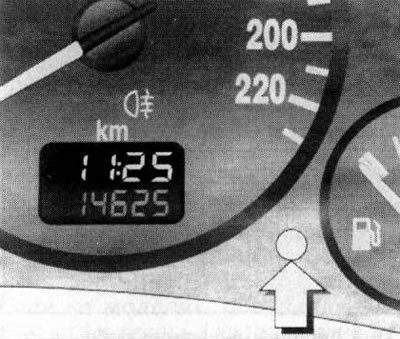
16.4. Button for resetting the current mileage counter/setting the clock readings
On some models, the display may also show the current time. With this configuration, to reset the current mileage counter, hold the reset button down for about 2 seconds. If the display is activated in the time display mode, first switch it to the counter display mode by briefly pressing the reset button.
The procedure for adjusting the clock readings is given below.
Setting/correcting the clock readings (with appropriate equipment)
To set/correct the clock display, switch the display to the time display mode by briefly pressing the reset button (see illustration 16.4).
Press and hold the reset button for about 2 seconds - the current time in hours is activated in flashing mode. Set the desired value by briefly pressing the same button. Then press the button again and hold it for about 2 seconds - now the current time in minutes is activated in flashing mode. Set the desired value by briefly pressing the button. After another 2-second press of the button, the watch will switch to the standard indication mode.
Note: If the battery has been disconnected from the vehicle's electrical system for a period of time, the chronometer readings will be reset when the power supply is turned on again.
Display indicating the selected transmission mode
On models equipped with AT/Easytronic (see Sections 23 and 24), the display is mounted in the lower part of the tachometer dial field (see illustration 16.5) and is designed to display information about the currently selected operating mode of the gearbox.
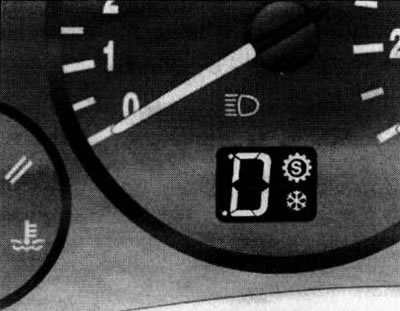
16.5. Display of the selected gearbox mode indication
When the selector lever is switched to the appropriate position, the selected gearbox mode is indicated on the left side of the display:
- R - Parking
- R — Reverse
- N — Neutral gear
- A - Automatic mode (Easytronic)
- M - Manual mode (Easytronic)
- D — Automatic mode (AT)
- 1-4 — Currently engaged gear (AT)
- 1-5 — Manual mode, currently engaged gear (Easytronic)
Note: On models equipped with the Easytronic system, the mode indicator flashes for a few seconds if, with the engine running and the brake pedal not pressed, the selector lever is switched to position A - you must start moving or move the lever to position "N".
When special transmission control modes are activated (see Section 25) the corresponding indicators are displayed on the right side of the display field:
 Winter mode.
 Sports mode.
Control lamps, indicator lights
Note: Some indicator/warning lamps are built into the corresponding switches located on the instrument panel/center console of the vehicle, their operating procedure is given in the description of the corresponding system.
The vehicle's instrument cluster assembly contains a whole range of control lamps and indicator lights (see illustration 16.1), with the help of which the driver receives important information about the serviceability/malfunction of the main units and systems of the vehicle (control lamps), and can also monitor the correct activation/deactivation of the corresponding units and systems (indicator lights).
Below is a list and description of the control lamps and indicator lights built into the instrument cluster.
Note: Depending on the model and equipment, not all of the following indicator/warning lights may be installed on your vehicle.
Left instrument cluster indicator/warning lamp window
 The "Fasten seat belt" indicator lamp reminds the driver to fasten the seat belt. The lamp is activated when the ignition is switched on and remains lit until the driver's seat belt buckle is fastened.
Note: An additional warning gong will sound to remind you to fasten your seat belts.
 Indicator lamp for failure of the automatic headlight leveling device. On models with the corresponding configuration, this indicator lamp is activated when a malfunction of the automatic headlight leveling device occurs - it is necessary to immediately eliminate the malfunction! Continuing to drive with a failed regulator in conditions of limited visibility (twilight, night time) creates a risk of blinding drivers of oncoming and preceding vehicles, as well as the occurrence of accidents due to deterioration of visibility. After eliminating the malfunction, contact a service station at the first opportunity, where there is special equipment for adjusting headlights.
 This indicator serves to confirm the correct activation of the fog lights (with appropriate equipment). When the headlights are turned off, the indicator goes out.
 Electronic starter/engine/gearbox immobilizer malfunction indicator lamp. On models with the corresponding configuration, activation of the lamp with the engine running indicates a malfunction in the electronic equipment of the engine or automatic transmission. The electronic system switches to emergency mode - fuel consumption may increase and the ability to drive the car is limited. In some cases, the malfunction can be eliminated by turning off and starting the engine again. If the indicator lamp continues to light with the engine running, you should seek assistance from a service station.
Note: A short, single flashing of the lamp has no significance.
Activation of the indicator lamp in flashing mode after the ignition is switched on indicates a malfunction in the engine start interlock system; the engine cannot be started. In this case, switch off the ignition and switch it on again. If the lamp continues to flash, try to start the engine using the spare key and contact a service station for assistance.
 The engine management system failure indicator lamp (M11/ "Check engine") is activated when the ignition is turned on and should go out a few seconds after the engine has started. The lamp's failure to turn off, as well as its activation while driving, indicate a malfunction of the engine management system - the permissible toxicity standards of the exhaust gases may be exceeded. To identify and eliminate the malfunction, it is necessary to carry out diagnostics using special equipment - it is recommended to contact car service specialists.
Activation of the indicator lamp in flashing mode with the engine running indicates a malfunction that may lead to failure of the catalytic converter. If it is necessary to continue driving, reduce the fuel supply with the gas pedal so that the indicator lamp stops flashing and lights continuously - contact a service station as soon as possible.
 Supplemental Restraint System (SRS) failure indicator lamp. When the ignition is turned on, the indicator lamp should light up. If the SRS is working properly, the lamp will go out approximately 4 seconds after being turned on. If the lamp does not turn off, does not light up at all, or is activated while driving, this may indicate a malfunction in the airbag circuits or automatic emergency seat belt tensioners. The car should be taken to a service station as soon as possible for the necessary diagnostics and repairs. For more information on the operation of the SRS see Section 13.
 Engine oil pressure warning light. The light is activated when the ignition is turned on. If this light fails to turn off after the engine has started, or if it is activated while driving, this indicates a dangerous drop in engine oil pressure. If the light is activated while the vehicle is moving in a constant or flashing mode, pull off the road in a safe place and turn off the engine immediately.
Caution: Operating the vehicle with the warning light on may cause serious damage and engine failure!
Check the engine oil level and make adjustments if necessary (see Chapter 1). If the warning light comes on when the oil level is normal, the car should be taken to a service station for more detailed diagnostics and necessary repairs.
Note: The engine oil pressure indicator light is not intended to monitor the oil level in the system, this function is performed by another indicator (see below). In addition, the dipstick is intended to check the oil level (see Chapter 1).
Right instrument cluster indicator/warning lamp window
 The charge indicator lamp is activated when the ignition is turned on and should go out a few seconds after the engine is started. If the lamp does not turn off, or if it turns on while driving, this indicates a fault in the charging system - you must pull off the road in a safe place, turn off the engine and check the condition of the multi-rib belt (see Chapter 1). A broken or loose belt may be accompanied by malfunctions of the engine cooling system, and on diesel models, in addition, by the cessation of the vacuum booster.
Warning: Do not continue driving if the belt is loose, damaged or missing - contact your nearest service station!
 Low Brake Fluid/Parking Brake Engaged Indicator Light: When the ignition is turned on, the indicator light illuminates continuously with the parking brake engaged, reminding the driver to release it before driving.
Note: On models equipped with the Easytronic system, the indicator lamp will flash for a few seconds after the ignition is switched off if the parking brake lever is not engaged.
If the indicator lamp continues to light after releasing the parking brake, or comes on while driving, this usually indicates an excessive drop in the brake fluid level - you should stop and check the brake fluid level in the master cylinder reservoir, and also carefully inspect the components of the hydraulic circuit of the brake system for leaks. If necessary, eliminate the causes of leaks and add fresh fluid to the reservoir. If the brake fluid level is normal, contact service station specialists to check the operability of the corresponding components of the electrical circuit.
Attention: Driving a vehicle with a faulty braking system is not permitted under any circumstances!
 The anti-lock brake system (ABS) indicator light comes on briefly when the ignition is turned on (at this point, the ABS self-diagnostic system is activated, accompanied by a characteristic noise in the engine compartment) and should go out after a few seconds. The lamp's failure to turn off, as well as its activation while driving, indicates a malfunction of the ABS - at the first opportunity, it is necessary to diagnose the brake system using special equipment or drive the car to a service station to perform the necessary repairs.
Note: When the indicator lamp is on, the anti-lock brake system will not operate, but the brake system will continue to function normally.
 Engine oil level indicator. This indicator light is activated when the engine oil level drops to the minimum permissible value - check the oil level and make the appropriate adjustment if necessary (see Chapter 1).
EPS Electric Power Steering Failure Warning Light When this warning light comes on, it warns you that the power steering has stopped working - you can continue driving, but remember that turning the vehicle will require much more effort than when driving under normal conditions.
 Indicator of deterioration of road surface traction/disabling of the anti-skid (ESP)/anti-skid (TS) system. On models equipped with ESP/TS, this indicator lights up when the ignition is turned on. If the anti-skid system is working properly, the indicator goes out after a few seconds.
When the vehicle is moving, the indicator is activated in flashing mode when the EEDS system is turned on, thereby warning the driver about the deterioration of the road surface grip properties and that the vehicle wheels are on the verge of slipping, and the vehicle movement is automatically slowed down.
Note: When ESPTC is operating, a characteristic noise can be heard in the engine compartment.
The indicator's refusal to turn off, as well as its activation during movement in constant mode, confirms the fact of malfunction and disabling of the anti-skid/anti-slip system - you can continue driving, but the vehicle's directional stability may deteriorate when the properties of the road surface change. In case of system malfunction, contact service station specialists as soon as possible.
If the power supply/battery is interrupted on models equipped with ESP, when the power supply is restored the indicator will light continuously - the system should be adjusted. Additional information on the operation of ESP/TC is provided in Section 25.
 If equipped accordingly, this indicator serves to confirm the correct operation of the turn signals when the vehicle is towing a trailer. It is activated in flashing mode at the same frequency as the turn signals. Refusal to activate when the turn signal is on warns the driver that one of the turn signal lamps on the trailer or towing vehicle has failed.
Instrument cluster field
 The arrow-shaped indicators of the direction indicators/hazard warning lights have a green glow and serve to monitor the proper functioning of the corresponding direction indicators. The direction of the indicator arrows coincides with the selected direction of change of the vehicle's course. The indicators operate in a flashing mode with a frequency corresponding to the flashing frequency of the direction indicators. Rapid flashing of one of the indicators indicates that the lamp of one of the indicators of the corresponding direction indicator has burned out - replace the burned-out lamp as soon as possible (see Chapter 12), in order to avoid emergency situations on the roads. The activation of the hazard warning lights is accompanied by the simultaneous flashing of the indicators of both turn signals.
 SPORT mode activation indicator (with appropriate equipment) lights up in the upper right corner of the display indicating the selected gearbox mode (see above) - the "SPORT" mode is on.
 Winter mode activation indicator AT (with appropriate equipment) lights up in the lower right corner of the display indicating the selected gearbox mode (see above) - winter mode is on.
 This indicator is built into the lower part of the tachometer dial and serves to confirm that the high beam headlights are activated properly. When the headlights are switched to low beam, the indicator goes out.
 The diesel engine preheating indicator lamp is built into the lower part of the tachometer dial and lights up only at low ambient temperatures when the ignition is switched on, indicating that the preheating system is activated and goes out after the glow plugs have warmed up to the required temperature. The engine should not be started until the indicator lamp goes out.
Note: If the lamp does not go out for a long time, this may indicate a malfunction in the preheating system - contact a service station.
 This indicator is built into the lower part of the speedometer dial and serves to confirm that the rear fog lights are activated properly (with appropriate equipment). When the lights are turned off, the indicator goes out.
Visitor comments