


Contents: Left steering column switch ⬇ Tempostat Management ⬇ Right steering column switch ⬇ Adjustable steering column lock…⬇ Horn switch ⬇ Ignition Switch/Steering Column Lock ⬇
Left steering column switch
Left steering column switch (see illustrations 15.1, 17.1a, 17.1b) is designed to activate/deactivate the high beam mode, high beam signaling, control the operation of the direction indicators, and on models with the corresponding configuration - also to control the cruise control (see below).
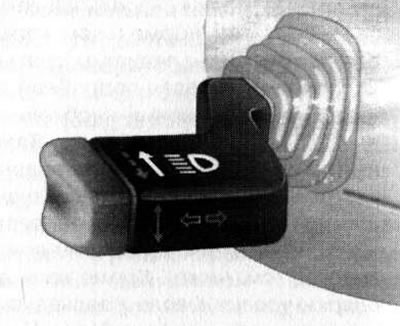
17.1a. Left steering column switch |
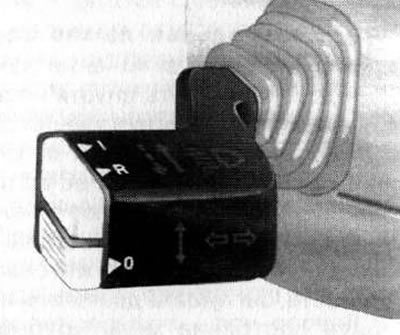
17.1b. Left steering column switch (models equipped with a time-lapse system) |
The low beam mode is activated when the ignition is on and the rotary switch on the switch panel to the left of the steering column is set to the appropriate position (see below).
To activate the high beam, you should press the switch lever away from you - the corresponding light indicator on the instrument cluster should light up (see Section 16). Switching to low beam mode will occur when you press the lever away from you again.
Note: The lever returns to its original position after each manipulation.
The high beam signal is activated by pulling the lever towards you (to the steering wheel) and can be performed at any position of the rotary switch. After releasing the lever, it will return to its original position.
The activation of the corresponding direction indicators is performed by pressing the lever up or down in the plane of the steering wheel until the point of resistance is overcome - the lever remains in the corresponding fixed position until the steering wheel is returned to the straight-ahead position (the limit switch will trip), or until the lever is forcibly returned to the neutral position.
Note: When turning the steering wheel at a small angle, the limit switch may not operate - the lever must be returned to the neutral position forcibly.
The correct activation of the direction indicators is confirmed by the flashing of the corresponding one of the two green indicator lights built into the instrument cluster (see Section 16). The indicators are switched off when the steering column switch lever is returned to the neutral position.
There is also the possibility of short-term (3-fold) activation of the pointers by lightly (without overcoming the point of resistance) pressing the lever in the appropriate direction, which is very convenient, for example, when changing lanes on roads with multi-lane markings. When released, the lever automatically returns to the neutral position. The left steering column switch also activates the "Homeward Bound Light" function (with appropriate equipment). To activate it, remove the key from the ignition, open the driver's door and pull the lever towards you - the low beam headlights and reversing lights will be activated for 30 seconds after the driver's door is closed. The function will be deactivated earlier than the specified period when the key is inserted into the ignition or when the lever is pulled again. If the driver's door is not closed, the backlight will automatically turn off after two minutes.
Tempostat Management
When equipped accordingly, the cruise control system (tempostat) allows you to automatically maintain the selected cruising speed of the car without using the gas pedal. The minimum supported cruising speed is 30 km/h. Using the cruise control becomes especially convenient during long trips on lightly loaded straight country highways. For safety reasons, it is not recommended to turn on the cruise control when driving in the city, on winding roads with many turns, on slippery road surfaces, in heavy rain and in other adverse weather and road conditions, as well as in other road situations that require frequent changes in speed. In the above cases, the driver must be able to fully control the vehicle's driving mode.
Attention: Incorrect use of the cruise control may cause an accident!
On cars with AT, the cruise control should be activated only when the selector lever is switched to the "D" position, and if the Easytronic system is present, only in the automatic smooth switching mode. The cruise control is controlled by a push-button switch built into the end part of the left steering column switch (see illustration 17.1b) The cruise control is activated by pressing the "I" switch button - the current vehicle speed is entered into the control device's memory and maintained automatically.
Pressing the accelerator pedal while the cruise control is active will increase the cruising speed to the point where the pedal will be released again.
The cruising speed value can be increased without affecting the gas pedal by briefly pressing or holding down the "I" button - after each press/while holding the button, the selected cruising speed value will increase in increments of 2 km/h; when released, the new value will be entered into memory.
The cruising speed is reduced by pressing or holding the "R" button. Each time the button is pressed/held, the selected cruising speed will decrease in 2 km/h increments. When the button is released, the new value will be entered into the device's memory.
To exit the automatic speed control mode and deactivate the cruise control, press the "O" button, the car will smoothly slow down. To continue driving, press the gas pedal - control is carried out in the normal mode.
The cruise control will also be deactivated by pressing the brake or clutch pedal and reducing the vehicle speed below 30 km/h. If the cruise control has been deactivated in one of these ways, after accelerating the vehicle above 30 km/h, the last selected cruising speed can be recalled from the system memory by briefly pressing the "R" button.
Note: The speed value stored in memory is erased after the ignition is turned off.
Caution: Activate the recall of the cruising speed from the system memory only if you remember its last value and are ready to drive in the corresponding speed mode!
On models with AT/Easytronic, automatic control of the vehicle's speed is also terminated when the selector lever is moved to the "N" position.
Right steering column switch
Attention: To avoid damage to the drive mechanism, do not turn on the windshield wipers when the glass surface is dry, and do not move the brushes by hand! Do not allow gasoline or other solvents to come into contact with the rubber working elements of the windshield wipers! To prevent the risk of failure of the washer fluid supply pumps, try not to activate them when the tank is empty!
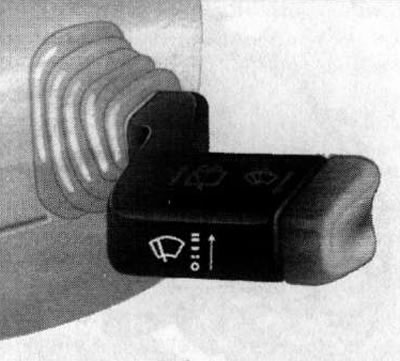
17.2. Right steering column switch
Right steering column switch (see illustration 17.2) designed to control the operation of windshield and rear window wipers/washers, as well as headlight lenses (with appropriate equipment). Moving the switch lever up and down in the plane of the steering wheel allows you to select the operating modes of the windshield wipers.
- ABOUT In this switch mode, the windshield wipers are off;
- -- Interval mode of operation of windshield wipers;
- — Continuous operation of windshield wipers with normal frequency of strokes;
- = High-speed windshield wiper operation.
The pause duration between windshield wipers in interval mode can be adjusted within the range from 2 to 15 seconds. To set the desired interval of wipers with the ignition on, move the switch lever to the "--" position and return it to the "O" position, wait the desired period of time, then set the lever back to the interval mode position - the pause duration is stored in the device's memory until the next change is made or until the ignition is turned off.
Note: Each time the ignition is turned on, the pause duration is automatically set to 7 seconds.
To supply the windshield with washer fluid, pull the switch lever towards you. In this case, if the switch is in the "O" position (see above), the windshield wipers will be activated simultaneously with the supply of fluid, and will stop functioning after another 2-3 strokes after releasing the lever. On models with the corresponding configuration, with the headlights on, the supply of washer fluid to their lenses is carried out simultaneously with its supply to the car's windshield.
On models equipped with an automatic windshield wiper control with a rain sensor, the automatic mode is activated by setting the lever to the "--" position - the rain sensor determines the amount of water on the windshield and automatically adjusts the speed of the windshield wipers.
Attention: Keep the rain sensor window clean, regularly clean it from dust and dirt!
If necessary, you can manually activate the windscreen wipers in continuous mode by selecting the "--" or "=" position using the switch lever (see above). To turn them off, set the lever to the "O" position.
If equipped, the rear window wiper and washer fluid supply to the rear window of the vehicle are controlled by pressing the right steering column switch. When the lever is pressed, the rear window wiper is activated in interval mode. When the lever is held in the depressed position, washer fluid is supplied, which is accompanied by the operation of the wiper. The rear window wiper is switched off by pulling the lever towards you.
Adjustable steering column lock release lever
Caution: Do not adjust the tilt of the steering column while driving!
The steering column should be adjusted so that the steering wheel hub is opposite the driver's chest. A position in which the steering wheel hub is opposite the driver's face is incorrect, since it reduces the protective functions of the airbag built into it.
If equipped, to release the lock, use the ignition key to unlock the steering wheel (see below) and move the lever located on the lower right side of the steering column to the lower position (see illustration 17.3). Move the steering wheel to adjust it properly, then lock the steering column again by returning the lock release lever to its original position - to check the reliability of the lock, tug the steering wheel.
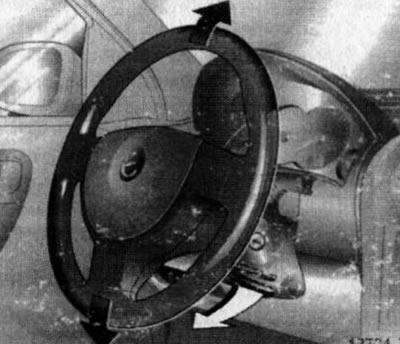
17.3. Move the adjustable steering column lock release lever down and adjust the steering wheel to the desired position
Horn switch
To activate the sound signal, press one of the horn switch buttons built into the steering wheel cross spokes (see illustration 17.4), indicated by pictograms.
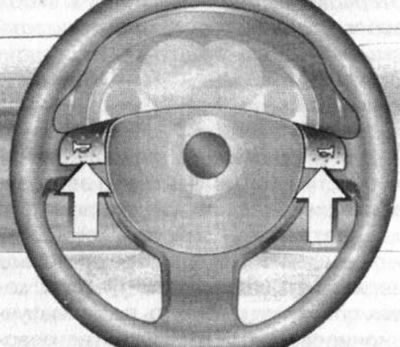
17.4. Push-button horn switches
Ignition Switch/Steering Column Lock
The ignition switch/steering column lock is located on the right side of the steering column and can be in one of the following four positions: (see illustration 17.5).
[Text copied from an online resource: OPELBOOK.ru]
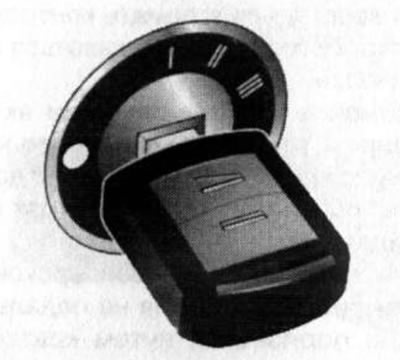
17.5. Ignition switch/steering column lock
O — The ignition key can be inserted or removed from the ignition switch only in this position. On AT-equipped models, the key can be removed from the ignition switch only after the AT selector lever is moved to position "P" and the foot brake pedal is released. Note: It is not possible to move the selector lever from position "P" until the key is inserted into the ignition switch and the foot brake pedal is depressed. On models with manual transmission, remember to engage first gear and set the parking brake before leaving the vehicle. If the key is in position "O", attempting to turn the steering wheel automatically locks the steering column.
I — When turning the ignition key from position O to position I, the steering column is unlocked, and it is necessary to turn the steering wheel slightly in one direction or another (in order to relieve the load from the retainer).
II — The ignition key is kept in this position at all times while the vehicle is moving, as well as when the engine is idling. On diesel models, turning the key to position II before starting the engine in cold weather activates the pre-heating system. At the same time, it supplies electrical power to all systems and additional equipment installed on the vehicle. When the key is turned to position II, some of the control lamps located on the vehicle's instrument panel briefly turn on, confirming that the relevant systems are functioning properly (see Section 16).
III — In this position of the lock, the starter is activated. After starting the engine, the key should be released - it should automatically return to position II. If the car is equipped with an immobilization system, the engine will be blocked if the anti-theft system does not identify the key code.
Visitor comments